
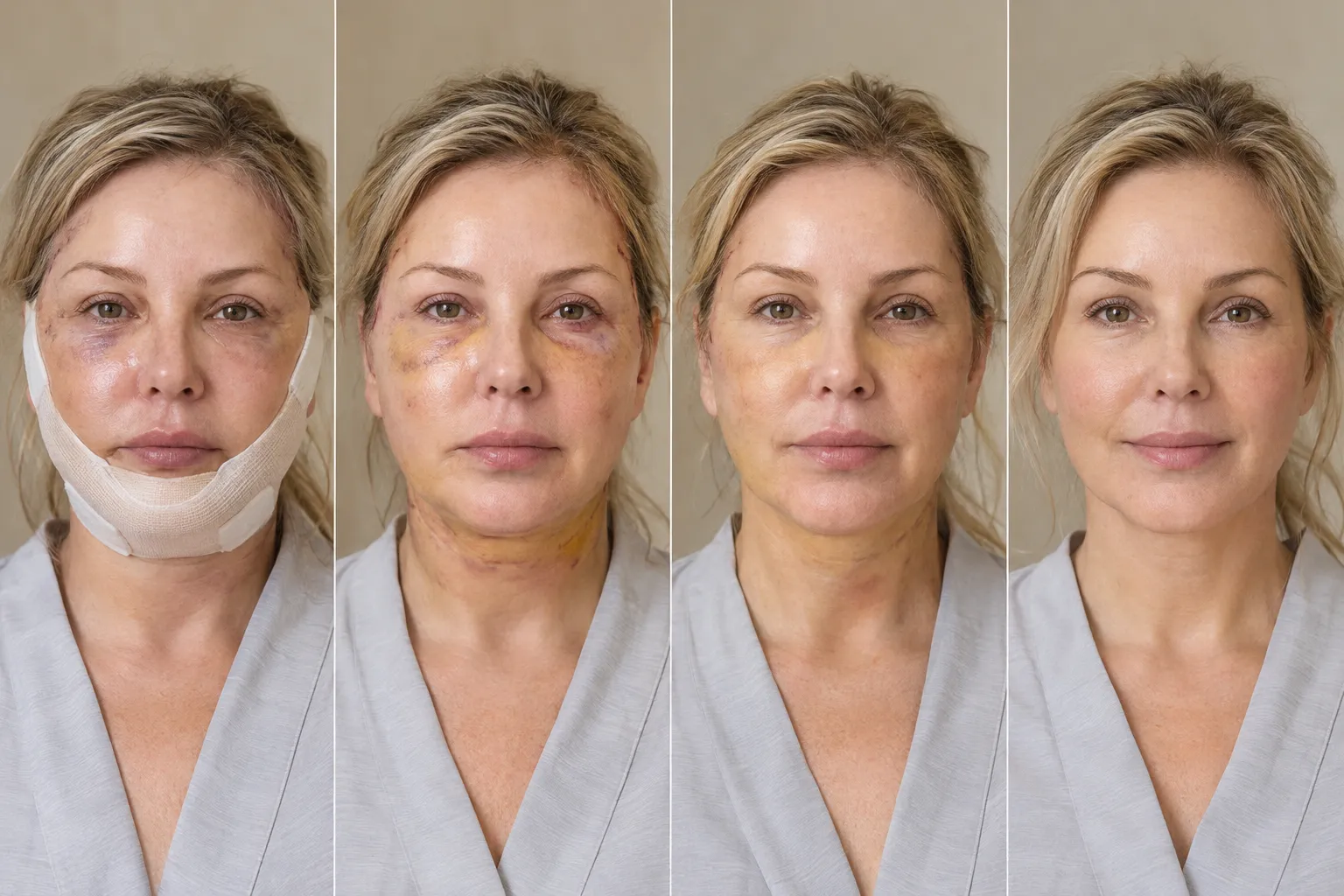
deep plane facelift recovery photos
Deep plane facelift recovery photos can help set expectations, but healing does not follow an identical schedule for everyone. In the first several days, swelling and bruising may be prominent; they usually ease over the following weeks, while subtle changes continue for months. This guide explains common milestones after a Deep Plane Facelift and why your own progress may differ. Dr. Mark Albert is certified by the American Board of Plastic Surgery and is a Fellow of the American College of Surgeons.
Key Takeaways
- Swelling and bruising are often most noticeable during the first several days after a deep plane facelift and typically improve over the following weeks.
- Subtle changes in facial contour can continue for several months as deeper tissues settle and healing progresses.
- Recovery timelines vary from patient to patient, so comparing your progress to online photos may be misleading.
- Following your surgeon's postoperative instructions and attending scheduled follow-up visits supports a smoother recovery.
- Any discussion of candidacy, technique, or expected results should take place during an in-person consultation with a qualified clinician.
Use the timeline as general education, not as a diagnosis or a promise about your appearance or recovery date. Your surgeon’s instructions should guide activity, wound care, and follow-up. Candidacy, technique, recovery, risks, and outcomes require an individualized clinical assessment.
What Does Deep Plane Facelift Recovery Look Like, Day by Day?
During the first two days, swelling and tightness commonly become noticeable. Swelling often reaches its high point around days 2 to 4, then gradually subsides. Bruising can change color as it fades, and one side may look different from the other during early healing. Sutures are commonly removed between days 7 and 10. Many people feel more comfortable being seen in public around the third week, though visible healing varies.
Photos are snapshots, not a day-by-day prediction. The captions below describe patterns that may occur, not a required appearance. If a change concerns you, contact your surgical team rather than relying on a photo comparison.
Day 0 to Day 2: Swelling Begins, Tightness, and What Incisions Look Like
Photo caption, early recovery: The face may appear puffy, with tightness around the cheeks and lower face. Bruising may be absent at first or begin to show. Incision lines are healing areas, often placed around the ears and hairline according to the surgical plan. Dressings or swelling can make their appearance difficult to judge in an image.
Rest and follow the care instructions from your surgical team. Light walking may be allowed within days, but the timing and amount should follow your clinician’s guidance. Avoid interpreting early facial fullness as the final contour. A single image cannot show how the tissues feel, whether swelling is changing, or what your surgeon observed during follow-up.
Day 3 to Day 5: When Swelling Peaks and Bruising Changes Color
Photo caption, peak-swelling window: Fullness may be most noticeable around days 2 to 4, and bruising may become more visible or shift in color as it develops. Some people notice uneven swelling from one side to the other. That can occur during healing, but a photo alone cannot determine whether a particular change is expected for you.
During this period, the face may feel tight, tender, or unfamiliar. The swelling and bruising pattern can fluctuate rather than improve in a straight line each day. Keep scheduled follow-up appointments and share concerns with the surgical team. Do not use someone else’s day-three image as a measure of whether your own recovery is on track.
Day 6 to Day 14: Suture Removal, Early Resolution, and Returning to Public View
Photo caption, early settling: Bruising and puffiness may start to recede, although they can remain visible. The face may still look swollen in photographs, and incision areas continue to heal. Sutures are commonly removed between days 7 and 10, based on the surgeon’s plan and healing assessment.
Many patients return to desk work around days 10 to 14, depending on comfort, job demands, and their surgeon’s advice. If you are deciding when to attend an event, allow flexibility: visible bruising or swelling may last longer than expected.
| Recovery stage | Possible swelling and bruising pattern | Common milestone |
|---|---|---|
| Days 0 to 2 | Swelling begins; tightness may be noticeable | Follow postoperative instructions |
| Days 3 to 5 | Swelling often peaks; bruising may become more apparent | Continue follow-up as directed |
| Days 6 to 14 | Early reduction may be visible; bruising can persist | Sutures commonly come out during days 7 to 10 |
Week-by-Week Milestones: Swelling Curve, Activity Limits, and Sensation Return
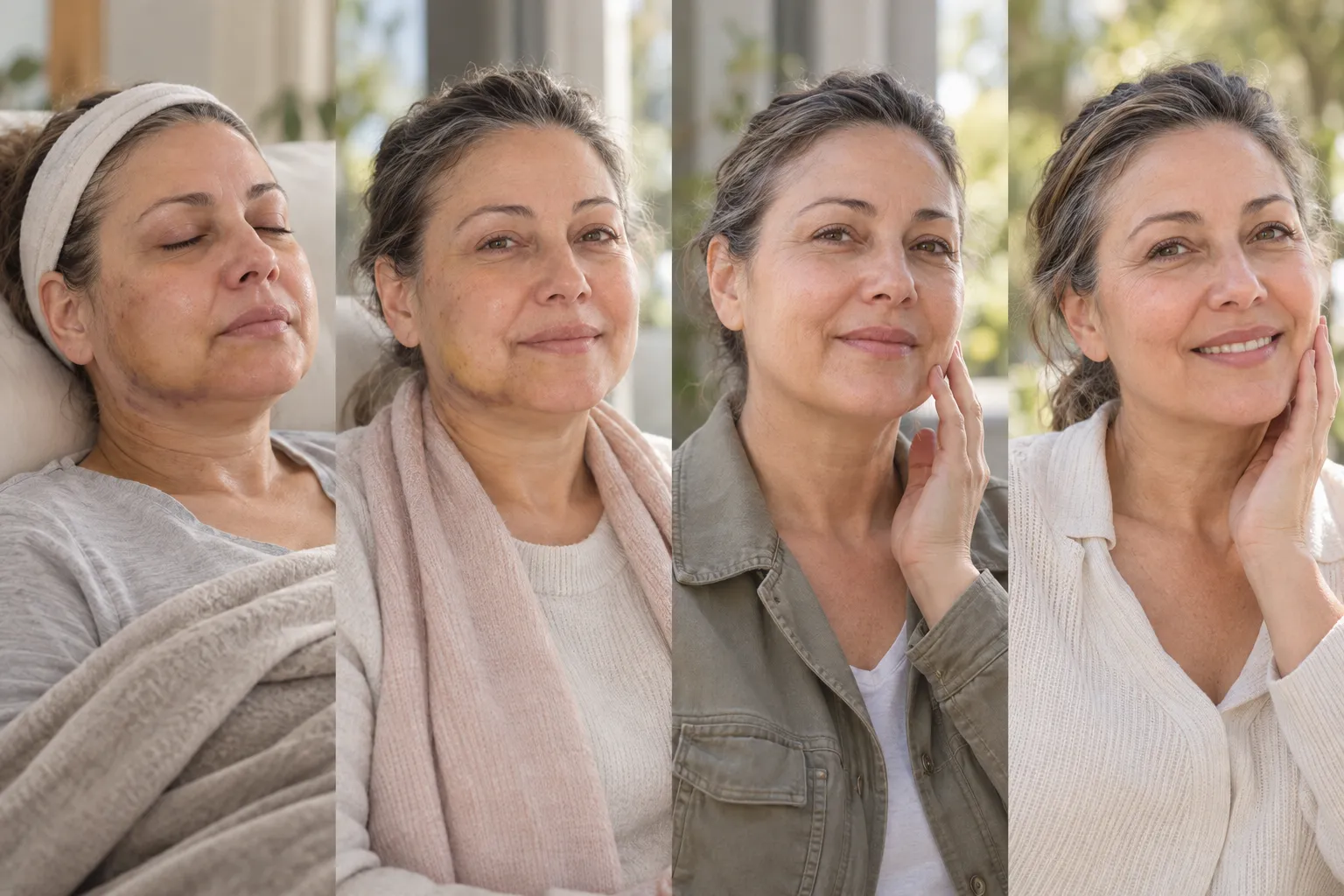
Healing generally moves from visible swelling and bruising toward gradual refinement, but there is no precise point when every patient looks or feels recovered. These are broad estimates, not a guarantee or a way to calculate an individual’s progress. Residual fullness, tightness, or altered sensation can continue after the early recovery period.
The Deep Plane Facelift recovery plan should be individualized. Activity progression depends on healing and your surgeon’s instructions; the milestones below are general reference points, not clearance for exercise or work.
Weeks 2 to 6: Driving, Makeup, Camouflage, and Light Exercise
People often resume desk work around 10 to 14 days, though comfort, bruising, and workplace demands matter. Drive only when you can do so safely and your surgical team has approved it. Ask before applying makeup near healing incisions or using camouflage products. Light walking may begin within days; moderate cardio may be considered around weeks 4 to 5, while full exercise clearance commonly falls around weeks 6 to 8. Your surgeon’s guidance takes precedence.
Months 2 to 6: Numbness, Tightness, and How Feeling Comes Back
Some areas may feel numb, firm, or tight after swelling has substantially improved. Sensation can return gradually and unevenly, so one area may feel different from another for a time. Mention persistent or concerning changes at follow-up. Do not assume that a sensation described by another patient will match your own recovery.
Months 6 to 12: When Final Results Settle
Facial tissues continue to settle, and subtle changes in softness and contour may develop over 6 to 12 months. A photograph taken early in recovery is not a final-result image. Your surgeon can assess your healing in person and explain which changes are consistent with your individual course.
Return-to-Work and Social Event Timing by Recovery Stage
Desk work often resumes around 10 to 14 days, while social re-entry may feel more comfortable around three weeks. Neither timing means all signs of surgery have disappeared. If an event matters to you, discuss its date during consultation and plan for the possibility of lingering swelling or bruising. Leave room to adjust plans rather than relying on a fixed photo timeline.
| Stage | General healing milestone | Activity or planning note |
|---|---|---|
| Months 6 to 12 | Final settling continues | Subtle changes may remain during this period |
Why Do Recovery Photos Look So Different Between Patients?
Deep Plane Facelift recovery photos can help illustrate the range of early healing, but a photograph cannot establish whether someone else’s progress is a useful benchmark for you. Apparent swelling, bruising, and facial symmetry vary with the stage of healing and the way an image is made. Dr. Mark Albert describes recovery information as general education, not an individual assessment.
Lighting, Angle, Timing, and Filtering: Reading Recovery Photos Critically
Lighting can deepen shadows or make redness and bruising look more pronounced. A close camera angle may exaggerate fullness, while a turned head can make one side appear more swollen. Images taken at different times of day may also capture changes in fluid retention. Compare photographs cautiously when the camera distance, head position, background, and lighting differ.
Check whether an image is dated and whether it shows the same person at a consistent angle. Cropping, color correction, filters, makeup, and selective image choice can affect what is visible. A polished before-and-after pair does not show every stage between the images or how the person felt during healing.
Individual Factors That Change Swelling and Bruising Patterns
Healing reflects more than the procedure date. A person’s tissue response, skin characteristics, baseline facial asymmetry, health history, and the details of the surgical plan can all influence visible swelling and bruising. The location and color of bruising may change as it fades, and swelling may not recede evenly across both sides of the face. Different camera conditions can make those differences look larger or smaller.
Images also leave out useful context: the surgeon’s examination, incision healing, comfort, and whether symptoms are changing. For a Deep Plane Facelift, the operating surgeon’s follow-up assessment and instructions are more relevant to your care than a stranger’s photo timeline.
Why One Patient’s Day 3 Photo Is Not Your Predicted Outcome
A day-three image captures one person at one moment. It cannot predict your degree of puffiness, bruising, asymmetry, or the date you will feel comfortable returning to work or social plans. Even photographs of the same patient may look different from one day to the next as healing changes. Use images to understand possible variation, not to grade your recovery or set a deadline.
How Should You Document Your Own Healing at Home?
A consistent photo record can help you describe changes to your surgical team more clearly than memory alone. It is not a way to diagnose a concern or decide whether healing is on schedule. After a Deep Plane Facelift, follow your surgeon’s instructions first, including any guidance about when photographs are appropriate and how to protect healing incisions.
A Simple Photo-Documentation Protocol: Same Time, Same Angle, Same Light
Choose a regular time and a well-lit location, then use the same camera distance and head positions for each set. Capture a front view and both side views without filters, makeup, or image adjustments. Keep the camera at eye level and include the same areas of the face each time. Record the date and note relevant changes, such as increased tenderness or a new area of bruising. Avoid repeatedly photographing or touching an area if doing so conflicts with your care instructions.
- Use steady, even lighting and a neutral background.
- Keep camera height, distance, and facial position consistent.
- Save original images with dates; do not edit or compare them as a diagnosis.
What to Share With Your Surgical Team and When
Send images through the communication method your office recommends, and include when the change began, whether it is worsening, and any symptoms that accompany it. Do not wait for a scheduled photo update if you have a concerning change. If you are unsure whether an image is useful, contact the office for instructions rather than relying on online comparisons.
Normal Healing Versus Warning Signs: When to Call the Office

Some swelling, bruising, tightness, and temporary changes in sensation can occur during recovery. Appearance alone cannot establish whether a symptom is expected for you. Your surgical team can interpret changes in the context of your operation, examination, and recovery instructions. When in doubt, contact the office and describe what has changed rather than waiting for a photo comparison to provide reassurance.
Symptoms That Are Expected at Each Stage
Early healing may include facial fullness, bruising, tightness, and some unevenness between sides. These features can shift as recovery progresses. A familiar symptom that is stable or improving is different from a sudden or worsening change, but only your clinician can assess your individual situation.
Red Flags That Warrant a Same-Day Call or Urgent Care
Contact your surgeon promptly about sudden, marked swelling, increasing pain, spreading redness, drainage, fever, or a change that concerns you. Seek urgent or emergency care for severe symptoms such as trouble breathing, chest pain, fainting, or uncontrolled bleeding. Do not wait for an office response when symptoms may be an emergency.
| What you notice | How to respond |
|---|---|
| Bruising, tightness, or swelling that is not rapidly worsening | Follow your postoperative plan and raise questions at follow-up. |
| Sudden swelling, increasing pain, fever, redness, or drainage | Call your surgical team the same day for guidance. |
| Breathing difficulty, chest pain, fainting, or uncontrolled bleeding | Seek emergency care immediately. |
Recovery varies, and no online guide can determine whether your symptoms are normal. To discuss your individual plan, arrange a consultation with Dr. Mark Albert.
Frequently Asked Questions
How long does it take to recover from a deep plane facelift?
Deep plane facelift recovery commonly spans several months, with swelling and bruising most noticeable in the first weeks and subtle refinement continuing for months. Your surgeon's instructions should guide activity and follow-up.
What does a deep plane facelift include?
A deep plane facelift lifts the deeper facial tissues rather than relying only on the skin, with incision lines commonly placed around the ears and hairline according to the surgical plan. Candidacy and technique are individualized, so a consultation with a qualified facelift surgeon such as Dr. Mark Albert is the best way to learn what the procedure may involve for you.
What is the downside of a deep plane facelift?
The most common early downsides are swelling, bruising, tightness, and temporary changes in sensation, and full recovery can take months rather than weeks. Deep plane facelift surgery also carries surgical risks and requires individualized assessment. Candidacy, technique, and outcomes vary by patient and should be discussed with a qualified clinician.
How long does it take to recover from a deep plane neck lift?
A deep plane neck lift generally follows a healing pattern similar to a deep plane facelift, with early swelling and bruising easing over the first weeks and subtle changes continuing for months. Timelines vary by patient and depend on the extent of surgery. Recovery plans should be individualized and guided by your surgical team.
What is a mini facelift?
A mini facelift is a less extensive facelift technique that typically addresses earlier signs of aging, often with shorter incisions than a traditional facelift. It may suit some patients better than a full or deep plane approach. Suitability depends on individual anatomy and goals, so an in-person facelift consultation is needed to determine candidacy.
When can I return to work and exercise after a deep plane facelift?
Many patients return to desk work around days 10 to 14, depending on comfort, bruising, job demands, and their surgeon's advice. Light walking may begin within days, moderate cardio is often considered around weeks 4 to 5, and full exercise clearance commonly falls around weeks 6 to 8. Your surgeon's guidance takes precedence over any general timeline.
How much does a deep plane facelift generally cost?
Deep plane facelift cost varies with the surgeon's experience, the surgical facility, anesthesia, and the scope of the procedure, so practices typically provide pricing after an individualized consultation. Cost should not be the only factor in choosing a qualified facelift surgeon. Schedule a consultation to receive an estimate specific to your surgical plan.

