
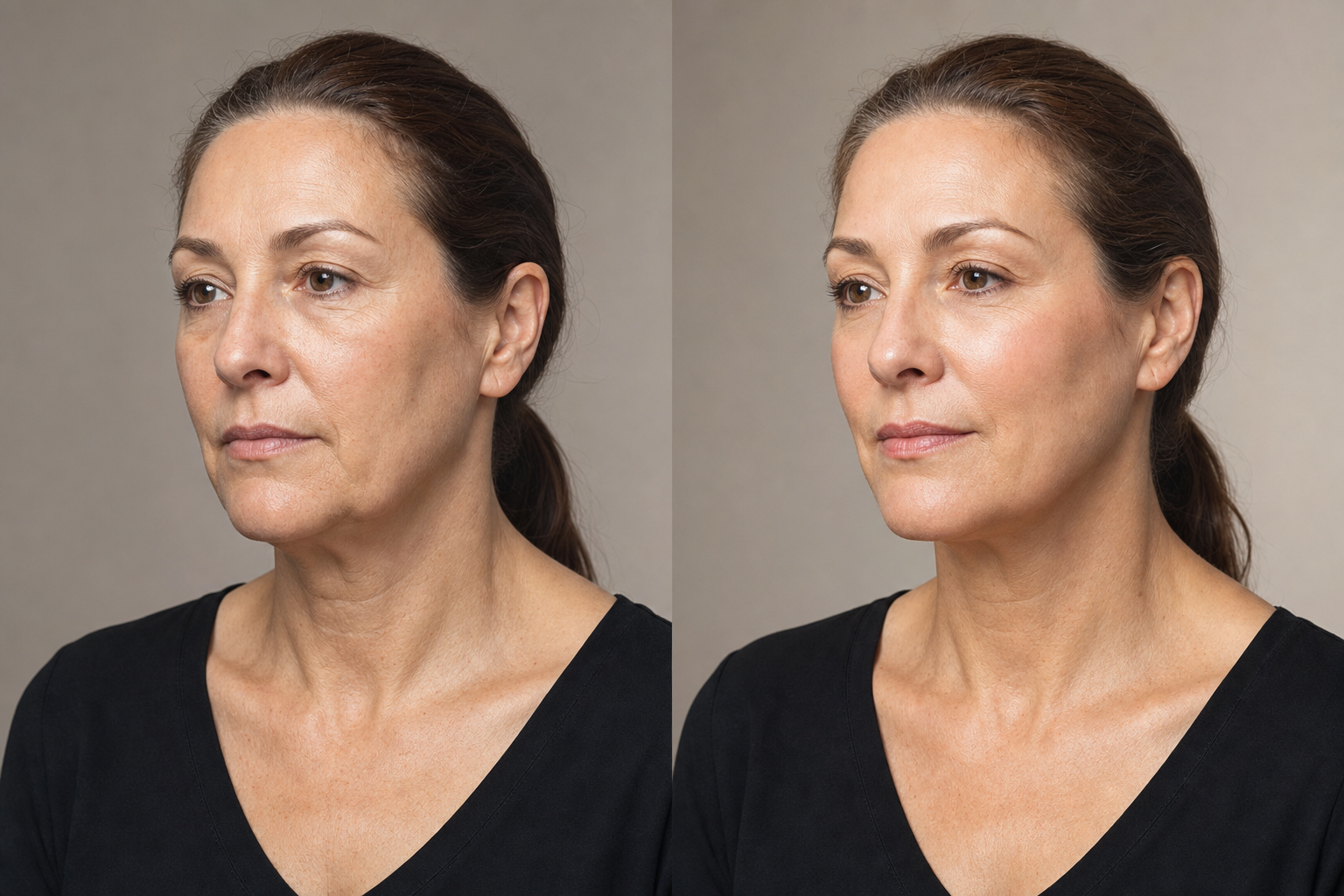
advanced mini facelift before and after
When reviewing advanced mini facelift before and after photographs, look beyond a tighter surface. The most informative images show whether the lower face and jawline appear supported, the ear retains a natural shape, and the expression remains recognizable. Consistent lighting, head position, facial expression, and healing time matter when judging apparent lift.
The Mini Facelift may address selected lower-face laxity. Dr. Mark Albert, a board-certified plastic surgeon and Fellow of the American College of Surgeons, evaluates the skin, superficial musculoaponeurotic system, facial ligaments, jawline, and ear anatomy before discussing candidacy. Technique, anesthesia, recovery, risks, and outcomes require an in-person clinical assessment.
Understanding Advanced Mini Facelift Before and After Photos: A Patient's Guide
What "Advanced Mini Facelift" Truly Means: Beyond Skin Tightening
“Mini facelift” does not describe one standardized operation. Some procedures mainly trim or redrape skin; an advanced approach may reposition the SMAS, the supportive tissue layer beneath the skin. Addressing this layer can reduce reliance on skin tension and help restore the relationship between cheek, jowl, and mandibular border. The operation is limited compared with a more comprehensive facelift, so the plan should reflect anatomy rather than the procedure’s name.
The Goal: Natural Rejuvenation, Not a “Pulled” Look
A well-planned result should look like a refreshed version of the patient, not a face held under tension. Signs may include a cleaner jawline, reduced jowls, a smoother cheek-to-lower-face transition, and preserved proportions. Skin texture, fine lines, volume changes, and neck laxity may remain. The goal is structural restoration within appropriate limits, not an artificial change in identity or expression.
Why Evaluating Photos Critically Matters
Lighting, makeup, camera distance, head tilt, hairstyle, and expression can change how a result appears. A lowered chin can exaggerate laxity; a lifted chin can sharpen the jawline. Compare similar conditions, with ears, hairline, and full lower face visible. Mature photographs are more informative than images taken during swelling, when contour and scars are changing.
Deconstructing “Before and Afters”: What to Look For in Advanced Mini Facelift Results

Anatomical Evaluation: Focusing on the Lower Face and Jawline
Follow the contour from cheek to jowl and mandibular edge. Look for a gradual transition, not a sharply outlined or hollow appearance. A lower-face lift may improve soft-tissue descent but cannot change every cause of fullness or laxity. Compare mouth corners, chin, prejowl area, and visible neck. Strong photographic evidence shows proportionate improvement rather than an isolated, overly sharp jawline.
Assessing SMAS Repositioning: The Key to Structural Lift
The SMAS is a fibrous layer connected with facial muscles and retaining structures. Repositioning it bases the lift on deeper support instead of skin traction alone. Patients cannot confirm the exact plane or vector from a photograph because the SMAS is not visible. Ask about dissection, release, fixation, and tissue-movement direction. A smooth result without a stretched hairline or flattened expression may reflect thoughtful planning, but photographs cannot prove a specific technique.
Incision Lines: Natural Placement and Scar Maturation
When shown, inspect the hairline, sideburn, crease in front of the ear, earlobe junction, and area behind the ear. Incisions should follow natural folds and preserve relationships among sideburn, tragus, and hair-bearing skin. Early redness, firmness, or unevenness may change. Ask when images were taken and whether they are unretouched. Scar maturation varies with genetics, skin characteristics, tension, sun exposure, and postoperative care.
Earlobe and Tragus Integrity: Avoiding Distortion
The ear is a useful anatomical reference. Look for a relaxed earlobe that is not elongated, attached, or pulled downward. The tragus, the small cartilage structure at the front of the ear canal, should retain a recognizable contour rather than appear blunted or exposed. These details depend on incision design, redraping, deeper-layer support, and closure. View both ears when possible, since one-sided images can conceal changes.
Facial Expression and Movement: Preserving Natural Animation
Judge more than stillness. Compare resting expression, smile, mouth position, and eye area. A neutral image may show cleaner contour, while a smile can reveal comfortable movement. Photographs cannot assess sensation, muscle function, or lived experience. Dr. Mark Albert can discuss how tissue vectors, facial nerve anatomy, skin elasticity, and goals shape an individualized plan.
Patient Evaluation Checklist
- Are lighting, camera angle, distance, and head position reasonably consistent?
- Are the before and after images labeled with the time from surgery?
- Can you see the jawline, jowl, chin, neck, ears, and hairline clearly?
- Does the result look supported rather than stretched or overly tight?
- Do the earlobe, tragus, sideburn, and hairline retain natural relationships?
- Does the patient’s expression remain recognizable and proportionate?
- Does the surgeon explain what the procedure can and cannot address?
- Are limitations, possible complications, scar changes, asymmetry, swelling, and revision considerations discussed?
Use this checklist to make advanced mini facelift before and after photographs more useful, not to diagnose from a gallery. Mini lift, skin-only lift, SMAS lift, and weekend lift may be used inconsistently. Ask which operation is shown, which anatomical areas were treated, and what healing course is expected. A qualified surgeon should explain why a particular approach may or may not suit your facial structure.
Comparing Facelift Techniques: Mini Facelift vs. Deep Plane vs. Nanolift™
Facelift terminology varies. A mini lift may mean a limited incision pattern, skin-focused operation, or deeper-layer repositioning. Deep Plane Facelift and Nanolift™ describe different concepts, but names do not establish treatment extent or predict results. Ask which tissues and facial regions were treated and how long healing lasted. The useful comparison is anatomical.
The Mini Facelift: Targeted Lower Face Rejuvenation
The Mini Facelift may suit laxity concentrated in the lower cheek, jowl, or jawline when broader dissection is not needed. An advanced version may reposition the SMAS, addressing support beneath the skin instead of relying on skin tension. Look for smoother jowls and a continuous mandibular border without tightness at the mouth, hairline, or ear.
The Deep Plane Facelift: Comprehensive Structural Lifting
A Deep Plane Facelift is designed around release and movement of deeper facial tissue planes contributing to cheek and lower-face descent. It may suit more advanced laxity, broader midface descent, or greater tissue displacement, based on anatomy. Images may show change across cheek, nasolabial region, jowl, and jawline. A gallery cannot reveal the dissection plane, so the surgeon should explain anatomy and intended vectors.
Dr. Mark Albert's Nanolift™: A Proprietary Approach
Dr. Mark Albert’s Nanolift™ is a proprietary facelift approach in his practice. Ask how it is adapted to skin quality, ligament position, facial proportions, and laxity location. Examine cheek transition, jawline, hollowing, pulled appearance, ear, tragus, sideburn, and hairline. The name should lead to discussion of tissue handling, incision design, limitations, and recovery.
When Does a Mini Facelift Suffice? Candidate Considerations
A limited facelift may suit localized lower-face concerns when skin elasticity, tissue descent, neck contour, and goals fit that scope. More extensive surgery may be discussed when laxity spans several regions or a limited approach would leave concerns untreated. Candidacy, anesthesia, risks, scars, recovery, and outcome require assessment by a qualified clinician. No photograph determines the right operation.
Visualizing Differences in Before and After Galleries
Use a gallery to assess the treated area, not to rank procedures by dramatic change. Compare neutral frontal, oblique, and profile views with similar lighting, distance, expression, and head position. Confirm the postoperative interval and whether images are unretouched. Dr. Albert can explain technique selection after examining facial structure.
| Facelift approach | Typical anatomical focus | What to examine in photographs |
|---|---|---|
| Mini Facelift | Selected lower-face laxity, jowls, and jawline | Supported contour, natural ear anatomy, and proportionate change |
| Deep Plane Facelift | Broader descent involving deeper facial planes | Cheek, lower-face, and jawline relationships across multiple views |
| Nanolift™ | Individualized structural planning within Dr. Albert’s proprietary approach | Technique-specific explanation, tissue movement, scars, and limitations |
The Healing Journey: Seeing Settled Results in Advanced Mini Facelift Photos
Confirm the time between surgery and the after image. Healing changes swelling, bruising, tightness, incisions, and jawline definition. Early images may show temporary distortion. With targeted mini facelift procedures, visible bruising and acute swelling often improve within approximately 10 to 14 days, while contour and scar maturation can continue for several months.
Immediate Post-Op and Early Healing (First 1-2 Weeks)
During the first several days, swelling and bruising may be most noticeable around cheeks, jawline, ears, and neck. One-sided tightness or mild asymmetry may reflect fluid movement or different healing rates. Incisions may be red, firm, or more visible than later. Follow surgical instructions and promptly contact the office about wound changes, fever, increasing pain, or other unexpected symptoms.
Six Weeks Post-Op: Initial Settling and Subtlety
At about six weeks, many patients have a more presentable contour, though swelling, firmness, numbness, or scar coloration may remain. The jawline may look more defined, but tissue softness has not necessarily returned. A useful gallery identifies the interval. Compare expression, ear position, hairline, and lower-face proportions, not only mandibular sharpness.
Six Months and Beyond: The Final, Natural Outcome
Images from six months or later generally show a more settled outcome. Swelling has had more time to resolve, tissues have adapted, and scars may be less conspicuous. Changes can continue beyond six months in scar texture and sensation. A mature photograph shows whether the lower face remains natural at rest and during expression, with balanced cheek, jowl, jawline, earlobe, and tragus.
Factors Influencing Healing and Maturation Time
Recovery varies with skin quality, age, genetics, smoking or nicotine exposure, medical history, medication use, tissue release, incision placement, and technique. Sun exposure can affect scar coloration, and facial asymmetry can persist during healing. The surgeon should direct follow-up, activity restrictions, wound care, and scar management. A timeline cannot predict an individual recovery.
What “Natural” Looks Like Over Time
A natural result is proportionate, supported, and recognizable, not maximally tight. The mouth should not look fixed, the hairline should not appear displaced, and the ears should retain their relationship with the cheek. Consistent views at multiple stages help distinguish temporary change from lasting improvement in an advanced mini facelift before and after record.
Recovery Timeline at a Glance
First 1 to 2 weeks: Bruising and acute swelling are commonly most visible.
About 6 weeks: Early contour is easier to assess, though firmness and swelling may remain.
Six months or later: Photographs usually offer a more reliable view of settled contour and scar maturation.
Your Consultation and Next Steps with Dr. Mark Albert
A consultation connects photographic goals with anatomy, medical history, and limitations. Dr. Mark Albert is certified by the American Board of Plastic Surgery and is a Fellow of the American College of Surgeons. He completed plastic surgery residency and chief residency at the University of Massachusetts Medical School, followed by an aesthetic plastic surgery fellowship at Manhattan Eye, Ear, and Throat Hospital. Also consider communication, facility standards, and continuity of care.
Questions to Ask Your Surgeon About Mini Facelifts
Ask which layers will be addressed, why the incision pattern fits your anatomy, how the tragus and earlobe will be protected, and when images represent mature healing. Discuss anesthesia, scars, activity limits, asymmetry, bleeding, infection, nerve-related complications, revision surgery, and circumstances requiring urgent contact.
Dr. Mark Albert’s Approach to Individualized Planning
Dr. Albert evaluates laxity, skin elasticity, SMAS position, facial ligaments, jawline, neck, ear anatomy, and goals before recommending an approach. The Mini Facelift may suit selected lower-face concerns, but candidacy and scope cannot be established from photographs or an online form.
Verifying Surgeon Credentials and Experience
Confirm board certification, hospital privileges when relevant, fellowship training, surgical setting, and follow-up plan. Ask to see consistently photographed results from procedures similar in scope.
Realistic Expectations and Candidacy Assessment
An in-person examination is necessary to determine whether a limited facelift addresses your concerns. Outcomes vary, and surgery cannot correct every aspect of facial aging or guarantee a contour, scar pattern, or recovery course.
Moving Forward: Preparing for Your Procedure
After establishing a plan, discuss medications, nicotine exposure, transportation, home support, time away from work, follow-up appointments, and warning signs. Proceed only after understanding material risks, expected healing, and available facelift alternatives.
Frequently Asked Questions
What is the downside of a mini facelift?
An advanced mini facelift may not address significant neck laxity, extensive skin excess, deep facial changes, or volume loss, and results vary by anatomy and technique. Mini facelift risks can include swelling, bruising, asymmetry, scarring, infection, nerve-related changes, healing concerns, and possible revision. An in-person assessment with Dr. Mark Albert is needed to discuss limitations and suitability.
How long does it take to look normal after a mini facelift?
Advanced mini facelift recovery often involves visible swelling, bruising, incision changes, and contour fluctuations before the face settles, so the time to look normal varies among patients. Healing depends on the surgical plan, tissue response, skin characteristics, and postoperative care. Dr. Mark Albert can discuss an individualized recovery timeline during consultation.
What is the new facelift everyone is getting?
There is no single new facelift that suits everyone, because mini facelift, SMAS facelift, deep plane facelift, and skin-focused procedures address different anatomy. An advanced mini facelift may reposition deeper supportive tissue for selected lower-face laxity, while a more comprehensive facelift may be considered for broader changes. Technique should follow the patient’s examination, goals, and risks.
How much does a mini facelift cost on average?
Mini facelift cost varies with surgical technique, anesthesia, facility fees, geographic location, surgeon experience, and the extent of correction planned. A reliable average cannot be assigned without knowing the specific treatment plan, and consultation fees and postoperative care may also affect total cost. Albert Plastic Surgery can provide practice-specific financial information after evaluation.
What age is best for a mini facelift?
The best age for a mini facelift depends on facial anatomy, skin and soft-tissue laxity, health, goals, and the changes a patient wants addressed, not a fixed number. Candidates often have selected lower-face concerns, but age alone does not establish suitability. Dr. Mark Albert evaluates the jawline, SMAS, ligaments, skin, and ear anatomy before discussing options.
How can I judge advanced mini facelift before and after photos?
Advanced mini facelift before and after photos are most useful when lighting, camera angle, head position, expression, and healing time are reasonably consistent. Review the jawline, jowls, chin, ears, hairline, earlobes, tragus, scars, and facial expression for proportionate change rather than a pulled appearance. Photographs can inform questions but cannot predict an individual result.
Does an advanced mini facelift leave scars or change the ears?
An advanced mini facelift involves incisions that may leave scars, and careful design aims to preserve natural relationships among the hairline, sideburn, tragus, and earlobe. Scar color, firmness, visibility, and ear appearance vary with technique, healing, skin characteristics, and postoperative care. Mature photographs and an examination provide more useful information than early postoperative images alone.

