
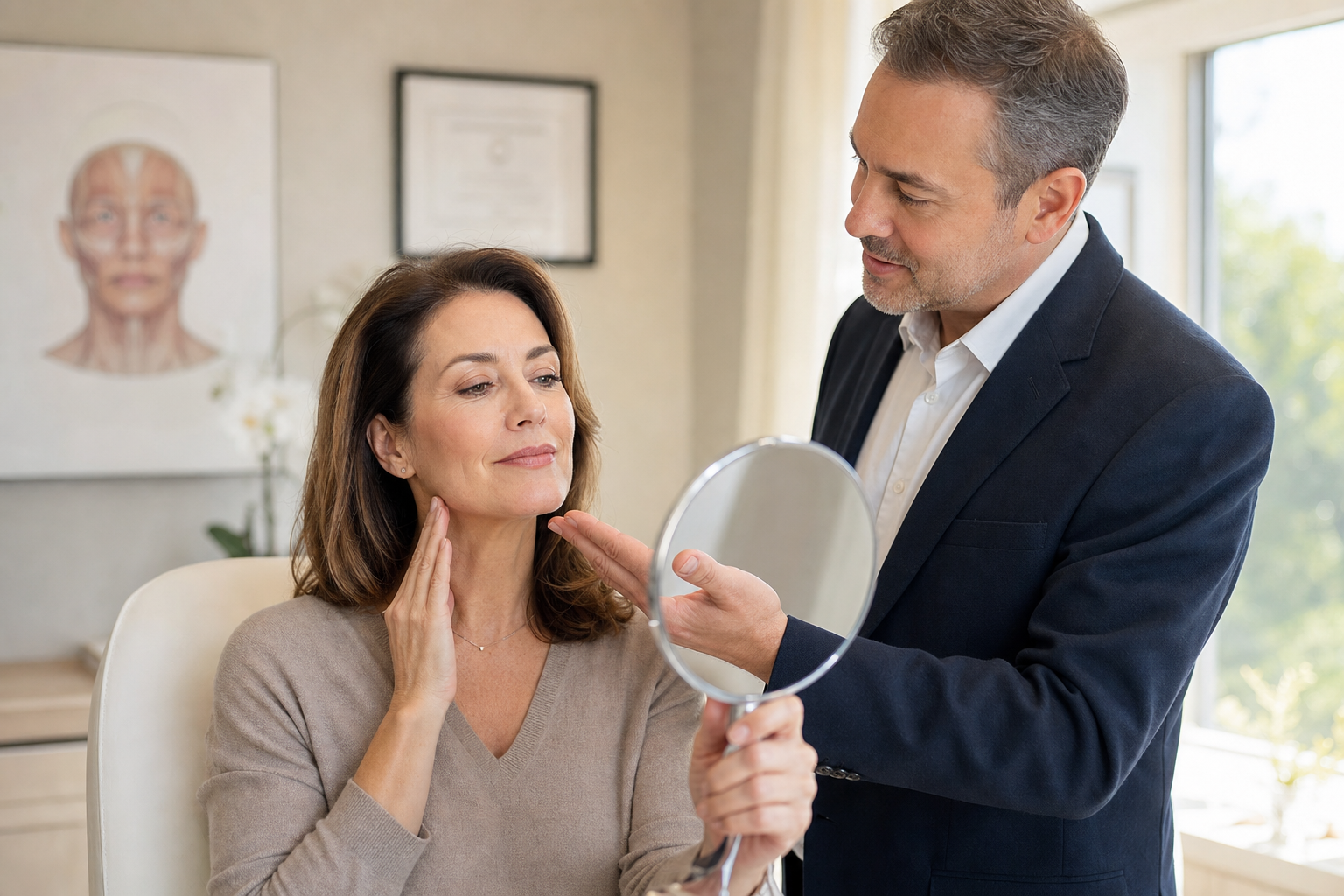
average age for mini facelift
The average age for mini facelift surgery is often in the 40s or 50s, when early jowling and lower-face laxity appear while the neck retains reasonable elasticity. Age alone does not determine candidacy. Skin quality, facial structure, SMAS position, neck changes, health, and goals all influence whether a Mini Facelift is appropriate.
This guide uses age as a reference, not a qualification rule. A younger adult may have enough laxity for surgery, while an older adult may need a broader plan. Only an in-person evaluation with a qualified plastic surgeon can determine candidacy, technique, anesthesia, recovery, and individualized risk.
What Is the Average Age for a Mini Facelift?
There is no required age for a Mini Facelift, but the common candidate is an adult in the 40s to mid-50s with mild-to-moderate jowling, early lower-face laxity, and relatively preserved neck definition. The procedure repositions and supports loosened facial tissues through limited facelift access rather than addressing every sign of aging. It may be considered when changes are structural, not merely related to surface texture.
Defining the Mini Facelift: Scope and Goals
A Mini Facelift focuses mainly on the lower face and jawline. Depending on anatomy, surgery may involve the skin and underlying SMAS layer, the supportive tissue beneath the skin. The goal is balanced improvement in laxity, jowling, and contour without a pulled appearance. It cannot stop future aging, correct every neck concern, or guarantee a particular duration of improvement.
Why Age Is Only One Factor: The Anatomical Approach
Chronological age does not show how deeply tissues have changed. People of the same age may differ in collagen loss, elasticity, fat descent, bone structure, sun exposure, and neck laxity. A surgeon assesses facial proportions at rest and with movement, the jawline, nasolabial area, jowls, pre-jowl hollowing, neck skin, and tissue mobility. This distinguishes a limited lower-face concern from aging that extends across the cheeks and neck.
Introducing Dr. Mark Albert: Your Guide to Facial Rejuvenation
Dr. Mark Albert is certified by the American Board of Plastic Surgery and is a Fellow of the American College of Surgeons. His training includes plastic surgery residency and chief residency at the University of Massachusetts Medical School, followed by an aesthetic plastic surgery fellowship at Manhattan Eye, Ear, and Throat Hospital. His facelift planning emphasizes anatomy, proportion, safety, and realistic expectations rather than an age-based formula.
Facelift Suitability by Decade: An Anatomical Perspective

The average age for mini facelift can help set expectations, but decade-based guidance must remain flexible. Facial aging reflects genetics, skin thickness, sun exposure, weight changes, smoking history, and tissue support. These benchmarks describe patterns a surgeon may evaluate, not automatic recommendations.
The 30s: Early Signs of Aging and When to Consider Rejuvenation
In the 30s, changes may include a softer jawline, mild jowling, reduced recoil, or a subtle cheek-to-lower-face transition. Many adults with minimal laxity do not need surgery, especially when the concern is skin quality or texture. A Mini Facelift may be discussed in selected younger patients with clear, persistent tissue descent and realistic expectations.
Being in the 30s does not make someone too young or establish a need for surgery. A consultation should examine anatomy, medical history, elasticity, and the reason for seeking a lasting structural change. Someone considering a mini facelift in 30s should understand that surgery does not prevent future aging and may not address later changes in the cheeks or neck.
The 40s and 50s: The Prime Window for Mini Facelifts and Beyond
The 40s and 50s often match the recognizable Mini Facelift candidate profile. Mild-to-moderate jowling may become established, the mandibular border less defined, and the lower cheek may descend toward the jaw. The neck may still retain enough elasticity for a limited approach. Many patients research the average age for mini facelift when their concerns involve contour and tissue position rather than isolated lines.
Some patients in this range have loose neck skin, platysmal bands, substantial lower-face descent, or laxity extending into the midface. These findings may call for a broader facelift discussion. Selection should reflect the area requiring correction, tissue movement needed, and acceptable degree of change, while preserving natural facial movement.
The 60s and 70s+: Addressing Advanced Aging with Precision
A Mini Facelift can sometimes be considered in the 60s or 70s when aging remains concentrated in the lower face and neck excess is limited. Age alone does not exclude a patient. Medical history, medications, skin quality, healing capacity, anatomy, and anesthesia require review. The phrase mini facelift at 70 describes an age point, not a recommendation.
Older patients often have laxity across the cheeks, jawline, and neck. Deep neck bands, substantial skin redundancy, or descent beyond the lower face may not respond adequately to a limited operation. A surgeon may explain why a comprehensive facelift better matches the anatomy. A smaller procedure should not be selected solely for less downtime if it cannot treat the responsible tissues.
Beyond Chronology: Key Anatomical Indicators for Candidacy
Assessment considers jowling, jawline definition, cheek descent, neck skin, platysma visibility, SMAS mobility, elasticity, asymmetry, and the relationship between the chin and lower face. The surgeon also reviews health conditions, nicotine exposure, prior facial surgery, medications, and tolerance for recovery. These factors provide more useful guidance than age alone.
The plan should match anatomy and expectations. A patient seeking modest lower-face improvement may be evaluated for a Mini Facelift, while widespread laxity may require another design. The consultation should explain limitations, scars, possible asymmetry, bleeding, infection, nerve injury, sensation changes, healing concerns, and dissatisfaction. The average age for mini facelift is a reference point, not medical advice.
Mini Facelift vs. Full Facelift: A Comprehensive Comparison
A Mini Facelift and a full facelift differ in the distribution and degree of aging treated. A limited procedure may suit laxity around the lower cheeks, jowls, and jawline. A comprehensive facelift is designed for descent involving the cheeks, jawline, and neck. Choice should reflect anatomy, skin excess, SMAS position, neck definition, and desired correction, not only a preference for a shorter operation.
Understanding the Differences: Scope of Treatment Areas
The Mini Facelift generally focuses on early to moderate lower-face laxity. Tissue beneath the skin may be repositioned instead of relying on skin tension alone. A full facelift addresses broader descent and may suit loose neck skin, pronounced jowls, platysmal changes, or laxity across the midface and lower face. Neither approach corrects every feature of aging, and boundaries vary by patient.
| Decision factor | Mini Facelift | Full Facelift |
|---|---|---|
| Typical focus | Early to moderate jowling and lower-face laxity | More extensive cheek, jawline, and neck descent |
| Tissue correction | Limited repositioning tailored to localized laxity | Broader tissue repositioning for wider areas of descent |
| Expected recovery | Non-strenuous work may be possible within about 7 to 10 days, depending on healing and occupation | Often requires a longer recovery period because treatment is more extensive |
| Typical duration of improvement | Research commonly cites approximately 5 to 7 years | Research commonly cites approximately 10 to 15 years for comprehensive or deep plane techniques |
Longevity Expectations: How Long Does Each Procedure Last?
Research commonly places Mini Facelift improvement at approximately five to seven years, while comprehensive or deep plane facelift results are often described as lasting about 10 to 15 years. These are estimates, not guarantees. Aging continues after either operation, influenced by genetics, sun exposure, weight fluctuation, elasticity, smoking, and correction extent. A limited operation should not be expected to last as long as a broader facelift.
Recovery Timeline and Downtime: What to Anticipate
Mini Facelift recovery may allow non-strenuous work within seven to 10 days, though bruising, swelling, tightness, numbness, incision healing, and restrictions can continue. A full facelift usually involves more tissue and may require more time before social and physical activities feel comfortable. Recovery varies with surgical extent, anesthesia, healing, health history, and occupation. The surgeon’s instructions should guide activity, wound care, and follow-up.
Dr. Mark Albert’s Approach to Procedure Selection
Dr. Mark Albert, certified by the American Board of Plastic Surgery and a Fellow of the American College of Surgeons, evaluates whether the operation matches the tissues causing concern. His assessment includes skin redundancy, jawline contour, cheek descent, neck laxity, SMAS mobility, proportions, health history, and expectations. The goal is not automatically the smallest operation, but a plan that addresses the anatomy without excessive tension or an artificially tightened appearance.
Key Tradeoffs to Consider
Pros
- A Mini Facelift may suit localized lower-face laxity with a shorter anticipated recovery.
- A full facelift may provide broader correction when aging extends into the cheeks and neck.
- An anatomy-based plan can support proportionate, natural-looking facial movement.
Cons
- A limited procedure may not adequately treat substantial neck skin or widespread tissue descent.
- A full facelift involves greater surgical scope and potentially more downtime.
- Both procedures carry risks and limitations, including bleeding, infection, asymmetry, nerve injury, sensation changes, scarring, and dissatisfaction with the result.
The Investment: Understanding Mini Facelift Costs and Value
The mini facelift cost reflects the technique, tissue correction, facility, anesthesia, postoperative visits, and aftercare. A written estimate should identify included services. Prices vary by patient and location, so an online figure cannot establish an individual amount. A consultation with Dr. Mark Albert can explain applicable costs before scheduling.
Components of Facelift Surgery Costs
Pricing commonly includes the surgeon’s fee, operating facility, anesthesia, preoperative assessment, supplies, and postoperative care. The estimate may differ between limited lower-face correction and treatment of the cheeks, jawline, and neck. Ask whether follow-up visits, medications, garments, and changes in surgical scope are included.
- Surgeon’s professional fee and operative planning
- Accredited facility and operating-room charges
- Anesthesia services and monitoring
- Preoperative testing when clinically indicated
- Postoperative appointments and routine surgical care
Mini Facelift vs. Full Facelift: A Cost Comparison
The cost of mini facelift vs full facelift is not determined by the procedure name alone. A Mini Facelift may involve a smaller field, while a comprehensive facelift can require broader dissection, tissue repositioning, and operating time. A lower fee is not better value if the operation cannot address the actual laxity. Compare procedures that can reasonably treat the same anatomical concern.
| Cost consideration | Mini Facelift | Full Facelift |
|---|---|---|
| Operative scope | Usually focused on localized lower-face laxity | Typically addresses more extensive facial and neck descent |
| Potential price drivers | Limited treatment area and operative duration | Broader tissue correction and greater operative complexity |
| Financial question | Whether the limited plan matches the anatomy | Whether broader correction may provide more complete treatment |
Factors Influencing Price: Location, Surgeon, and Anesthesia
Regional pricing differs because facility expenses, staffing, anesthesia fees, insurance requirements, and overhead vary between cities. Surgeon training and experience also affect professional fees. Consider these alongside board certification, judgment, facility standards, continuity of care, and informed consent. Anesthesia may be provided by a qualified professional or under another arrangement determined by the surgical setting. Patients searching for a mini facelift near me should verify credentials and request a complete estimate instead of choosing an advertised starting price.
Evaluating Value: Cost Per Year of Longevity
Value involves the investment, correction achieved, recovery, and expected duration. Research commonly describes Mini Facelift results as lasting about five to seven years and comprehensive facelift results as lasting about 10 to 15 years, though outcomes vary and aging continues. Dividing a fee by expected duration is only a planning exercise, not a guarantee. The responsible choice is the operation that addresses the relevant tissues without unnecessary treatment.
Your Consultation and Next Steps with Dr. Mark Albert

A consultation with Dr. Mark Albert should be an assessment, not confirmation of a procedure chosen online. He reviews facial proportions, skin quality, jowling, jawline definition, neck laxity, SMAS position, medical history, medications, nicotine exposure, and goals. This helps determine whether a Mini Facelift matches the tissues requiring correction.
What to Expect During Your Consultation
Ask how the operation would address your anatomy, what it cannot correct, which anesthesia plan is appropriate, and where incisions may be placed. Request an estimate separating surgical, facility, anesthesia, and postoperative charges. Discuss restrictions, follow-up, scarring, asymmetry, bleeding, infection, altered sensation, nerve injury, healing problems, and the possibility of an unexpected outcome.
Preparing for Your Mini Facelift Journey
Preparation may include reviewing medical conditions, medications, allergies, prior facial procedures, and smoking or nicotine use. Arrange transportation, early assistance, and time away from strenuous work. Follow instructions about eating, drinking, medication changes, and wound care. Do not change medications without guidance from the prescribing clinician.
Realistic Expectations and Natural-Looking Outcomes
A facelift improves laxity and contour; it does not stop aging or create a fixed appearance. Swelling, bruising, numbness, incision changes, asymmetry, and gradual settling may occur during healing. Dr. Albert’s board-certified training and FACS credentials support a consultation grounded in anatomy, proportion, safety, and informed choice. Candidacy, technique, recovery, risks, and outcomes require individualized clinical assessment.
Frequently Asked Questions
What is the downside of a mini facelift?
A mini facelift may provide less correction and shorter-lasting improvement than a more comprehensive facelift when laxity extends across the cheeks or neck. Mini facelift limitations can include residual neck skin, platysmal bands, or deeper tissue descent, along with standard surgical risks such as scarring, infection, bleeding, nerve changes, and asymmetry. Individual suitability requires an in-person evaluation.
Can a facelift make you look 10 years younger?
A facelift can create a more rested and youthful appearance, but it cannot reliably make every patient look 10 years younger. Facelift results depend on tissue descent, skin quality, facial structure, age, surgical technique, and healing. A consultation with a qualified plastic surgeon should focus on natural improvement and realistic expectations rather than a specific age reduction.
What happens 10 years after a facelift?
Facelift results usually remain visible 10 years later, though natural aging continues and some laxity may return. Changes depend on genetics, skin quality, sun exposure, weight fluctuations, smoking history, and the original procedure. Some patients may discuss additional nonsurgical care or revision surgery, while others may not need further treatment.
How much does a mini facelift last?
A mini facelift commonly provides improvement for several years, but the duration varies and cannot be not assured. Longevity depends on age at surgery, skin elasticity, tissue support, lifestyle factors, and whether the procedure matches the degree of facial and neck laxity. An individualized consultation can explain likely durability for a specific anatomy.
How painful is a mini facelift recovery?
Mini facelift recovery commonly involves soreness, tightness, swelling, bruising, and temporary numbness, with discomfort varying among patients. Pain management and activity guidance should come from the operating surgeon because medications and recovery needs differ. Significant or worsening symptoms require prompt communication with the surgical team.
Is there an ideal age for a mini facelift?
The average age for a mini facelift is often in the 40s or 50s, but no required age applies to every patient. Candidacy depends more on jowling, lower-face laxity, neck elasticity, skin quality, health, and personal goals than on chronology. Younger or older adults may be candidates when the surgical plan matches their anatomy.

