

deep plane facelift
A deep plane facelift repositions deeper facial tissue rather than relying on skin tension alone. Adults considering the operation should ask whether their facial aging suits the technique, what recovery may involve, and whether the surgeon’s plan matches their goals. Dr. Mark Albert is a board-certified plastic surgeon and Fellow of the American College of Surgeons in New York City.
Key Takeaways
- A deep plane facelift lifts the underlying facial structures, which can produce results that look natural and last longer than techniques based on skin tightening alone.
- Candidates should evaluate whether their pattern of facial aging aligns with what this procedure is designed to correct.
- Recovery typically involves swelling and bruising, and patients should plan for adequate downtime before returning to social or professional activities.
- Selecting a board-certified surgeon with specific experience in deep plane technique is one of the most important steps in achieving a safe outcome and a satisfying result.
- Costs vary based on surgeon expertise, geographic location, and the extent of the procedure, so patients should request a detailed breakdown during consultation.
The Deep Plane Facelift is one option within facelift surgery, not a universal choice. Technique, candidacy, recovery, risks, and expected results require individualized assessment during a consultation.
Deep Plane Facelift at a Glance: Quick Facts from Dr. Mark Albert
Dr. Mark Albert, MD, FACS, completed plastic surgery residency and chief residency at the University of Massachusetts Medical School, followed by an aesthetic plastic surgery fellowship at Manhattan Eye, Ear, and Throat Hospital. He is Program Director of the MEETH Aesthetic Plastic Surgery Fellowship and an Assistant Clinical Professor of Surgery at the Zucker School of Medicine at Hofstra/Northwell. These credentials provide context; a consultation is needed to assess whether an approach fits an individual patient.
What Is a Deep Plane Facelift? (SMAS and Retaining Ligaments Explained Simply)
The SMAS, or superficial musculoaponeurotic system, is a supportive layer beneath the skin that connects with facial muscles and soft tissue. In this technique, the surgeon releases retaining ligaments, including the zygomatic, masseteric, mandibular, and cervical ligaments. The skin and SMAS can then be repositioned together as a composite unit. The aim is to address descent in areas such as the midface, jawline, and neck through deeper tissue movement, rather than making skin carry the lift by itself.
How Is a Deep Plane Facelift Different From a Traditional SMAS Facelift?
“SMAS facelift” describes approaches that address the supportive layer beneath the skin, while “deep plane” refers to a particular dissection and release of retaining ligaments. Public descriptions may use these terms inconsistently, so ask the surgeon to explain the planned tissue plane, areas of release, and how the operation addresses your anatomy. A procedure’s name alone does not establish its extent or predict an individual result.
Where Are the Scars Located?
Incisions are generally placed around the ears, often following natural creases and continuing into the hairline as needed. The pattern depends on the operation and the patient’s anatomy, including hairline position and skin characteristics. Scars mature over time but do not disappear entirely, and their appearance varies. Discuss incision placement, healing, and personal risk factors with the operating surgeon.
Deep Plane vs. Mini Deep Plane vs. SMAS Facelift: Which Option Fits Your Anatomy?
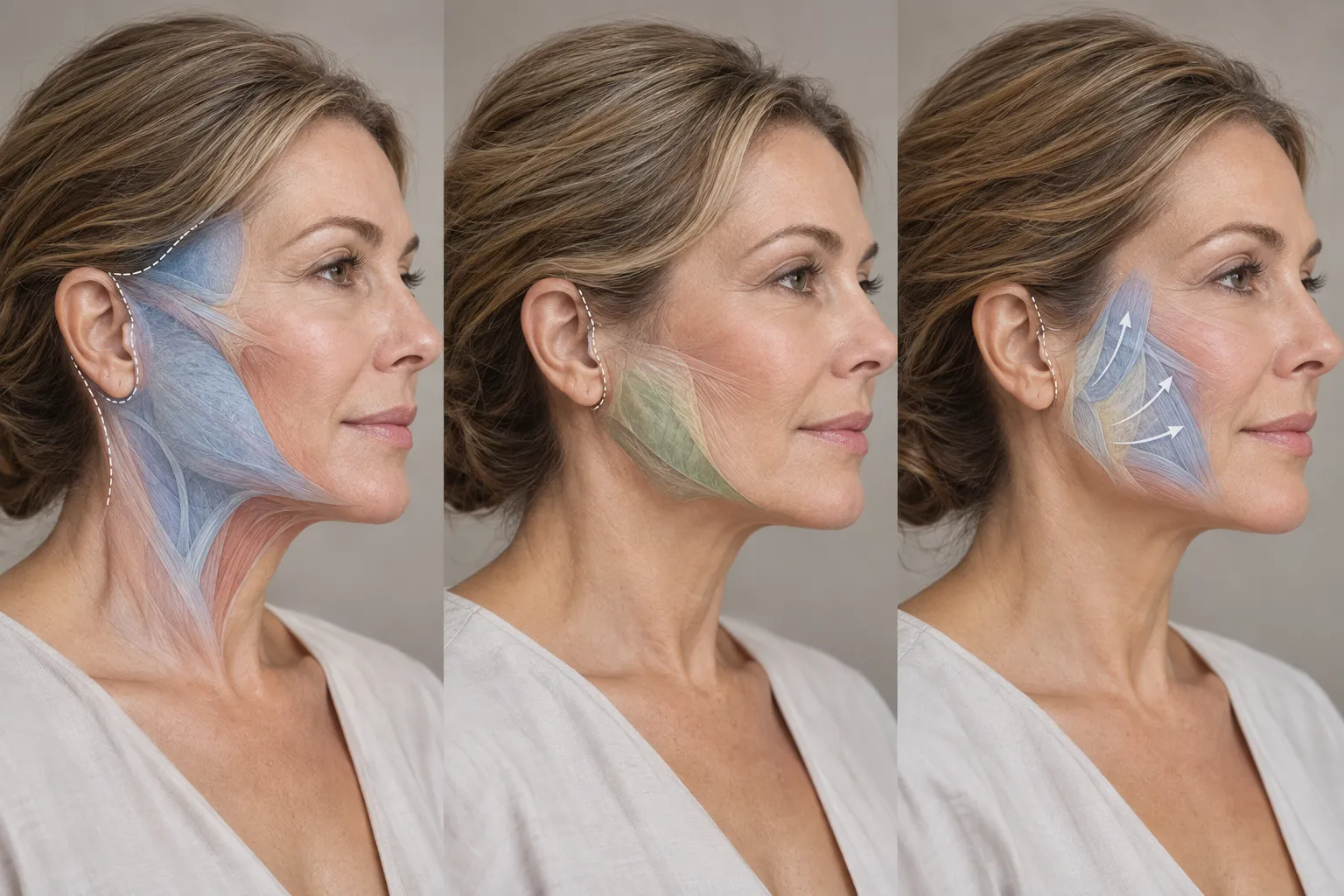
Facelift terminology can be confusing because “mini” may refer to a shorter incision, a limited area of correction, or a particular surgical plan. The comparison below describes broad distinctions, not fixed definitions; surgeons may use the same label for different techniques. Dr. Albert’s assessment should consider tissue descent, skin quality, facial proportions, health history, and priorities. Recovery and cost also vary with the scope of surgery and individual circumstances.
Side-by-Side Comparison: Technique, Recovery, Longevity, and Cost
| Approach | General focus | Recovery and longevity | Cost context |
|---|---|---|---|
| Full deep plane | Releases retaining ligaments and repositions deeper tissue with the skin as a unit; the planned areas depend on anatomy. | Many patients allow about two weeks away from work. Results commonly last 10 to 15 years, though aging continues. | Approximately $20,000 to $50,000 nationally. |
| Mini deep plane | A more limited operation; exact extent and technique vary by surgeon and patient. | Recovery and durability depend on the areas treated and the individual plan. | |
| SMAS facelift | Addresses the SMAS layer, with technique and degree of tissue release varying. | Recovery and longevity depend on the procedure’s scope, anatomy, and healing. | Pricing is specific to the surgeon’s plan and quote. |
These are broad research ranges, not a practice quote. A personalized estimate should identify the planned operation and included services. A mini procedure should not be assumed to offer the same extent of correction or durability as a full operation.
Who Is a Candidate for a Full Deep Plane Facelift (and Who Is Not)?
Adults with visible descent in the midface, jowls, or jawline may discuss a full operation when seeking broader facial rejuvenation. The decision also depends on medical history, skin and soft-tissue characteristics, expectations, and willingness to follow postoperative instructions. A consultation may show that the proposed extent does not match a patient’s concerns, or that health factors require further evaluation. An article cannot determine candidacy; an in-person assessment with a qualified clinician is necessary.
Mini Deep Plane and Less Invasive Alternatives, Including the Nanolift™
A limited facelift may suit patients with localized concerns, but “mini deep plane” has no single universal definition. Dr. Albert also offers the Nanolift™, a less invasive facelift option. Suitability depends on the degree and location of facial changes and the patient’s goals. Ask what areas each operation would address, what limitations remain, and how incision pattern and recovery compare with a fuller lift. Learn about the mini facelift option as part of that discussion.
Why Natural-Looking Results Depend on Technique, Not Tension
A natural-looking result depends on planning that respects facial proportions, tissue position, and the patient’s features. Pulling skin tightly is not a substitute for a sound surgical plan; excessive tension can affect the appearance of the ears or scars. Deeper tissue repositioning may suit some anatomy, while a limited approach may fit other goals. No technique guarantees a particular appearance; healing, aging, and individual factors affect results.
How Much Does a Deep Plane Facelift Cost in NYC and Across the U.S.?
The price of a Deep Plane Facelift depends on surgical scope, the surgeon’s fee, anesthesia, facility charges, and follow-up care. These are broad estimates, not a quote from Dr. Mark Albert or a guarantee of the total you will pay.
Full Deep Plane vs. Mini Deep Plane: Realistic Price Ranges
A smaller operation may cost less, but “mini” does not define a consistent surgical plan. Areas treated, tissue release, anesthesia arrangements, and facility setting can differ. Compare written estimates after confirming which areas the procedure addresses and what the surgeon plans to do. A lower price alone does not show whether two operations have equivalent scope.
| Procedure scope | Reported U.S. cost range | What to confirm |
|---|---|---|
| Full operation | Approximately $20,000 to $50,000 | Areas addressed, surgeon’s fee, anesthesia, facility, and postoperative visits |
| Mini operation | What “mini” means in the proposed plan and which costs are included |
What a Transparent Quote Should Include (Anesthesia, Facility, Follow-Up)
Ask for an itemized written estimate identifying the surgeon’s fee, anesthesia services, operating facility, routine postoperative appointments, and any charges that may be separate. Clarify how the practice handles plan changes, additional care, or unexpected follow-up, and what the fee does not cover. These details help compare estimates and avoid a headline price obscuring the expected total.
Why Prices Vary by Region: New York City, Florida, and National Averages
Prices can differ across New York City, Florida, and other parts of the country because surgeon fees, facilities, anesthesia services, and local practice costs vary. The available national ranges do not establish a directly comparable average for either NYC or Florida. Search phrases such as “deep plane facelift cost Florida” may return estimates with different inclusions and definitions. For an accurate local figure, request a consultation-based quote and confirm its scope.
Deep Plane Facelift Recovery Week by Week, Plus Risks You Should Understand
Recovery varies with the operation, a patient’s health, and individual healing. Many patients plan for about two weeks away from work, while bruising can remain visible for three to four weeks in a minority of patients. This schedule is a general guide, not a prediction. Follow the operating surgeon’s instructions and contact the clinical team about concerning symptoms.
Recovery Timeline: Days 1-4, Week 2, and Weeks 3-4
| Period | What may occur | Planning considerations |
|---|---|---|
| Days 1-4 | Swelling, bruising, tightness, and temporary changes in sensation may be noticeable. | Arrange help at home and attend scheduled postoperative checks. |
| Week 2 | Bruising and swelling may be improving, though visible signs can remain. | Many patients plan time away from work; readiness depends on healing and job demands. |
| Weeks 3-4 | Some patients still have residual bruising or swelling, which can take longer to settle. | Ask the surgeon before resuming strenuous activity or activities that could affect healing. |
When Can You Drive, Work, and Return to Social Life?
There is no universal date for returning to driving, employment, or social activities. Do not drive while taking medication that impairs alertness; wait until you can move comfortably enough to drive safely and have surgeon approval. Desk work may be possible sooner than physically demanding work, though visible bruising can affect comfort in public. Your clinician can tailor guidance to your progress and responsibilities.
Honest Discussion of Complications: Numbness, Nerve Injury, Hematoma, and Scarring
Temporary numbness or altered sensation can occur during healing. Permanent nerve injury is uncommon but remains a material risk; nerve problems may affect sensation or facial movement. A hematoma, or collection of blood beneath the skin, may require prompt clinical assessment and treatment. Other risks include bleeding, infection, delayed healing, visible scars, asymmetry, and changes in skin sensation. RealSelf clinical Q&A describes temporary numbness as common during healing and permanent nerve injury as uncommon. Ask how the operation’s depth, your health, and postoperative monitoring relate to your risks.
How Long Do Results Last, and What Affects Longevity?
Results commonly last 10 to 15 years, though experience varies and the face continues to age. Skin quality, facial anatomy, healing, health, and the operation’s extent can affect how long changes remain apparent. Surgery does not stop future aging or ensure a fixed appearance. Discuss realistic expectations, limitations, and which changes the planned operation is intended to address.
How to Choose the Right Deep Plane Facelift Surgeon: A Checklist from Dr. Mark Albert

When evaluating a Deep Plane Facelift, look beyond the procedure name. Ask how the surgeon’s training, assessment, and proposed plan relate to your anatomy and goals. A useful consultation explains the approach and material risks and leaves room for questions. This checklist can help you assess whether you have enough information to decide, without treating marketing language or social-media images as evidence of a suitable plan.
Credentials to Verify: Board Certification, Fellowship Training, and Deep Plane Case Volume
Verify that the surgeon is certified by the American Board of Plastic Surgery, and ask about relevant training and experience. Dr. Mark G. Albert, MD, FACS, is board-certified by the American Board of Plastic Surgery and a Fellow of the American College of Surgeons. His training includes plastic surgery residency and chief residency at the University of Massachusetts Medical School, followed by an aesthetic plastic surgery fellowship at Manhattan Eye, Ear, and Throat Hospital. Ask about experience with the planned technique and how follow-up and complications are managed. Case volume alone does not establish skill or predict an individual result.
- Confirm board certification through the relevant certifying board.
- Ask where the operation will take place and who provides anesthesia.
- Request an explanation of the planned tissue work, incisions, limitations, and risks.
- Clarify how postoperative questions and urgent concerns are managed.
Questions to Ask at Your Consultation
Ask which changes the operation is intended to address, what may remain, and why the surgeon recommends that extent of surgery. Discuss how the plan affects incision placement, recovery instructions, and follow-up visits. Request a written estimate listing included services and possible additional charges. If the explanation uses a label such as “mini” or “extended,” ask what it means for your plan. An individualized consultation is necessary to assess candidacy, technique, anesthesia, recovery, and risk.
Why Dr. Mark Albert's Patients Choose Albert Plastic Surgery in NYC
Dr. Albert is the surgeon associated with facelift care at Albert Plastic Surgery in New York City. He is Program Director of the MEETH Aesthetic Plastic Surgery Fellowship and an Assistant Clinical Professor of Surgery at the Zucker School of Medicine at Hofstra/Northwell. A consultation can address whether the proposed approach fits your anatomy, expectations, and health history. Learn more about Dr. Mark Albert or visit Albert Plastic Surgery. Credentials provide context but do not replace discussion of the individual plan.
Frequently Asked Questions
How much does a deep plane facelift cost?
Deep plane facelift costs range from approximately $20,000 to $50,000 nationally for the full procedure. Actual pricing depends on the surgeon's plan, the scope of surgery, and included services, so a personalized estimate from a consultation is the only reliable way to know your specific cost.
What is the best age for a deep plane facelift?
There is no single best age for a deep plane facelift, since candidacy depends on facial anatomy, the degree of tissue descent, health history, and personal goals rather than age alone. Adults with visible descent in the midface, jowls, or jawline may be candidates, but an in-person evaluation with a qualified surgeon is necessary to determine suitability.
What are the cons of a deep plane facelift?
Deep plane facelift limitations include a longer recovery than less invasive options, with many patients planning about two weeks away from work and bruising that can last longer. Scars mature over time but do not disappear entirely, results vary between individuals, and candidacy depends on health and anatomy, which requires professional evaluation.
How long do deep plane facelift results last?
Deep plane facelift results commonly last 10 to 15 years, though this varies between individuals. Aging continues after surgery, so the duration of any outcome depends on factors such as skin quality, anatomy, and lifestyle, which should be discussed during a consultation.
How painful is a deep plane facelift?
Pain levels after a deep plane facelift vary between individuals and cannot be predicted in advance. Most patients focus more on swelling and bruising during the roughly two-week initial recovery period, but any discussion of discomfort management and personal risk factors should happen directly with your operating surgeon.
What is the difference between a deep plane facelift and a mini deep plane facelift?
A full deep plane facelift releases facial retaining ligaments and repositions deeper tissue with the skin as a unit, while a mini deep plane is a more limited operation whose exact extent varies by surgeon and patient. A mini procedure should not be assumed to offer the same extent of correction or durability as a full operation.
Where are the scars from a deep plane facelift located?
Deep plane facelift incisions are generally placed around the ears, often following natural creases and continuing into the hairline as needed. The pattern depends on the patient's anatomy, including hairline position and skin characteristics, and scar appearance varies, so incision placement should be discussed with your surgeon.