

facelift deep plane
A facelift deep plane approach repositions deeper facial tissue rather than relying on skin tension alone. The right technique depends on your anatomy, concerns, and goals; a procedure’s name cannot determine which option is appropriate. Dr. Mark Albert is a board-certified plastic surgeon in New York City and a Fellow of the American College of Surgeons. Albert Plastic Surgery’s Facelift page provides information about the practice’s facelift surgery.
Key Takeaways
- The deep plane facelift lifts deeper facial structures, which can produce results that look natural rather than pulled.
- Techniques such as SMAS, vertical, and mini lifts each address different degrees of aging and facial anatomy.
- No single technique is best for everyone, since the right choice depends on your unique concerns and goals.
- Consulting a board-certified plastic surgeon is the most reliable way to determine which facelift approach suits you.
Below, the main approaches are compared by tissue, lift direction, typical use, and reported longevity. This is general education, not a determination of candidacy. A qualified clinician must assess your facial structure and health before recommending a technique.
What Is a Deep Plane Facelift? A Board-Certified NYC Surgeon's Plain-English Explanation
A deep plane facelift releases selected facial retaining ligaments and repositions a connected layer of deeper tissue and skin. This composite flap can be lifted without relying on skin tension alone. The approach was described more than 40 years ago. Dr. Mark G. Albert, MD, FACS, completed plastic surgery residency and chief residency at the University of Massachusetts Medical School, followed by an aesthetic plastic surgery fellowship at Manhattan Eye, Ear, and Throat Hospital. He is Program Director of that fellowship and an Assistant Clinical Professor of Surgery at the Zucker School of Medicine at Hofstra/Northwell.
Quick Facts: Deep Plane Facelift at a Glance
- Primary tissue: The SMAS, or superficial musculoaponeurotic system, is addressed with the skin as a composite layer.
- Movement: Deeper cheek and lower-face tissue is repositioned, with direction tailored to facial anatomy.
- Common goals: Improvement in jowls, lower-face laxity, and certain cheek changes associated with aging.
- Planning: Incision pattern, extent of release, and technique require individualized assessment.
How the Deep Plane Works: Retaining Ligaments and the Composite Flap
Facial retaining ligaments attach soft tissue to deeper structures and help hold facial contours in place. The surgeon releases selected ligaments, which may include the zygomatic, masseteric, mandibular, and cervical groups. The SMAS and overlying skin are mobilized together as a composite flap and repositioned. This differs from a skin-only pull, though dissection and lift direction vary by surgeon and patient. StatPearls, hosted by the National Library of Medicine, describes facelift anatomy and the role of facial tissue layers; an individual operation still depends on clinical judgment.
What an Extended Deep Plane Facelift Adds (and Who Benefits)
An extended deep plane facelift generally describes broader release and dissection than a more limited deep-plane technique, often reaching additional midface areas. Surgeons do not use the term identically, so ask what “extended” means, which tissues will be released, and what areas the plan is intended to address. It may be considered when aging changes extend beyond the lower face, but the label alone does not establish benefit. Cheek position, skin quality, facial structure, and goals guide the discussion.
Scars and Incision Placement: Where to Expect Them
Incisions are commonly placed around the ear and within nearby hair-bearing areas; the pattern depends on anatomy and the surgical plan. Scars are permanent, though they typically mature over time. Visibility varies with healing, skin characteristics, and placement. Ask how incisions relate to the hairline and natural creases, and how follow-up care addresses healing concerns. A deeper tissue lift does not eliminate scars or guarantee a particular appearance. Learn more about Dr. Albert’s approach to deep plane facelift surgery.
Deep Plane vs SMAS, Vertical, and Mini Facelifts: A Side-by-Side Comparison
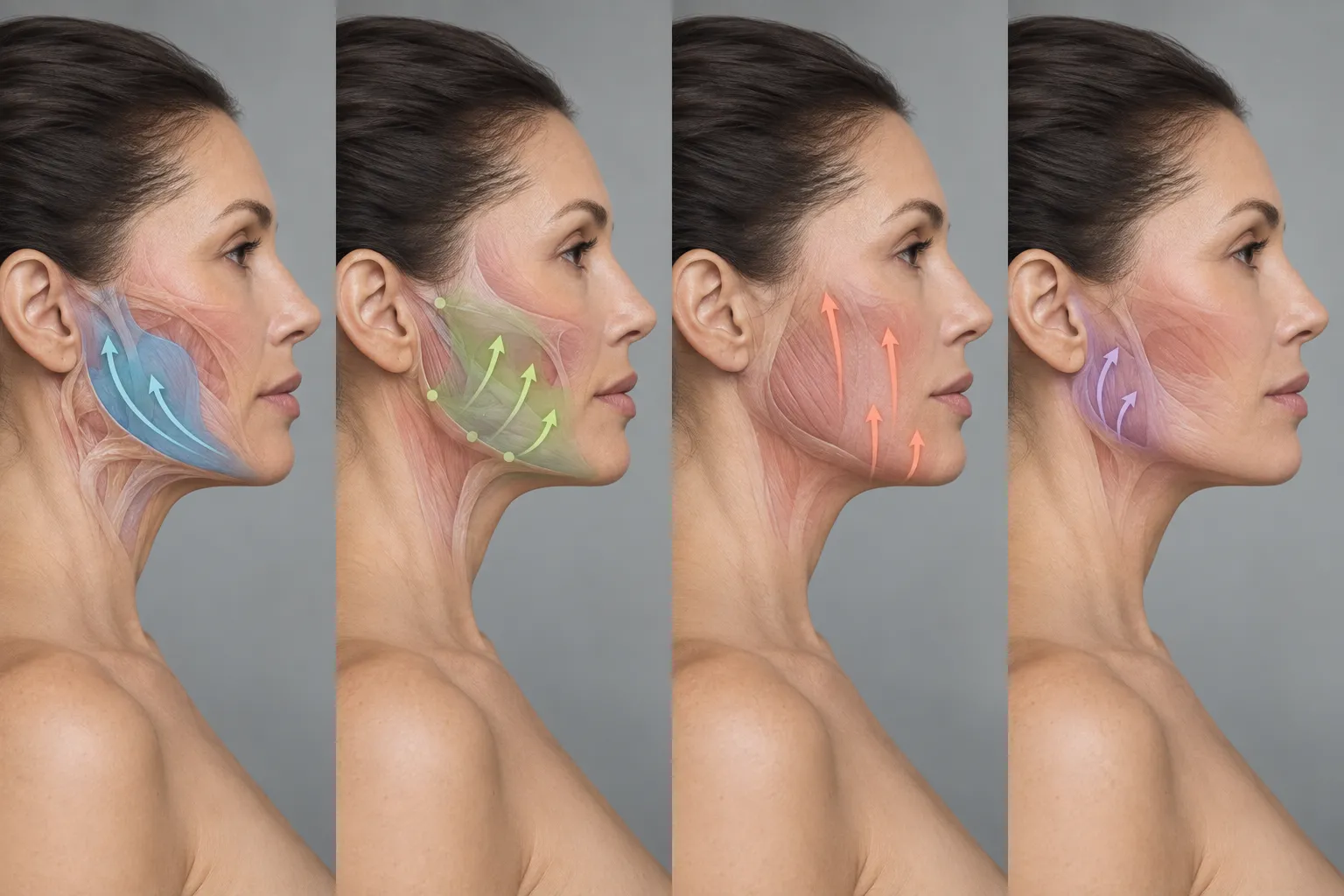
These names describe different features of a surgical plan, and terminology varies between surgeons. “SMAS” refers to a tissue layer, “vertical” describes a lift direction, and “mini” commonly signals a more limited operation. A deep plane approach describes a plane of dissection and release. A facelift deep plane procedure is not automatically a better match: the question is whether planned tissue movement addresses your concerns while respecting your anatomy and priorities. The table outlines broad distinctions, not a ranking or substitute for consultation.
| Approach | Tissue and lift direction | Often considered for | Longevity and relative cost |
|---|---|---|---|
| Deep plane | Releases retaining ligaments and repositions the SMAS and skin together; vector varies by plan. | Changes involving the cheek, jowls, and lower face that call for deeper mobilization. | Often cited around 10 to 15 years; generally more costly than a mini lift. |
| SMAS | Addresses the SMAS separately from the skin; the method and direction vary. | Lower-face laxity where a surgeon judges SMAS work appropriate. | Often cited around 7 to 10 years; pricing varies by scope and practice. |
| Vertical | Describes an upward-oriented vector; it is not one uniform dissection method. | Patients whose facial anatomy and goals suit a more vertical repositioning plan. | No single duration or price applies; technique and extent matter. |
| Mini | Typically involves a more limited incision and tissue adjustment, often focused on the lower face. | Selected patients with less extensive laxity and goals suited to a smaller operation. | Often less costly than a full facelift; longevity varies with technique and aging. |
Deep Plane vs SMAS Facelift: Which Tissue Layers Are Lifted?
With a SMAS facelift, the surgeon works on the supportive layer beneath the skin, using a method that may fold, tighten, or reposition it. In a deep-plane method, selected ligament releases allow the SMAS and skin to move together. This distinction affects dissection, not just the procedure’s label. Both approaches require careful planning of tissue tension and facial balance. Neither guarantees a natural-looking result; suitability depends on laxity, cheek position, skin characteristics, and the surgeon’s assessment.
Deep Plane vs Vertical Facelift: Midface and Jawline Direction of Lift
“Vertical facelift” generally refers to the direction tissue is repositioned, while “deep plane” refers to the surgical plane and release. A vertical vector may be used within different facelift methods, so the terms are not always mutually exclusive. The midface, jawline, and cheek respond to the vectors and tissue mobilization selected for an individual face. When considering a deep plane facelift vs vertical facelift, ask the surgeon to explain the planned direction and how it relates to your concerns, rather than relying on a technique name alone.
Deep Plane vs Mini Facelift: How Much Correction Do You Need?
A mini facelift is generally more limited and may suit someone whose concerns are localized and tissue changes less extensive. A deeper, broader lift may be discussed when concerns involve more of the cheek and lower face. The comparison is not simply about age: anatomy, laxity, health, and desired change matter. In a consultation about deep plane facelift vs mini facelift, ask which areas each plan would address, what it would leave unchanged, and why its scope fits your goals. Albert Plastic Surgery also describes its Mini Facelift option.
How Long Each Technique Lasts: Longevity Compared
Patient-facing estimates commonly describe results lasting about 10 to 15 years after a deep-plane approach and roughly 7 to 10 years after SMAS techniques. These are broad estimates, not expiration dates or promises. Aging continues after surgery; longevity depends on anatomy, healing, surgical plan, and personal factors. Figures are less consistent for vertical and mini approaches because those labels cover different methods and degrees of correction. Ask how the surgeon defines longevity and what changes may continue over time; no facelift stops natural aging.
Recovery Timeline, Candidacy, and Risks of a Deep Plane Facelift
Recovery after a facelift deep plane procedure is gradual and varies with the surgical plan, healing, and individual health. Swelling and bruising are expected early; refinement continues beyond the first few weeks. Plan for help at home and follow your surgeon’s instructions rather than treating a general timeline as a personal prediction. A qualified clinician can discuss how the procedure’s scope may affect recovery and whether your health and goals make surgery appropriate.
Week-by-Week Recovery: Swelling, Bruising, and Returning to Work
Many patients take about two weeks away from work, a general estimate rather than a guarantee of readiness. Your surgeon will provide instructions for activity, wound care, and follow-up. Bruising may remain visible for three to four weeks in a minority of patients, and swelling can take longer to settle. Timing for work and social activities depends on comfort, job demands, healing, and your care team’s advice.
- Early recovery: Rest and follow your surgeon’s guidance as swelling and bruising develop.
- Around two weeks: Some patients return to work, depending on healing and daily responsibilities.
- Following weeks: Bruising or swelling may persist; keep scheduled follow-up appointments.
Who Is (and Isn't) a Good Candidate
A consultation considers facial anatomy, areas you want to address, overall health, healing factors, and expectations. Someone with cheek or lower-face changes may wish to discuss whether this technique fits their goals, but those concerns alone do not establish candidacy. Surgery may not be appropriate if a medical condition or other factor makes risks unacceptable, or expectations cannot be met by the likely outcome. Candidacy and technique require individualized clinical assessment.
Honest Discussion of Risks, Including Nerve Injury
Facelift surgery carries risks, including bleeding, infection, fluid collection, delayed healing, visible or unfavorable scars, asymmetry, changes in sensation, and anesthesia-related risks. Facial nerve injury is uncommon but meaningful; it can cause temporary or, rarely, lasting weakness. Dissection extent is one factor in surgical planning, but no approach is free of risk. A natural-looking result cannot be not assured, and the face may continue to age after surgery.
When to Contact Your Surgeon After Surgery
Follow your surgical team’s contact instructions. Reach out promptly about concerning symptoms, including increasing pain or swelling, unusual drainage, fever, bleeding, or a sudden change in facial movement. Seek emergency care for severe symptoms such as trouble breathing or chest pain. Do not wait for a routine follow-up if you believe an urgent problem may be developing. Your clinician’s individual instructions take priority over general education.
How Much Does a Deep Plane Facelift Cost? NYC Pricing Explained
A personalized quote reflects the planned operation, not just its name. Ask for an itemized estimate and confirm what is included, what may be billed separately, and how the office handles follow-up care.
Why Deep Plane Commands a Premium Over SMAS and Mini Lifts
A deep-plane operation can require broader tissue release and more surgical work than a limited mini lift. Cost may also reflect the surgeon’s training, operating room and anesthesia fees, and procedure time. SMAS techniques vary in scope, so the price difference is not fixed. A lower fee does not establish better value; compare the proposed work, surgeon’s qualifications, and included services.
What Deep Plane Facelift, Mini Deep Plane, and Deep Plane Neck Lift Pricing Typically Includes
Ask whether the written estimate covers the surgeon’s fee, anesthesia, facility charges, preoperative assessment, and scheduled postoperative visits. These may be bundled or itemized, and “mini deep plane” is not standardized across practices. A deep plane neck lift cost may be quoted separately or included in a broader plan. Confirm whether the quote covers only facial surgery or also planned neck work, and ask about possible additional charges.
| Quote component | What to confirm |
|---|---|
| Surgeon’s fee | Which planned procedures and surgical services it covers. |
| Anesthesia and facility | Whether these charges are included or listed separately. |
| Follow-up care | Which scheduled postoperative visits are included. |
| Additional services | Whether any separately planned facial or neck work changes the estimate. |
Factors That Move Your Quote Up or Down
Price can vary with tissue-release extent, operative time, anesthesia and facility arrangements, surgeon experience, and local costs. The estimate may differ if the plan addresses a broader area than a limited lift. Ask for the proposed scope in writing, including what surgery is intended to address and what it will not change. Cost alone cannot determine whether an operation is appropriate; the consultation should establish whether the plan fits your anatomy, health, and goals.
How to Vet a 'Deep Plane' Surgeon: Dr. Mark Albert's Checklist and Consultation Guide

The phrase “deep plane” can describe different surgical details across practices, so evaluate the surgeon’s explanation and credentials, not just the label. Dr. Mark Albert is certified by the American Board of Plastic Surgery and is a Fellow of the American College of Surgeons. He completed plastic surgery residency and chief residency at the University of Massachusetts Medical School, followed by an aesthetic plastic surgery fellowship at Manhattan Eye, Ear, and Throat Hospital. These qualifications provide context; your decision should also reflect an individualized discussion of the proposed operation.
Credentials Checklist: Board Certification, Training, and Deep Plane Case Volume
- Verify board certification in plastic surgery and ask about relevant fellowship training.
- Ask how the surgeon defines the technique and which tissues the plan addresses.
- Discuss the surgeon’s experience with this operation and how outcomes and complications are followed.
- Review representative before-and-after photographs, recognizing that results vary.
What Dr. Mark Albert Examines During a Deep Plane Facelift Consultation
Dr. Albert assesses facial structure, tissue position, skin characteristics, health history, and the areas you hope to address. The discussion should connect those findings to the proposed incision pattern, tissue movement, limitations, and risks. Ask how the plan addresses your concerns and what changes would remain. Candidacy, technique, recovery, risks, and outcomes require individualized clinical assessment.
Questions to Ask Before You Commit
- What does “deep plane” mean in my proposed operation?
- Why does this plan fit my anatomy better than a more limited approach?
- What risks, recovery needs, and limits should I consider?
- Who will provide follow-up, and whom should I contact with a concern?
These questions help you compare the proposed plan with your priorities without treating any technique as universally preferable.
Next Step: Schedule a Consultation with Dr. Mark Albert in NYC
If you are considering surgery, a consultation can clarify your options and remaining questions. Read more about Dr. Mark Albert’s background and the practice’s Facelift information. You can then decide whether to request an appointment based on your goals and comfort with the proposed plan.
Frequently Asked Questions
Is deep plane facelift surgery available in the United States?
Yes, deep plane facelift surgery is widely available in the United States from qualified plastic surgeons. Dr. Mark Albert, a board-certified plastic surgeon in New York City, offers deep plane facelift surgery at Albert Plastic Surgery. Suitability for any technique requires an individualized clinical assessment.
What is the average cost of a deep plane facelift?
The cost of a deep plane facelift varies by surgeon, location, anesthesia, and the scope of the surgical plan, and it is generally more costly than a mini lift. Practices typically provide pricing only after a consultation establishes the technique and extent appropriate for a patient's anatomy and goals.
What are the disadvantages of a deep plane facelift?
A deep plane facelift involves more extensive dissection than more limited techniques, is generally more costly, and carries the same fundamental trade-offs as any facelift, including permanent scars and outcomes that vary by individual. Incisions are permanent and visibility depends on healing and skin characteristics. A qualified surgeon should discuss risks and limitations in a consultation.
Is a deep plane facelift worth it?
Whether a deep plane facelift is worthwhile depends on a patient's anatomy, aging concerns, goals, and priorities, not on the procedure's name. This approach repositions deeper facial tissue together with skin, and it is often considered for changes involving the jowls, cheeks, and lower face. A consultation with a qualified clinician is needed to determine suitability.
What is the best age to get a deep plane facelift?
There is no single best age for a deep plane facelift; candidacy depends on individual anatomy, degree of skin and tissue laxity, health, and personal goals rather than a number. Many patients consider it when aging changes in the cheeks, jowls, and lower face no longer respond to less extensive measures. A clinical evaluation can address timing for a specific patient.
How does a deep plane facelift differ from a SMAS facelift?
A SMAS facelift works on the supportive layer beneath the skin separately, often folding, tightening, or repositioning it, while a deep plane approach releases selected facial retaining ligaments so the SMAS and skin move together as a composite flap. This distinction affects dissection and tissue movement, and the better match depends on individual anatomy and concerns.
How long do deep plane facelift results typically last?
A deep plane facelift is often cited as lasting around 10 to 15 years, though longevity varies with technique, individual anatomy, skin quality, and continued aging. No surgical result is permanent, and a qualified surgeon can discuss expected duration in the context of a patient's specific plan.