

how much does a mini facelift cost in nyc
Understanding how much does a mini facelift cost in NYC requires more than looking at an advertised number. In Manhattan, a quoted price may reflect the surgeon’s training, surgical facility, anesthesia, operative time, and follow-up. A realistic estimate should explain each component rather than present a low introductory figure that changes during consultation.
Key Takeaways
- A mini facelift quote in Manhattan generally bundles the surgeon's fee, anesthesia, facility charges, and postoperative visits, so patients should always ask for an itemized estimate.
- Prices vary widely across New York City because each practice sets its fees based on the surgeon's training, board certification, and the accredited surgical center used.
- An unusually low advertised figure can be misleading if it excludes anesthesia, operating room time, or follow-up appointments that are added later in the process.
- The extent of correction needed, the type of anesthesia chosen, and the total operative time all influence what a patient ultimately pays.
- During consultation, a board-certified plastic surgeon should explain every component of the price so patients can compare quotes accurately and avoid unexpected charges.
The Mini Facelift is a focused facelift operation, but it remains real surgery with individualized planning, anesthesia considerations, recovery requirements, and potential complications. The figures below are general educational guidance. Candidacy, technique, recovery, risks, and outcomes require individualized clinical assessment with a qualified plastic surgeon.
NYC Mini Facelift Cost: What the Average Range Includes and Excludes
Understanding the $12,000 to $30,000+ Range for Mini Facelifts in Manhattan
Published NYC estimates for a mini facelift commonly range from approximately $12,000 to $30,000 or more. The spread reflects differences in surgeon expertise, surgical setting, anesthesia, operative complexity, and the anatomic concerns being addressed. A shorter operation in an accredited outpatient facility may carry a different fee from a more involved procedure performed by a highly experienced facelift surgeon in Manhattan. Operative time commonly falls between 90 minutes and 2.5 hours, though technique and patient factors can change that estimate.
The American Society of Plastic Surgeons reports an average surgeon fee of approximately $9,281 for facelift surgery, excluding facility and anesthesia charges. That benchmark is not an all-inclusive NYC price and may include procedures broader than a mini facelift. Patients should request a complete surgical estimate rather than compare one surgeon fee with another practice’s package price.
What Is Typically Included in a Mini Facelift Quote, and What Is Not
A written estimate should identify whether the amount covers the surgeon’s professional fee, preoperative planning, operating room or facility charges, anesthesia, routine postoperative visits, dressings, and immediate surgical supplies. It should also state which services are billed separately. Facility deposits, laboratory testing, prescription medication, garments, overnight observation, and treatment of an unexpected complication may not be included. Policies differ, so the absence of a line item does not confirm that the charge is included.
| Quote component | What it may cover | What to verify |
|---|---|---|
| Surgeon fee | Consultation-based surgical planning and performance of the facelift | Whether preoperative and postoperative visits are included |
| Facility fee | Operating room, nursing staff, equipment, and facility recovery area | Accreditation, time limits, supplies, and observation charges |
| Anesthesia fee | Anesthesia professional services and monitoring | Anesthesia type, provider, minimum fees, and recovery monitoring |
| Recovery-related costs | Selected dressings, instructions, and scheduled follow-up care | Medication, transportation, garments, and unscheduled visits |
Why a Low Price Quote Should Raise Questions, Not Excitement
A substantially lower estimate may be legitimate, but it deserves a line-by-line explanation. Ask whether it represents only the surgeon’s fee, excludes anesthesia, uses a nonaccredited setting, or assumes additional postoperative charges. Confirm who will perform the operation and whether a board-certified plastic surgeon will remain responsible for the surgical plan and follow-up. Cost should be considered alongside training, facility standards, communication, and continuity of care.
Itemized Surgical Quote Breakdown: Surgeon Fee, Facility Fee, and Anesthesia Fee

Surgeon Fee: What You Are Paying For Beyond the Procedure
The surgeon fee may include examination of facial anatomy, discussion of goals and limitations, incision planning, assessment of skin laxity and deeper facial support, operative judgment, and postoperative assessment. Facelift surgery is not a standardized commodity. A careful plan seeks a refreshed, proportionate appearance rather than excessive skin tension or an overpulled look. Ask whether consultation, surgical design, follow-up visits, and management of routine postoperative concerns are included.
Dr. Mark G. Albert, MD, FACS of Albert Plastic Surgery is certified by the American Board of Plastic Surgery and is a Fellow of the American College of Surgeons. His training includes plastic surgery residency and chief residency at the University of Massachusetts Medical School, followed by an aesthetic plastic surgery fellowship at Manhattan Eye, Ear, and Throat Hospital. Training and ongoing clinical responsibility do not guarantee an outcome, but they are relevant when assessing a surgical quote.
Accredited Surgical Facility Fees and How They Vary in NYC
The facility fee can include the operating room, surgical equipment, sterile supplies, nursing personnel, monitoring equipment, and recovery area. Charges may vary according to location, accreditation, staffing model, operating-room duration, and extended observation. Ask whether the procedure will take place in an accredited ambulatory surgical center or hospital-based setting, and clarify cancellation policies, operating-time thresholds, and additional recovery-monitoring charges.
Board-Certified Anesthesiologist Costs vs. Anesthesia Monitoring by a Nurse
Anesthesia is a separate professional service in many estimates. The fee may depend on anesthetic type, procedure duration, provider credentials, and monitoring requirements. Ask who will administer and monitor anesthesia, who is medically responsible during the operation, and whether the fee includes recovery-room care. A nurse may assist with monitoring in some settings, but the staffing model and medical supervision should be explained by the surgical facility and anesthesia team.
Financial checkpoint: Before paying a deposit, request one written estimate separating surgeon, facility, anesthesia, and recovery-related charges. Ask which fees are fixed, which may change with operative time or medical needs, and which services remain your responsibility after surgery.
Mini Facelift vs. Deep Plane Facelift vs. Nanolift™: How Pricing Reflects Anatomical Differences
Anatomical Targets and Incision Patterns of Each Technique
Price differences begin with the anatomy addressed and the amount of surgical dissection required. A Mini Facelift generally focuses on early to moderate skin laxity along the lower face and jawline. Incisions are often shorter, and the operation may involve limited repositioning of deeper facial support rather than extensive elevation across the midface and neck. This can reduce operative time, facility use, and anesthesia requirements, although candidacy depends on skin quality, facial structure, tissue descent, and goals.
A Deep Plane Facelift involves a deeper anatomic layer beneath the superficial musculoaponeurotic system, commonly called the SMAS. By releasing and repositioning deeper facial tissues, it may address more advanced descent in the cheeks, jowls, and neck. Nanolift™ is a distinct, more limited facelift approach intended for selected patients whose concerns and degree of laxity do not require a full deep plane operation. Technique names alone do not determine suitability. An in-person examination is needed to assess incision placement, tissue mobility, facial balance, and limitations.
Typical Recovery Timeline and Time Off Work per Procedure
Recovery is influenced by tissue elevation, bruising tendency, healing response, occupation, and the surgeon’s instructions. A Mini Facelift may involve less swelling and a shorter period away from public-facing activities than a more extensive operation, but it is still surgery and provides no not assured schedule. Deep Plane Facelift recovery can require additional time because deeper tissues are repositioned and more areas may be treated. Nanolift™ may offer a more limited recovery pattern for an appropriate candidate, though experiences vary.
Patients should plan for swelling, bruising, tightness, temporary numbness, incision care, activity restrictions, and scheduled follow-up. People with physically demanding work, frequent travel, or public-facing responsibilities may need a different plan from someone working remotely. Your surgeon should explain when routine activities, exercise, driving, and work may resume.
Average NYC Cost Comparison: Mini Facelift, Deep Plane Facelift, and Nanolift™
In New York City, a focused technique generally costs less than a deeper or more extensive facelift because it may require less operative time, dissection, anesthesia, and facility use. Published Manhattan estimates for combined deep plane and neck procedures frequently reach approximately $28,000 to $65,000 or more. A Mini Facelift may fall within the broader $12,000 to $30,000-plus range, while Nanolift™ pricing depends on its exact design, surgeon fee, facility, anesthesia, and anatomy treated. These are educational ranges, not personal quotations.
| Technique | Primary anatomic focus | Why pricing may differ | Best financial question to ask |
|---|---|---|---|
| Mini Facelift | Selected lower-face laxity, jowls, and jawline definition | Often shorter incisions, operative time, and facility use | Which layers will be addressed, and what does the estimate include? |
| Nanolift™ | Limited facial laxity in carefully selected patients | More focused planning may reduce surgical scope, but fees remain individualized | What anatomic concern makes this approach appropriate for me? |
| Deep Plane Facelift | Deeper descent involving cheeks, jowls, and possibly the neck | Greater dissection, operative complexity, anesthesia, and facility time | Which deeper tissues require repositioning, and why? |
The least expensive option is not automatically the most appropriate, and a higher fee does not guarantee a superior result. The goal is a technique that matches the anatomy without unnecessary dissection or an artificially tight appearance. Albert Plastic Surgery maintains a dedicated live service page for Mini Facelift information. A consultation should connect the operation, recovery, itemized charges, and limitations.
How Anesthesia Choices and Add-On Procedures Affect Your Total Investment
Local Anesthesia with Oral Sedation vs. IV Twilight vs. General Anesthesia
Anesthesia selection can change the estimate because methods involve different medications, personnel, monitoring, recovery requirements, and facility policies. Local anesthesia with oral sedation may be considered for a limited operation in selected patients. IV sedation, sometimes called twilight anesthesia, provides a different medication and monitoring level. General anesthesia involves a deeper anesthetic state and may require additional anesthesia services and recovery observation. The surgeon and anesthesia professional should determine what is medically appropriate, rather than choosing solely by price.
| Anesthesia approach | Cost variables to review | Questions for the written estimate |
|---|---|---|
| Local anesthesia with oral sedation | Medication, monitoring, staff, and recovery observation | Who administers medications, and what monitoring is provided? |
| IV sedation | Anesthesia professional, medication, monitoring time, and recovery care | Is anesthesia billed separately, and is recovery-room monitoring included? |
| General anesthesia | Anesthesia team, airway management, operating time, and post-anesthesia care | Are there minimum time charges or additional observation fees? |
Common Add-Ons: Neck Contouring, Blepharoplasty, and Fat Grafting Costs
Additional procedures can substantially change a quote because they add operative time, supplies, facility use, anesthesia, and postoperative care. Neck contouring may be proposed when laxity or fullness extends below the jawline. Blepharoplasty addresses eyelid concerns that a facelift does not treat. Fat grafting involves harvesting, processing, and placing fat in selected facial areas. Each has separate indications, limitations, and risks. Ask for each service to appear on its own line, with a separate professional fee and an explanation of whether it is medically or aesthetically relevant to your goals.
How to Distinguish a Thoughtful Recommendation from a Pushy Upsell
A thoughtful recommendation is tied to a specific anatomic finding, explains the expected benefit and limitation, and remains optional when it is not necessary for the primary operation. The surgeon should discuss the facelift alone, explain how the result may differ, and describe added risks and recovery demands without pressure. Be cautious when a package is presented as mandatory without an examination, costs appear only after a deposit, or urgency replaces individualized discussion.
How to Vet a Plastic Surgery Quote: Questions to Ask During Your Consultation
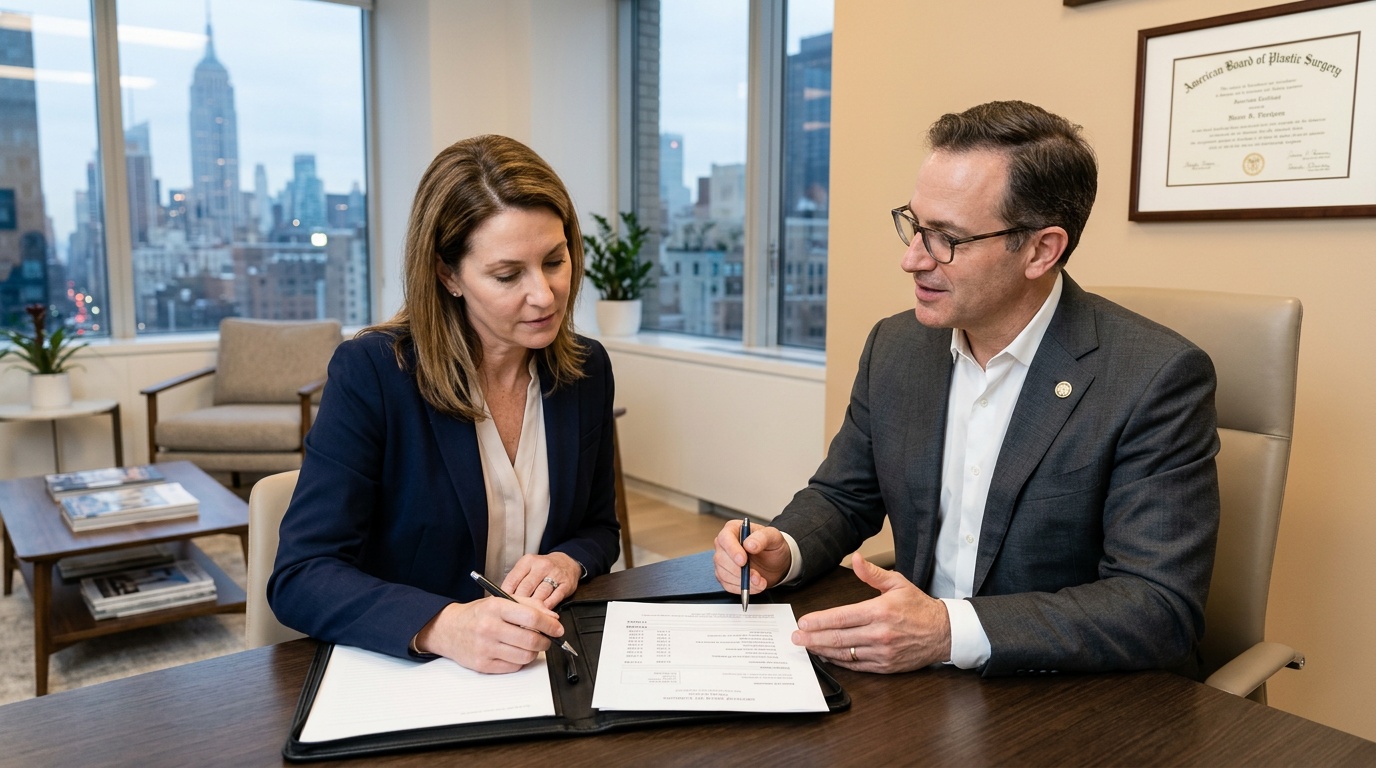
When evaluating how much does a mini facelift cost in NYC, the surgeon’s qualifications and written estimate deserve as much attention as the total. A consultation should explain the proposed technique, setting, anesthesia plan, follow-up care, and possible additional charges. Candidacy, technique, recovery, risks, and outcomes require individualized clinical assessment.
Verifying Credentials: Board Certification, Fellowship Training, and Hospital Privileges
Confirm that the surgeon is certified by the American Board of Plastic Surgery, rather than relying on general references to being “board certified.” Fellowship training in aesthetic plastic surgery can provide additional focused preparation, while hospital privileges or practice in an accredited ambulatory surgical facility may offer information about the operating environment. Dr. Albert is certified by the American Board of Plastic Surgery and is a Fellow of the American College of Surgeons. His training includes plastic surgery residency and chief residency at the University of Massachusetts Medical School, followed by an aesthetic plastic surgery fellowship at Manhattan Eye, Ear, and Throat Hospital.
What to Ask About the Surgeon’s Experience with Mini Facelifts
Ask how the surgeon determines whether a Mini Facelift is appropriate, which facial layers will be addressed, and what limitations the operation has. Discuss incision placement, expected changes along the jawline and lower face, possible asymmetry, visible scars, numbness, swelling, bleeding, infection, and the possibility that the result may not meet expectations. Ask how often the surgeon performs facelift surgery, who will be present in the operating room, and who will manage questions after surgery. Experience is relevant but does not guarantee an outcome.
Requesting Before-and-After Photos and Understanding Recovery Support Costs
Before-and-after photographs can help assess incision placement, facial proportion, jawline transition, and whether results appear natural rather than tight or windswept. Ask whether images are unretouched, taken under similar lighting, and representative of patients with comparable anatomy. Request a written recovery plan identifying scheduled visits, after-hours contact, dressing supplies, prescriptions, transportation needs, and charges for unscheduled evaluations. Ask whether a deposit is refundable, how cancellations are handled, and which expenses remain your responsibility if healing requires additional care.
Frequently Asked Questions
Is a mini facelift worth the money in NYC?
A mini facelift may be worth the cost for patients whose goals match what the procedure can address, with NYC estimates commonly ranging from about $12,000 to $30,000 or more. Value depends on the surgeon’s training, facility standards, anesthesia, expected recovery, risks, and whether the planned technique fits the patient’s anatomy and goals.
What is a good age to get a mini facelift?
A good age for a mini facelift depends on facial laxity, skin quality, anatomy, health, and personal goals rather than a specific birthday. Many patients consider consultation when non-surgical treatments no longer address their concerns, though candidacy, technique, risks, and likely outcomes require an individualized examination.
How long will a mini facelift last?
A mini facelift can provide improvement for several years, but the duration varies with aging, skin quality, sun exposure, lifestyle, anatomy, and surgical technique. Mini facelift results do not stop the aging process, so a consultation is needed to discuss expected longevity and whether the procedure matches the patient’s concerns.
How does a 60-year-old look before and after a mini facelift?
A 60-year-old may look more refreshed after a mini facelift, with improvement in selected areas of lower-face or jawline laxity, though results differ substantially among patients. Before-and-after photos cannot predict an individual outcome, and an examination is needed to determine whether a mini facelift or another facelift approach is appropriate.
What are the downsides of a mini facelift?
The downsides of a mini facelift include surgical risks, temporary swelling or bruising, scars, possible asymmetry, changes in sensation, dissatisfaction, and the potential need for additional treatment. A mini facelift may also provide less correction than a more comprehensive facelift, so patients should review limitations, recovery, costs, and alternatives during consultation.