

is deep plane facelift the best
Is deep plane facelift the best approach? It can be a strong option when facial laxity and descended cheek tissue call for deeper repositioning, but no single facelift technique is right for everyone. Dr. Mark Albert considers facial anatomy, areas of concern, and a patient’s goals before weighing a Deep Plane Facelift against other facelift approaches.
Key Takeaways
- A deep plane facelift can be an excellent choice for patients whose facial aging involves loose skin and lowered cheek tissue that benefit from deeper structural support.
- No single surgical technique suits every patient, so the right approach depends on each person's unique facial anatomy.
- Dr. Albert evaluates a patient's specific areas of concern and personal goals before recommending any particular facelift method.
- Comparing the deep plane technique with other facelift options helps ensure that the chosen procedure matches the patient's expected results.
A technique’s name does not determine whether an outcome will look natural. The plan, surgical judgment, and a patient’s anatomy all matter. The comparisons below explain what the options involve and how their differences may affect results and recovery.
Is a Deep Plane Facelift the Best? The Direct Answer
A deep plane facelift is not universally the best facelift. It may suit patients whose concerns include pronounced lower-face laxity, deep folds, or descended midface tissue because it repositions deeper facial structures. A different approach may be more appropriate when concerns are limited or a smaller change better fits a patient’s goals and recovery preferences. The right choice requires an in-person evaluation by a qualified clinician.
Best for What? How Dr. Mark Albert Frames the Question
Dr. Mark Albert frames the decision around the changes a patient hopes to address, not a ranking of technique names. A consultation considers skin looseness, cheek position, jawline definition, facial proportions, health history, and expectations. It also allows discussion of tradeoffs: how much repositioning may help, the extent of surgery, recovery needs, and what a facelift cannot change. For someone asking, “Is deep plane facelift the best?” the more useful question is whether its approach matches their anatomy and priorities.
What the Deep Plane Technique Actually Does
In a deep plane facelift, the surgeon works beneath the superficial musculoaponeurotic system, or SMAS, and releases selected retaining ligaments. Skin, SMAS, fat pads, and supporting tissue are repositioned together as a composite layer, rather than relying only on pulling the skin or tightening tissue above the deeper plane. This can allow cheek and lower-face tissues to move with less dependence on skin tension. The technique is not a fixed operation: the areas released and repositioned depend on the patient’s anatomy and surgical plan.
Why “Gold Standard” Is Partly Anatomy and Partly Marketing
The deep plane approach has been described for decades, and its ability to address deeper tissue descent explains why some surgeons favor it for selected patients. Calling it a “gold standard,” though, can make a nuanced decision sound universal. A label cannot establish that a technique is right for a particular face or replace careful planning and experience. A natural-looking result depends on appropriate tissue movement, proportion, and surgical judgment, not the procedure’s name alone.
Deep Plane vs. SMAS vs. Mini Facelift: Side-by-Side Comparison
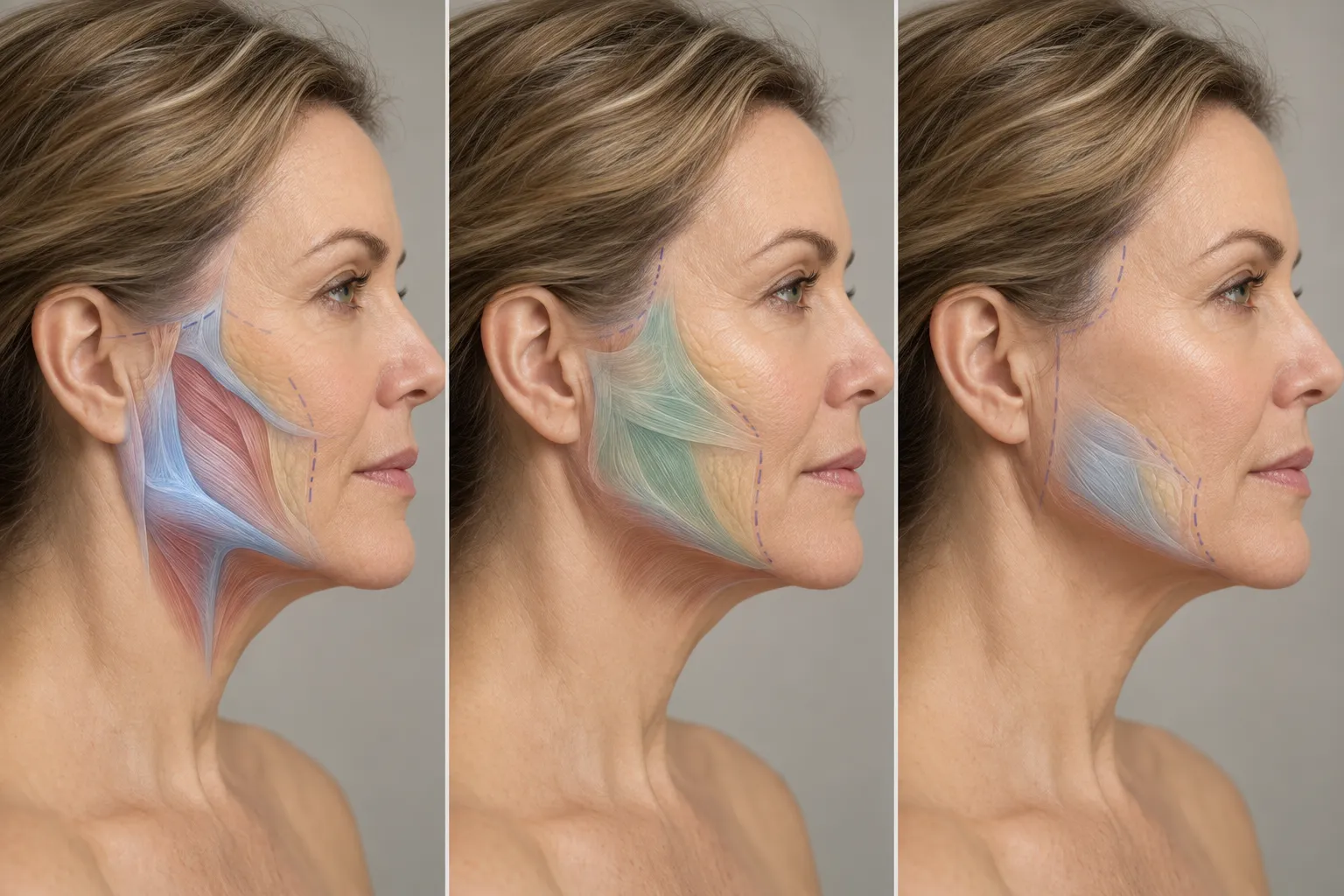
These approaches differ in how they address facial support and how much tissue is treated. A deep plane facelift works beneath the SMAS and releases selected ligaments; SMAS techniques adjust this supportive layer without necessarily using the same deep release. A mini facelift generally involves a more limited area and degree of correction. No method guarantees a particular duration, appearance, or recovery course. Use the comparison as a starting point for a consultation, not a substitute for an individualized surgical plan.
Technique Differences: What Each Lift Releases and Repositions
| Approach | General focus | Planning consideration |
|---|---|---|
| Deep plane facelift | Repositions a composite of deeper facial tissues after selected ligament release. | May suit concerns involving cheek descent and more substantial lower-face laxity. |
| SMAS facelift | Adjusts or repositions the SMAS support layer; the specific method varies. | The extent and direction of correction depend on anatomy and the chosen technique. |
| Mini facelift | Provides a more limited lift, often focused on early lower-face changes. | May not address more extensive laxity or deeper tissue descent. |
Longevity and Natural-Look Results Compared
Published patient-facing estimates commonly describe deep plane results as lasting about 10 to 15 years and SMAS facelift results as lasting roughly 5 to 7 years. These broad ranges are not predictions for an individual. Aging continues after surgery, and skin quality, facial anatomy, healing, and the surgical plan affect how results change over time. A mini facelift’s more limited correction may also mean a different pattern of visible aging. Any approach can look pulled if tissue movement or skin tension is poorly planned; technique names alone do not ensure a natural appearance.
Recovery Timelines and What to Expect at Each Milestone
Recovery varies with the operation, individual healing, and the clinician’s instructions. Many patients resume normal activities within about two weeks, while swelling and bruising often begin to ease during the first week. These patterns do not predict when any one person can return to work, exercise, or social plans. The deeper dissection involved in a deep plane lift may affect early recovery differently from a more limited operation, but “harder” cannot be judged by technique label alone.
- First days: Plan for rest, follow-up, and temporary swelling or bruising.
- First week: Bruising and swelling may start to subside, though visible changes can remain.
- About two weeks: Many patients return to normal activities, subject to their surgeon’s guidance and healing.
- Beyond early recovery: Residual swelling and tissue settling may continue, so the final appearance takes time to assess.
When the Deep Plane Facelift Is NOT the Best Choice
A Deep Plane Facelift is not automatically right because it is more extensive. If facial changes are mild or limited, a smaller lift may better match the concern and the amount of change a patient wants. The question “is deep plane facelift the best” is best answered by evaluating facial anatomy, goals, health history, and recovery needs together. No technique is right for everyone, and an in-person consultation is needed to assess candidacy.
When a SMAS or Mini Facelift Makes More Sense
A SMAS facelift may be appropriate when a patient needs adjustment of the supportive tissue layer but not the same degree of deep tissue release. A mini facelift may suit more limited lower-face laxity when the desired correction is modest. These options are not interchangeable, and their names alone do not show which plan is suitable. Dr. Mark Albert considers where laxity is present, how much repositioning may help, and whether the likely scope of surgery fits the patient’s priorities.
Where Nanolift™ Fits for Earlier Signs of Aging
Nanolift™ is a more limited facelift approach that may be considered for earlier signs of facial aging. It may be worth discussing when concerns are localized and a patient seeks a smaller degree of correction rather than extensive repositioning. A limited approach also has limits: it may not address more pronounced skin laxity or deeper tissue descent. The choice depends on an examination and a clear discussion of what the technique can and cannot change.
Candidacy by Age, Degree of Aging, and Recovery Tolerance
Age alone does not determine which facelift approach is appropriate. The pattern and degree of facial aging, tissue quality, overall health, expectations, and available recovery time all matter. Consider these questions as a starting point for a consultation:
- Are the changes mild and localized, or do they involve more substantial cheek and lower-face descent?
- Would a limited correction meet your goals, or are you considering a more extensive change?
- Can your schedule accommodate the recovery plan recommended for the procedure being considered?
- Do you understand the limitations and risks of each option?
These questions cannot establish candidacy on their own. A clinician must assess the individual before recommending a technique.
Risks, Cost, and Why Surgeon Skill Matters More Than the Technique Label
Technique is one part of facelift planning, not a measure of quality on its own. The Deep Plane Facelift involves work in deeper facial tissue, so patients should understand the operation’s risks, recovery instructions, and financial terms before deciding. Risk and recovery vary with the patient and surgical plan. A consultation with a qualified plastic surgeon is the setting for discussing personal medical factors and deciding whether potential benefits justify the extent of surgery.
Real Risks: Nerve Injury Rarity, Hematoma, and Prolonged Swelling
Facelift surgery carries risks, including bleeding, infection, scarring, delayed healing, changes in skin sensation, asymmetry, and dissatisfaction with the result. A hematoma, or collection of blood beneath the skin, may require prompt medical attention. Permanent motor nerve injury is considered extremely rare in experienced hands, but nerve injury remains a serious possible complication and should not be dismissed. Swelling and bruising are expected parts of healing for many patients, and swelling can last longer than anticipated. Ask the surgeon how complications are monitored and whom to contact if a concern develops.
What Deep Plane Facelifts Cost and What Drives Price
There is no single price that applies to every patient. Fees may reflect the surgeon’s work, the complexity and length of the planned operation, anesthesia, facility costs, and included follow-up care. A less expensive estimate may not include the same services as another quote, so compare itemized details rather than the headline figure alone.
How to Judge Surgeon Skill vs. Marketing Hype
When considering Dr. Mark Albert or any surgeon, focus on qualifications, judgment, communication, and the plan proposed for your anatomy. Dr. Albert is certified by the American Board of Plastic Surgery and is a Fellow of the American College of Surgeons. Ask how the surgeon explains intended tissue changes, alternatives, limitations, recovery, and material risks. A sound discussion should allow for uncertainty and individual variation, rather than promise a particular appearance or present one technique as right for every patient.
- Verify board certification in plastic surgery and ask about the surgeon’s training.
- Ask why the recommended approach fits your concerns and what it may not correct.
- Discuss how complications are addressed and how follow-up care is organized.
- Be cautious of guarantees, pressure to decide quickly, or claims that technique labels ensure a natural result.
Choosing the Right Facelift: FAQs and Next Steps with Dr. Mark Albert

When asking, “is deep plane facelift the best,” consider whether the technique fits your facial anatomy, goals, and comfort with the operation and recovery. The Deep Plane Facelift is one option to discuss with Dr. Mark Albert. General information can help you prepare, but only an individualized consultation can assess candidacy and guide a surgical plan.
Will a Deep Plane Facelift Look Pulled or Overdone?
It does not have to look pulled or windswept. A natural-looking outcome depends on proportionate tissue repositioning, thoughtful planning, and attention to facial anatomy, not simply the technique name. No surgeon can promise a particular appearance. Ask how the proposed plan would address your concerns while preserving facial character, and discuss the limits and risks as well as the intended changes.
Are Results Permanent?
No. A facelift can create lasting improvement, but it does not stop the aging process. Facial tissues continue to change over time, and the duration and appearance of results vary among patients. The Deep Plane Facelift should be considered with realistic expectations about ongoing aging, rather than as a permanent correction.
Is Deep Plane Recovery Really Harder?
Recovery is not the same for every patient. The extent of surgery, individual healing, and the surgeon’s instructions all shape the experience. Ask about activity restrictions, follow-up appointments, and how to reach the care team if symptoms concern you. Your clinician can discuss what recovery may involve in your case without guaranteeing a timeline.
Schedule a Facelift Consultation
Dr. Mark Albert is certified by the American Board of Plastic Surgery and is a Fellow of the American College of Surgeons. A consultation gives you the opportunity to discuss your concerns, medical history, expectations, and tradeoffs among facelift approaches. Bring questions about the proposed technique, risks, recovery, and follow-up care. The decision should follow an individualized clinical assessment, with time to consider whether the plan feels appropriate for you.
Frequently Asked Questions
Is the deep plane facelift really the best facelift technique?
No single facelift technique is universally the best, including the deep plane facelift. It may suit patients with pronounced lower-face laxity or descended cheek tissue, while other approaches may fit milder concerns better. The right choice depends on anatomy, goals, and an in-person evaluation with a qualified surgeon.
What makes a deep plane facelift different from a SMAS or mini facelift?
A deep plane facelift works beneath the SMAS layer and releases selected ligaments, repositioning skin, fat pads, and deeper tissue as a composite. SMAS techniques adjust the support layer without the same deep release, and a mini facelift addresses a more limited area with a smaller degree of correction.
How long do deep plane facelift results last compared to other lifts?
Published patient-facing estimates often describe deep plane results as lasting about 10 to 15 years, while SMAS facelift results are commonly estimated at 5 to 7 years. These ranges are not predictions for any individual, since aging continues and skin quality, anatomy, healing, and the surgical plan all affect longevity.
Is deep plane recovery longer or harder than other facelifts?
Recovery varies with the operation, individual healing, and a surgeon's instructions, so technique labels alone cannot determine difficulty. Many patients resume normal activities within about two weeks, with swelling and bruising often easing during the first week. Residual swelling and tissue settling can continue beyond early recovery.
Will a deep plane facelift look natural or 'overdone'?
A deep plane facelift can look natural when tissue movement, proportion, and skin tension are planned well. Any facelift approach can look pulled if these factors are poorly handled. The procedure's name does not determine the outcome; surgical judgment and individual anatomy matter most.
When is a deep plane facelift not the right choice?
A deep plane facelift may not be the best fit when facial changes are mild or limited, because a smaller lift may better match the amount of change a patient wants. Candidacy depends on skin looseness, cheek position, health history, expectations, and a personalized consultation.
Why is the deep plane facelift sometimes called the 'gold standard'?
The deep plane approach has been described for decades, and its ability to address deeper tissue descent explains why some surgeons favor it for selected patients. Calling it a gold standard can overstate the decision, because no label can confirm a technique is right for a particular face.