

male deep plane facelift
A male deep plane facelift addresses age-related descent by releasing selected retaining ligaments and repositioning deeper facial tissues rather than relying mainly on skin tension. It may help preserve a defined jawline, natural cheek structure, and masculine proportions when tailored to the patient’s anatomy. The Mini Facelift is another option, with suitability determined by the location and degree of laxity.
Men seeking facial rejuvenation often want correction without a windblown, feminized, or visibly operated appearance. Understanding tissue layers, ligament release, incision planning, and surgical judgment is more useful than choosing a procedure by name alone.
Understanding the Male Deep Plane Facelift: A Specialized Approach
What Is a Deep Plane Facelift?
A deep plane facelift works beneath the superficial musculoaponeurotic system, commonly called the SMAS, in a tissue plane that permits selected retaining ligaments to be released. Cheek and lower facial tissues can then be repositioned with less dependence on tightly pulling the skin. The dissection and degree of movement vary according to skin quality, facial volume, ligament anatomy, jawline definition, and tissue descent. A natural result requires measured correction rather than maximal elevation.
Why Men’s Faces Require Unique Considerations
Men often have thicker skin, a heavier beard-bearing envelope, stronger soft-tissue attachments, and a more angular lower face. Sideburn position, hairline recession, tragal definition, and beard direction can make incisions more visible if not mapped carefully. The goal is not to create a smaller or softer face, but to reduce sagging along the cheek, jowl, and neck while preserving masculine landmarks. A review of male rhytidectomy literature in PubMed supports treating male patients as a distinct surgical population rather than applying a generic facelift design.
Dr. Mark Albert’s Philosophy on Masculine Facial Rejuvenation
Dr. Mark Albert, a board-certified plastic surgeon and Fellow of the American College of Surgeons, approaches facelift planning through anatomy, proportion, and tissue behavior. His training includes plastic surgery residency and chief residency at the University of Massachusetts Medical School, followed by an aesthetic plastic surgery fellowship at Manhattan Eye, Ear, and Throat Hospital. Masculine rejuvenation means preserving recognizable jawline and cheek contours while avoiding excessive skin tension. The Mini Facelift may suit limited laxity, while deeper correction may be discussed when descent involves the cheek and lower face.
The Anatomy of Aging in the Male Face and Deep Plane Mechanics
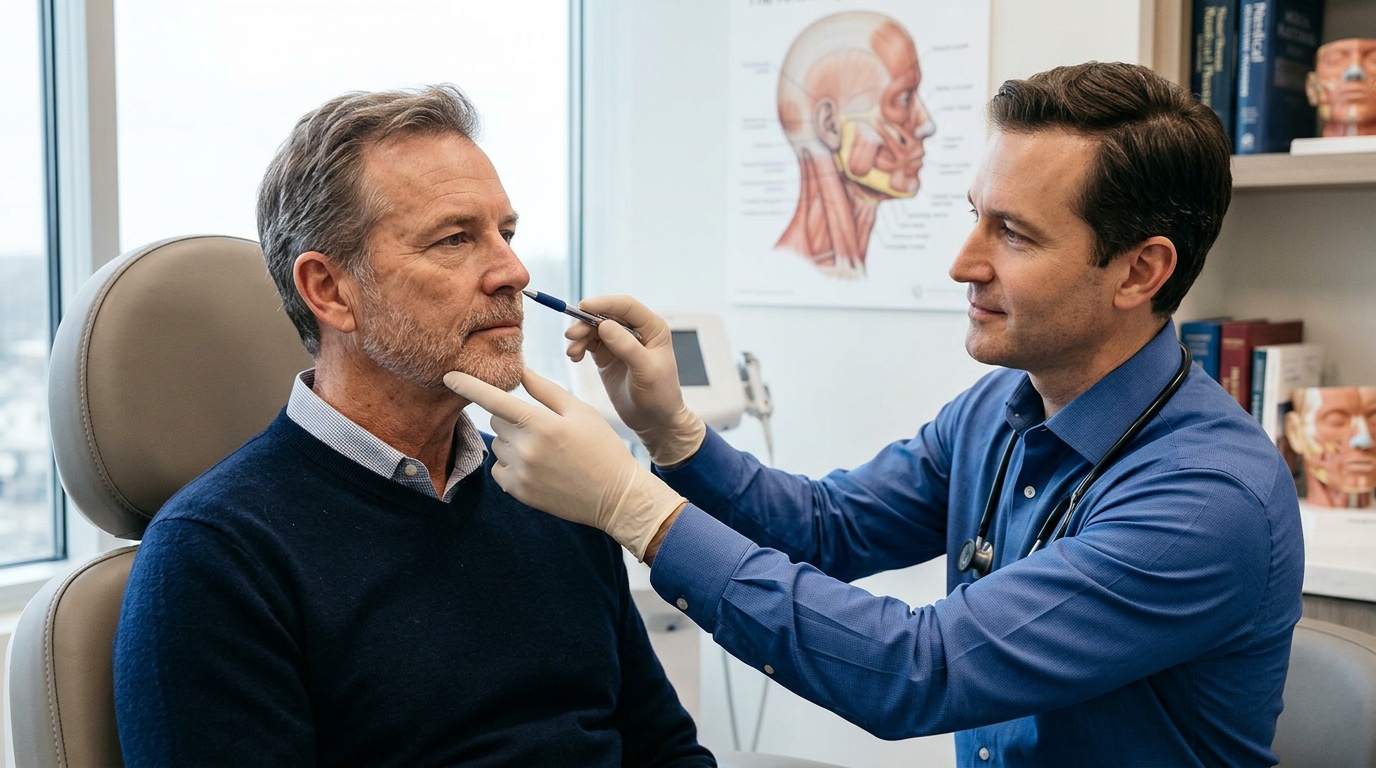
Dermal Differences: Skin Thickness and Fibrous Structure in Men
Facial aging involves the skin, subcutaneous fat, SMAS, retaining ligaments, facial muscles, and deeper fascial planes. Thicker male skin can conceal early laxity, while a heavier soft-tissue envelope may place greater downward load on the cheek and jawline. Beard follicles create a specific relationship between skin and ear. Treating only the outer skin may produce short-lived correction or visible tension, so a deep plane approach evaluates deeper support structures before skin removal.
The Role of Retaining Ligaments: Why Tension-Free Release Matters
Retaining ligaments connect facial soft tissue to deeper structures and help hold the cheek and lower face in position. With age, these attachments can contribute to folds and descent. Releasing selected ligaments allows the surgeon to mobilize the deeper facial layer instead of forcing skin to carry the full corrective load. This may reduce an over-pulled appearance and help maintain masculine contours. It does not remove risk: the facial nerve, blood vessels, parotid region, and subplatysmal tissues require careful management.
Deep Plane Versus SMAS Plication or Imbrication for Men
Both deep plane surgery and SMAS-based techniques can be used in facelift surgery. Their mechanics differ, and the choice depends on anatomy. Deep plane surgery works in a deeper plane and releases selected ligaments. SMAS plication or imbrication generally tightens or repositions the SMAS through suturing or tissue overlap. The comparison describes broad distinctions, not an individual result.
| Planning feature | Deep plane approach | SMAS plication or imbrication |
|---|---|---|
| Primary tissue action | Mobilizes deeper facial tissues after selected ligament release | Repositions or folds the SMAS with sutures or overlap |
| Skin tension | Correction may be distributed through deeper tissue support | Skin and SMAS tension depends on the specific design and fixation |
| Male-specific planning | Can address descent while preserving cheek and jawline proportions | Can be tailored to thicker skin and localized laxity |
| Technical considerations | Requires detailed knowledge of facial planes, ligaments, vessels, and nerve anatomy | Requires sound SMAS handling, fixation, skin management, and incision planning |
For a man evaluating a deep plane facelift in New York City, the meaningful question is whether the proposed tissue plane, ligament management, and skin closure match his anatomy and goals. Published clinical literature describes structural correction lasting 10 to 12 years or longer in suitable patients, though longevity varies with aging, tissue characteristics, health, and surgical technique. Candidacy, technique, recovery, risks, and outcomes require individualized clinical assessment.
Precise Incision Design and Scar Camouflage for Masculine Features
In a male deep plane facelift, incision planning is as important as tissue repositioning. Short hairstyles, receding hairlines, dense beard growth, and sideburns can make scars easier to see. Design must account for hair pattern, ear anatomy, skin thickness, and hairstyle. A scar cannot be not assured to disappear; healing, genetics, sun exposure, and aftercare affect its appearance. The plan should be reviewed in person rather than selected from photographs alone.
Navigating Sideburns and the Natural Hairline
Sideburn preservation is a central male facelift concern. An incision that shifts the sideburn upward, removes hair-bearing skin, or places traction on follicles can create an unnatural hairline break. The surgeon may map sideburn height, density, direction, and relationship to the ear. Receding temples require restraint because an incision placed too far into sparse hair can become more visible. Careful skin removal and tension-conscious closure help preserve the patient’s facial frame.
Tragal and Pre-Tragal Incision Strategies for Men
The incision near the tragus, the cartilage prominence at the front of the ear, must follow natural shadows and hair direction. A pre-tragal design may support a clean transition between facial skin and ear, while other patients may need a different relationship to the tragal edge. The choice depends on laxity, ear shape, facial hair, and tissue movement. Excessive tension can distort the ear or create a visible line, so incision placement and fixation must be planned together.
Managing Beard Growth and Retroauricular Scarring
Beard-bearing skin creates a technical challenge behind and around the ear. Displaced follicles or hair-bearing skin folded into the retroauricular crease can make shaving difficult. The surgeon must account for follicle direction, the hair-bearing boundary, and usual beard length. Behind the ear, the scar should follow a protected crease when anatomy permits, without gathering excess skin or placing closure under avoidable tension.
Dr. Mark Albert’s Protocol for Discreet Scarring
Dr. Mark Albert evaluates incision design as part of the full facial plan. His assessment considers sideburn position, temporal hair density, beard growth, tragal anatomy, earlobe shape, and the direction of skin redraping. The goal is a stable, proportionate result without a pulled hairline, distorted ear, or conspicuous scar. Patients should discuss prior scars, smoking or nicotine exposure, medications, and delayed wound healing before surgery.
Recovery, Risks, and Realistic Expectations for Male Deep Plane Facelifts
The Male Recovery Timeline: From Swelling to Social Re-entry
Recovery varies with surgical plane, correction, skin response, health, and healing. Early swelling, bruising, tightness, numbness, and limited facial movement are common. Bruising and swelling often remain noticeable for one to two weeks, while firmness, altered sensation, and scar maturation may continue for several months. Public-facing professionals may need more time before returning to work. Surgeon instructions should guide activity, wound care, sleeping position, and follow-up visits.
Reserve initial time for rest and monitoring, avoid important public appearances during visible bruising, and allow flexibility for uneven swelling. Improvement is gradual; one side may settle before the other, and early photographs do not represent the final result.
Understanding Elevated Hematoma Risk in Men and Prevention Strategies
Hematoma is a collection of blood beneath the skin that may require prompt assessment and treatment. Clinical studies cited in facial plastic surgery literature report a higher hematoma rate among male facelift patients, with published rates reaching approximately 7% to 8%, or two to three times the rate reported in female patients. Greater facial vascularity and higher baseline blood pressure are proposed factors. Blood-pressure management, medication review, limited early exertion, and close postoperative observation matter.
Contact the surgical team promptly for rapidly increasing swelling, marked one-sided pain, expanding bruising, drainage, fever, breathing difficulty, or other unexpected changes. Do not alter prescribed or routine medications without individualized medical guidance. Hematoma risk cannot be removed completely.
Facial Nerve Protection and Other Surgical Considerations
Deep facial dissection requires knowledge of facial nerve branches, blood vessels, the parotid region, SMAS, and deeper fascial planes. Temporary weakness, numbness, contour irregularity, infection, delayed healing, unfavorable scarring, hair loss near the incision, skin loss, asymmetry, and additional treatment are recognized risks. Permanent nerve weakness is uncommon but important. Planning must balance correction against risk, especially after prior facial surgery or with medical conditions and blood-pressure concerns.
Longevity of Deep Plane Results in Male Patients
Research literature describes structural correction from deep plane facelift surgery that may remain evident for 10 to 12 years or longer in suitable patients, although duration differs. Aging continues after surgery, and skin elasticity, weight changes, sun exposure, genetics, and health influence facial change. Longevity is not permanence, and no surgeon can guarantee a specific duration or appearance. A Mini Facelift may be discussed for limited laxity, but candidacy, technique, recovery, risks, and outcomes require individualized clinical assessment. The Mini Facelift is not a substitute for evaluating the location and degree of descent.
Is a Male Deep Plane Facelift Right for You? Consultation and Candidacy
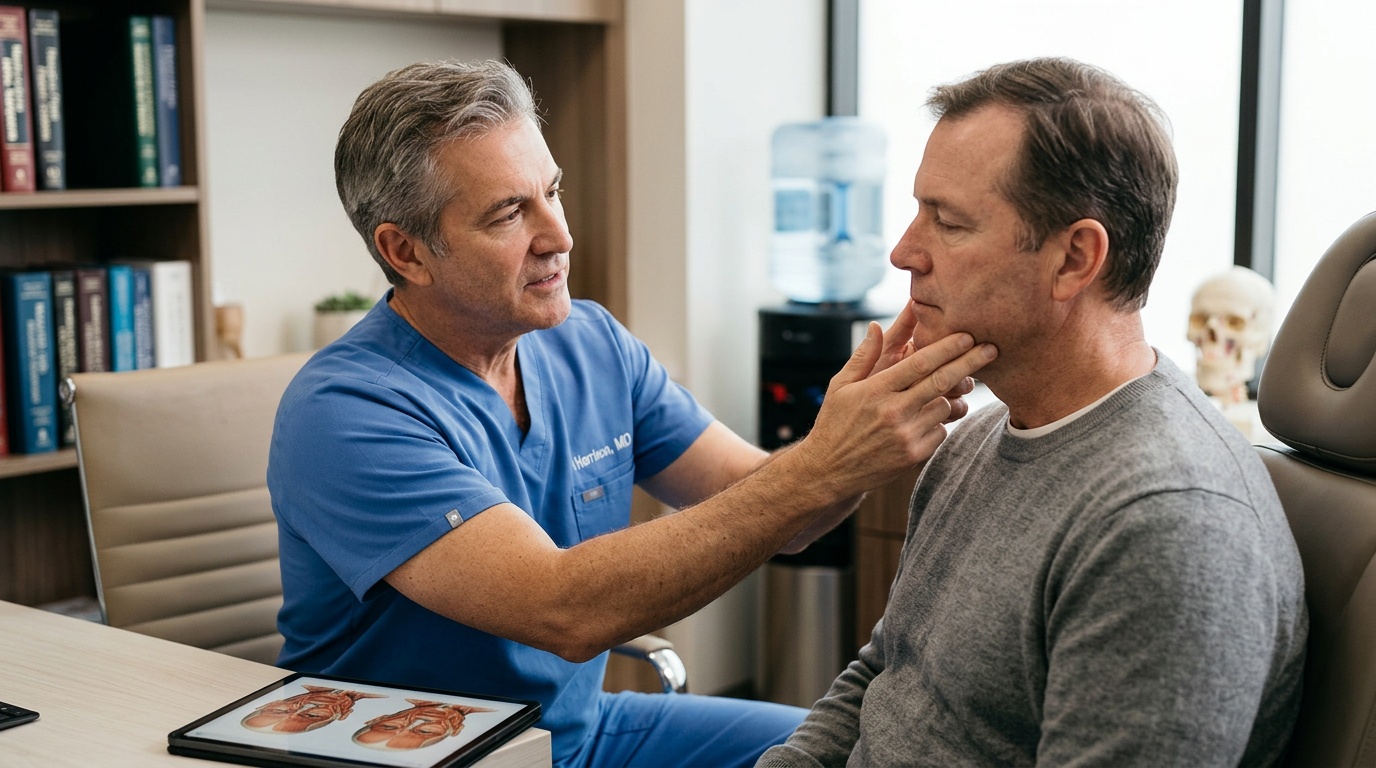
A male deep plane facelift may be considered by men with cheek descent, jowling, lower-face laxity, or jawline changes who want structural correction while preserving masculine proportions. Selection is not based on age alone. Skin quality, anatomy, medical history, blood pressure, prior surgery, hairline, beard pattern, and professional obligations influence planning. Candidacy, technique, anesthesia, recovery, risks, and outcomes require individualized assessment by a qualified surgeon.
Key Questions to Ask Your Surgeon
Ask which tissue plane the surgeon recommends and why it fits your aging pattern. Other useful questions concern ligament release, facial nerve protection, incision placement, sideburn preservation, beard-bearing skin, swelling, work restrictions, follow-up care, and complication management. Ask how the plan avoids an overly taut or feminized appearance, and request a discussion of limitations rather than only idealized photographs. Questions about board certification, facelift training, surgical facility arrangements, and emergency contact procedures are appropriate.
What to Expect During Your Consultation with Dr. Mark Albert
During a consultation with Dr. Mark Albert, discussion should begin with your concerns, priorities, and definition of a natural result. Examination may assess skin laxity, cheek position, jowls, neck contour, jawline, hairline, sideburns, ear anatomy, and beard growth. Medical history, medications, nicotine exposure, previous procedures, and healing factors should be reviewed. Dr. Albert can explain whether deeper repositioning, a limited facelift plan, or another option aligns with the anatomy observed. Photographs may support planning but cannot replace an in-person examination.
Beyond the Facelift: Facelift Options Within Scope
This educational discussion remains focused exclusively on facelift surgery. The featured Mini Facelift may suit selected patients with limited laxity, while a deeper operation may be considered when descent affects broader facial structures. The Mini Facelift should not be chosen because it sounds less extensive or promises an easier recovery. Suitability depends on laxity location and degree, tissue quality, facial proportions, and the desired correction. A surgeon should explain why a particular design is proposed.
Making an Informed Decision: Balancing Goals and Realities
The soundest decision balances desired improvement with scars, downtime, uncertainty, and surgical risks. Men with public-facing careers should plan around bruising, swelling, altered sensation, and gradual scar maturation rather than a fixed return date. Before scheduling, confirm that you understand the operative approach, anesthesia plan, recovery instructions, follow-up schedule, and warning signs requiring medical attention. A consultation is also an opportunity to decide that surgery is not appropriate at present. For the right patient, a carefully planned male deep plane facelift can be discussed as one path toward measured facial rejuvenation, never as a not assured outcome.
Frequently Asked Questions
Does a male deep plane facelift really last 10 years?
A male deep plane facelift may provide structural correction lasting 10 to 12 years or longer in suitable patients, though longevity varies. Aging, skin quality, facial volume, health, lifestyle, and surgical technique all affect how results change over time. An individualized consultation is needed to discuss expected durability and alternatives.
What is the ideal age range for a male facelift?
A male facelift has no single ideal age range because candidacy depends more on facial laxity, tissue descent, skin quality, and overall health than on age alone. Some men may benefit when sagging affects the cheek, jowl, or neck. A qualified surgeon must assess anatomy, goals, and medical factors in consultation.
Can I see before-and-after pictures of a male deep plane facelift?
Male deep plane facelift before-and-after photographs can show how facial descent, jowls, and neck laxity may change, but they cannot predict an individual result. Photos should be reviewed with attention to comparable anatomy, beard patterns, skin quality, and healing. Results vary, and image selection should be discussed during an in-person consultation.
Where is the best country to get a deep plane facelift?
The best place for a deep plane facelift is determined by surgeon training, relevant experience, facility standards, follow-up access, and the quality of individualized planning, not by country alone. Men should review the surgeon’s credentials, approach to masculine facial proportions, incision planning, risks, and aftercare before choosing a location.
What is the downside of a male deep plane facelift?
A male deep plane facelift carries risks including bleeding, infection, facial nerve injury, changes in sensation, scarring, asymmetry, hairline or sideburn changes, and an unsatisfactory cosmetic result. Recovery and outcomes vary, and deeper dissection requires careful management of facial planes, vessels, nerves, and nearby structures. Consultation is necessary to weigh benefits and alternatives.
How is a male deep plane facelift different from a mini facelift?
A male deep plane facelift addresses deeper facial tissue descent through selected ligament release, while a Mini Facelift may suit more limited laxity. The appropriate option depends on where sagging is located, its degree, skin quality, facial anatomy, and the desired correction. A consultation with Dr. Mark Albert can help compare techniques and risks.