
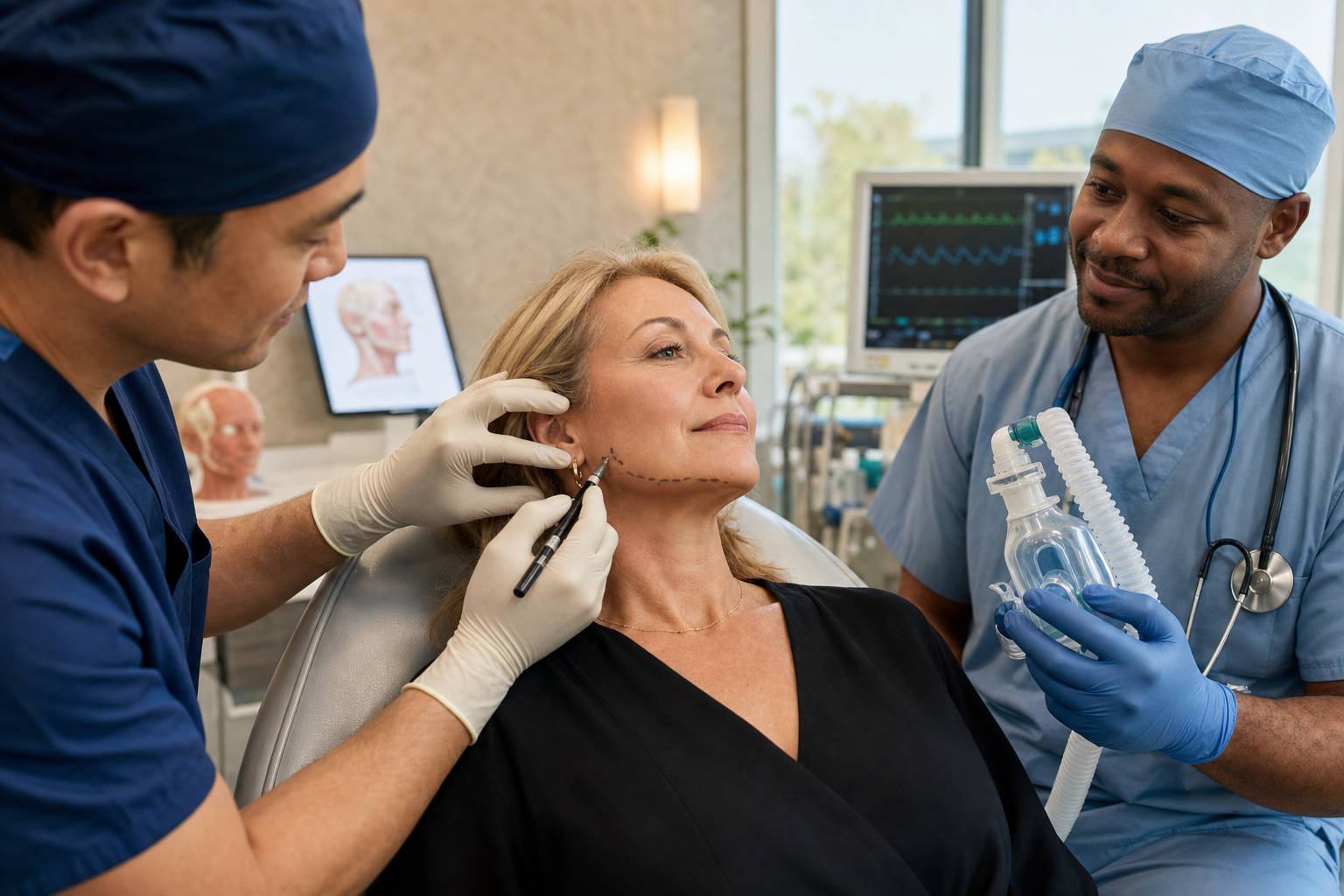
mini facelift anesthesia
Choosing anesthesia for a mini facelift anesthesia plan involves more than deciding whether you will be awake. The approach can affect comfort, communication during facial surgery, recovery-room time, and return to alertness. Local anesthesia, oral or intravenous sedation, and general anesthesia create different experiences.
Key Takeaways
- Local anesthesia numbs only the surgical area while you remain fully awake, which often means less time in the recovery room afterward.
- Twilight sedation combines local numbing with medication that can reduce anxiety and awareness; the depth of sedation and memory effects vary by patient and medication plan.
- General anesthesia keeps you completely unconscious and is usually reserved for patients who prefer to be unaware or for longer surgical sessions.
- The best option depends on your medical history, the expected length of surgery, your comfort level, and your surgeon's assessment during consultation.
- Sharing your complete medication list and health background before surgery helps the care team design the safest anesthesia plan for you.
The choice depends on the facelift technique, tissue adjustment, medical history, anxiety level, and the judgment of your surgeon and anesthesia professional. A qualified clinician must evaluate you because no method suits every patient.
Understanding Mini Facelift Anesthesia: Your Options for Comfort and Safety
The Primary Goal: A Comfortable and Precise Procedure
A mini facelift targets early jowling, mild lower-face laxity, or reduced jawline definition. The plan may use short-scar access and focused repositioning of facial tissues. Anesthesia should control pain while allowing careful work around skin, connective tissue, nerves, and blood vessels.
Being awake does not mean feeling sharp pain or watching the operation. Local anesthetic numbs the treatment area. Additional medication may make you relaxed or drowsy while monitoring continues. Some patients prefer to remain responsive; others prefer deeper sedation. Neither preference alone determines candidacy.
Anesthesia's Role in Mini Facelift Surgery
Local anesthetic interrupts pain signals. A surgeon may use tumescent infiltration, a diluted solution placed into tissue before incision. It can contain lidocaine for numbing and epinephrine to constrict small blood vessels. The dose and concentration must reflect weight, health, medications, and total dose. Tumescent fluid does not cause unconsciousness.
Oral or intravenous sedation can reduce awareness and anxiety without the complete unconsciousness of general anesthesia. General anesthesia produces controlled unconsciousness and requires airway and physiologic monitoring by a qualified anesthesia professional. Each option has benefits, limitations, medication effects, and recovery considerations. The safest plan matches the operation and individual patient.
Dr. Mark Albert's Approach to Anesthesia Selection
Dr. Mark Albert, a plastic surgeon certified by the American Board of Plastic Surgery and a Fellow of the American College of Surgeons, evaluates anesthesia as part of the full facelift plan. Assessment includes laxity, expected surgical duration, prior anesthesia reactions, medications, sleep and breathing history, cardiovascular health, and comfort with remaining responsive.
For a suitable patient undergoing the Mini Facelift, local anesthetic with selected sedation may be considered. This is not appropriate for every patient or operation. Dr. Albert explains the sensory experience, monitoring, limitations, and recovery implications so the decision is medically informed rather than driven by fear or the appeal of being “awake.”
The Anesthesia Spectrum: Local, Twilight Sedation, and General Anesthesia Explained
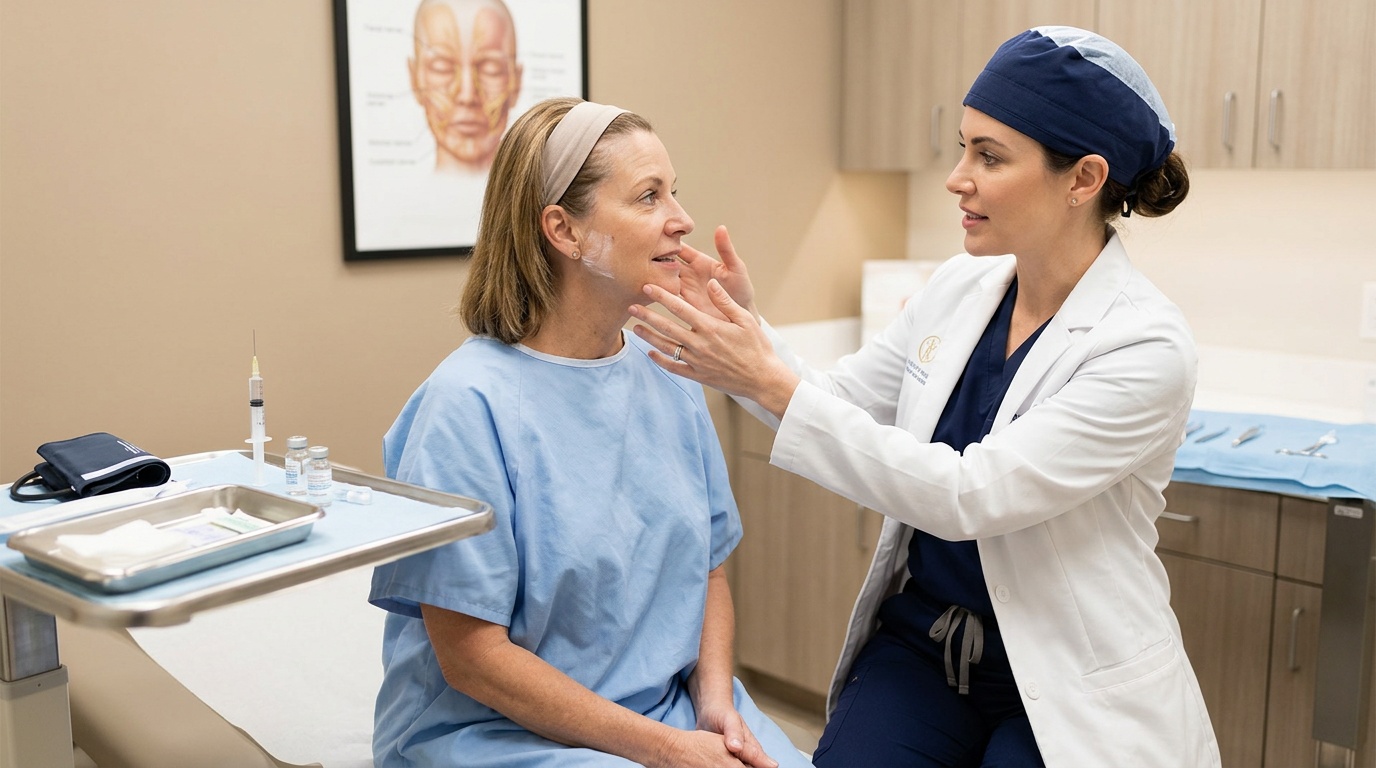
Local Anesthesia: The Foundation for Minimally Invasive Procedures
Local anesthesia is injected around the planned incision and nearby tissue. You may remain conscious and answer questions, although relaxation medication can alter memory. Pressure, pulling, or movement may remain noticeable even when sharp pain is blocked. Reporting sensations early allows the team to assess whether additional numbing is appropriate.
For selected short-scar procedures, local anesthesia can avoid some effects associated with unconsciousness, including an endotracheal airway and longer recovery from general anesthetic medication. It still requires monitoring, sterile technique, emergency readiness, and a plan for discomfort or anxiety.
Understanding Tumescent Infiltration for Pain Control
Tumescent infiltration places dilute local anesthetic into the surgical field. Lidocaine numbs tissue, while epinephrine can reduce small-vessel bleeding through temporary vasoconstriction. The solution needs time to work before incision. It does not eliminate swelling, bruising, pressure, or postoperative tenderness.
Lidocaine has dose limits, and epinephrine may require additional consideration with certain conditions or medications. The surgeon must count the total amount from every source, which is why anesthesia planning belongs in the preoperative assessment.
Twilight Sedation, Including IV Sedation
Twilight sedation describes a continuum of reduced awareness rather than one exact depth. Intravenous medication can produce relaxation, drowsiness, and partial memory loss while allowing spontaneous breathing in many cases. The level can be adjusted, and the patient may respond to voice or gentle stimulation when appropriate.
Patients may choose this type of mini facelift anesthesia when local numbing alone does not provide enough comfort. Sedation supplements local anesthesia rather than replacing it. Monitoring remains necessary because sedatives can affect breathing, blood pressure, heart rate, and alertness.
Oral Sedation vs. IV Sedation: Nuances in Patient Experience
Oral sedation may reduce anticipatory anxiety, but its onset and depth can be less predictable than intravenous medication. Once taken, it cannot be rapidly withdrawn. Transportation, fasting, medication, and post-discharge supervision instructions must be followed.
IV sedation begins quickly and lets the anesthesia professional adjust medication during surgery. It may provide closer control of drowsiness, while still carrying possible respiratory, cardiovascular, and nausea-related effects. The setting needs appropriate monitoring, trained personnel, equipment, and recovery protocols.
General Anesthesia: When It Is Considered
General anesthesia produces unconsciousness and usually involves airway support, continuous physiologic monitoring, and a dedicated anesthesia professional. It may be considered for a more extensive or longer operation, insufficient local techniques, or patient-specific reasons. A mini facelift does not automatically require it, and a smaller operation does not automatically make it unsuitable.
Possible effects include grogginess, sore throat, nausea, vomiting, medication reactions, and longer discharge supervision. Research summarized by the Duly Health and Care article on mini facelifts reports postoperative nausea and vomiting rates below 2 to 5 percent with local or twilight sedation compared with 20 to 30 percent under general inhalational anesthesia. Individual risk varies, so these figures are not a personal prediction.
Comparing the Sensory and Comfort Experience
“Awake lift,” “twilight sleep,” and “local anesthesia” may be used loosely. Ask which medications will be administered, who will monitor you, whether you will breathe independently, and which sensations to expect. The comparison below is general, not a personal recommendation.
| Approach | Awareness and sensation | Typical planning considerations | Recovery considerations |
|---|---|---|---|
| Local anesthesia | Awake or conversational; sharp pain should be blocked, while pressure may remain noticeable. | Suitable anatomy, adequate numbing time, dose calculation, and anxiety management. | Often less grogginess from systemic medication; observation is still required. |
| Local anesthesia with oral or IV sedation | Relaxed or drowsy; awareness and memory vary with medication depth. | Medication monitoring, fasting instructions, transportation, and respiratory assessment. | Alertness may take time to return; postoperative supervision is necessary. |
| General anesthesia | Unconscious during surgery; no awareness of the operative period. | Airway planning, anesthesia evaluation, continuous monitoring, and recovery capability. | More systemic medication effects may occur, including nausea, throat discomfort, or prolonged drowsiness. |
Discuss surgical extent, local numbing, sedation depth, airway planning, monitoring, discharge criteria, and the first hours afterward with the surgeon and anesthesia professional. Research cited by the Beverly Hills Center article on an awake and designed to minimize discomfort facelift reports that local anesthesia can reduce recovery-room time by more than 50 percent compared with general anesthesia, though individual recovery depends on the complete plan.
Anesthesia's Impact on Surgical Precision, Safety, and Patient Experience
How Anesthesia Choice Influences Surgical Control: The Surgeon's Perspective
Anesthesia affects more than comfort during a mini facelift anesthesia plan. A relaxed patient who remains still and communicates may help the surgeon assess tissue response, symmetry, and each adjustment. Local numbing with selected sedation can preserve communication, while general anesthesia creates unconsciousness and requires a different airway and physiologic management approach. Neither automatically produces a more natural result; precision depends on technique, anatomic judgment, and patient selection.
Anatomical Visualization and Tissue Handling Under Different Anesthesia
Facelift surgery involves skin, connective tissue, retaining ligaments, nerves, and blood vessels. The plan should permit exposure and controlled handling without unnecessary movement or discomfort. With local anesthesia or sedation, the surgeon may receive feedback during lower-face and jowl repositioning. With general anesthesia, the patient cannot respond, so the team relies on monitoring and direct anatomic assessment. A Mini Facelift must reflect individual facial structure rather than standardized tightening.
Minimizing Bleeding and Swelling: The Role of Tumescent Fluid
Tumescent infiltration can support comfort and operative visibility. Diluted lidocaine reduces sensation, while epinephrine temporarily constricts small vessels. This may limit oozing during incision and dissection but does not eliminate bleeding, bruising, or swelling. Dosing must account for weight, conditions, medications, timing, and total local anesthetic. Sufficient time must be allowed before surgery begins.
Intraoperative Comfort and Anxiety Management Strategies
Pressure, pulling, vibration, and movement may remain noticeable when sharp pain is blocked. Explanations, quiet communication, warming measures, and appropriate oral or IV sedation can help. Discuss severe anxiety before surgery. Sedation can reduce awareness but may affect breathing, blood pressure, memory, and alertness, so the team must balance comfort with monitoring.
The Safety Setting: Accredited Surgical Facilities and Monitoring
Anesthesia safety depends on the setting and medication. An accredited office-based facility should have trained personnel, emergency equipment, medication safeguards, sterile protocols, physiologic monitoring, and transfer procedures. Ask whether it follows standards associated with AAAASF, QUAD A, or AAAHC. Dr. Mark Albert is certified by the American Board of Plastic Surgery and a Fellow of the American College of Surgeons. These credentials do not remove risk but provide context when assessing training and facility planning.
Post-Anesthesia Recovery: Immediate Sensations and Discharge Readiness
The team assesses alertness, breathing, blood pressure, pain, nausea, bleeding, and ability to follow instructions. Local anesthesia may leave the face numb or heavy. Sedation can cause sleepiness and impaired judgment; general anesthesia may cause grogginess, nausea, throat discomfort, or longer observation. Discharge requires appropriate alertness, transportation, supervision, and written instructions for medication, wound care, warning signs, and follow-up.
Potential Benefits and Limitations of Each Approach
Pros
- Local anesthesia may preserve communication and reduce systemic medication exposure.
- Sedation can relieve anxiety while supplementing targeted numbing.
- General anesthesia provides unconsciousness when the surgical plan or patient factors support it.
Cons
- Local anesthesia does not remove pressure, pulling, swelling, or postoperative tenderness.
- Sedation may affect breathing, memory, coordination, and discharge timing.
- General anesthesia involves airway management and possible nausea, sore throat, or prolonged drowsiness.
Choosing Your Mini Facelift Anesthesia: Candidacy, Considerations, and Preparation
Assessing Candidacy: Medical History, Anxiety Levels, and Personal Preferences
Choosing mini facelift anesthesia begins with medical assessment, not a preference for being awake or asleep. Considerations include incision pattern, lower-face laxity, operating time, health, medications, allergies, prior reactions, sleep and breathing history, and cardiovascular status. Anxiety also matters. A patient suitable for local anesthesia may still need selected sedation. Candidacy and recovery require individualized evaluation.
Dr. Mark Albert's Consultation Process for Anesthesia Planning
Dr. Mark Albert discusses anesthesia during the complete facelift consultation, including goals, anatomy, tissue adjustment, sensory experience, medications, monitoring, facility standards, and discharge. He is certified by the American Board of Plastic Surgery and a Fellow of the American College of Surgeons. The plan remains specific to the patient and operation.
What to Expect During Pre-Anesthesia Preparation
The team reviews health history and instructions for food, drink, prescriptions, supplements, and transportation. Report prior nausea, difficult airway management, medication sensitivity, tobacco or alcohol use, and health changes. Ask how local anesthetic, epinephrine, oral medication, IV sedation, or general anesthesia will be used. Do not change medications or fasting plans without instructions.
Preparing for Your Procedure: Anesthesia Safety Checklist
- Provide a complete list of prescriptions, over-the-counter medications, vitamins, and supplements.
- Report allergies, previous anesthesia problems, sleep-related breathing concerns, and significant medical conditions.
- Confirm the planned anesthesia level, who will administer and monitor it, and where recovery will occur.
- Follow individualized fasting and medication instructions exactly.
- Arrange a responsible adult for transportation and postoperative supervision.
- Ask when driving, work, exercise, and other routine activities may resume.
Navigating Expectations: Pain Perception, Nausea, and Recovery Timelines
Local numbing blocks sharp incision-related pain, though pressure, pulling, or touch may remain. Sedation can reduce anxiety and awareness but does not replace local anesthetic. Nausea, grogginess, numbness, swelling, bruising, and alertness vary. Research summarized by the Duly Health and Care article reports postoperative nausea and vomiting below 2 to 5 percent with local or twilight sedation compared with 20 to 30 percent under general inhalational anesthesia. These are population-level findings.
Questions to Ask Your Surgeon About Anesthesia Options
Ask which approach fits the planned Mini Facelift, whether you will respond, which sensations may occur, who will monitor you, how local dosing is calculated, and what happens if anxiety or discomfort increases. Ask about facility accreditation, emergency readiness, observation, transportation, warning signs, and follow-up. Terminology such as “awake lift” and “twilight sleep” may describe different medication plans.
Dr. Mark Albert on Mini Facelift Anesthesia: Expert Insights and Next Steps

Summarizing Key Anesthesia Choices for Mini Facelifts
Local anesthesia, with or without oral or intravenous sedation, may suit selected Mini Facelift patients. General anesthesia may be considered when the operation, medical history, or patient experience calls for unconsciousness and airway support. No option is universally preferable. The plan must support comfort, tissue handling, monitoring, and recovery.
The Value of an Individualized Anesthesia Plan
A thoughtful mini facelift anesthesia plan accounts for anatomy, duration, medications, reactions, anxiety, and facility standards. It should set expectations for swelling, alertness, nausea, discomfort, and supervision. Less sedation does not guarantee a better aesthetic result, and general anesthesia does not prove that surgery is more extensive.
When to Schedule Your Consultation with Dr. Albert
Schedule a consultation when you can discuss goals, health history, awareness or pain concerns, and recovery needs. Dr. Albert can assess whether a Mini Facelift is appropriate and explain the anesthetic approach for your plan. An in-person assessment is required before candidacy, medication selection, anesthesia depth, and recovery instructions are determined.
Frequently Asked Questions
How painful is a mini facelift with anesthesia?
Mini facelift anesthesia is intended to control sharp surgical pain, although patients may still notice pressure, pulling, or movement. Local anesthetic, sometimes combined with oral or IV sedation, can affect comfort and alertness. Postoperative tenderness, swelling, bruising, and tightness are possible, and pain experiences vary by procedure and individual.
How risky is mini facelift anesthesia?
Mini facelift anesthesia carries risks that vary with the anesthetic method, medical history, medications, and procedure length. Local anesthesia, sedation, and general anesthesia can each affect breathing, blood pressure, heart rate, alertness, or nausea. A qualified surgeon and anesthesia professional should review your health and discuss monitoring, alternatives, and recovery.
What is the most painful day after a mini facelift?
Mini facelift discomfort often feels most noticeable during the first few days, but there is no single most painful day for every patient. Swelling, bruising, tightness, and tenderness can change during recovery. Your surgeon should provide individualized instructions for comfort, activity, medication use, and warning signs that need medical attention.
Is it possible to get a mini facelift without anesthesia?
A mini facelift cannot be performed comfortably without some form of pain control or anesthesia. Local anesthetic is commonly used to numb the treatment area, with oral or IV sedation considered for selected patients. The appropriate plan depends on the technique, expected duration, anxiety level, and medical evaluation.
How long does it take to look normal after a mini facelift?
Mini facelift recovery time varies, and swelling, bruising, tightness, and incision changes may remain while tissues heal. Some people look more presentable within several days to weeks, while final refinement can take longer. Your surgeon can provide a more specific timeline after assessing the technique, healing pattern, and individual health factors.
Can I be awake during a mini facelift?
Mini facelift patients may remain responsive with local anesthesia and selected sedation, depending on the operation and medical assessment. Being awake does not mean feeling sharp pain, though pressure or pulling may be noticeable. Sedation depth can affect memory and alertness, and continuous monitoring remains necessary throughout the procedure.

