
mini facelift bruising
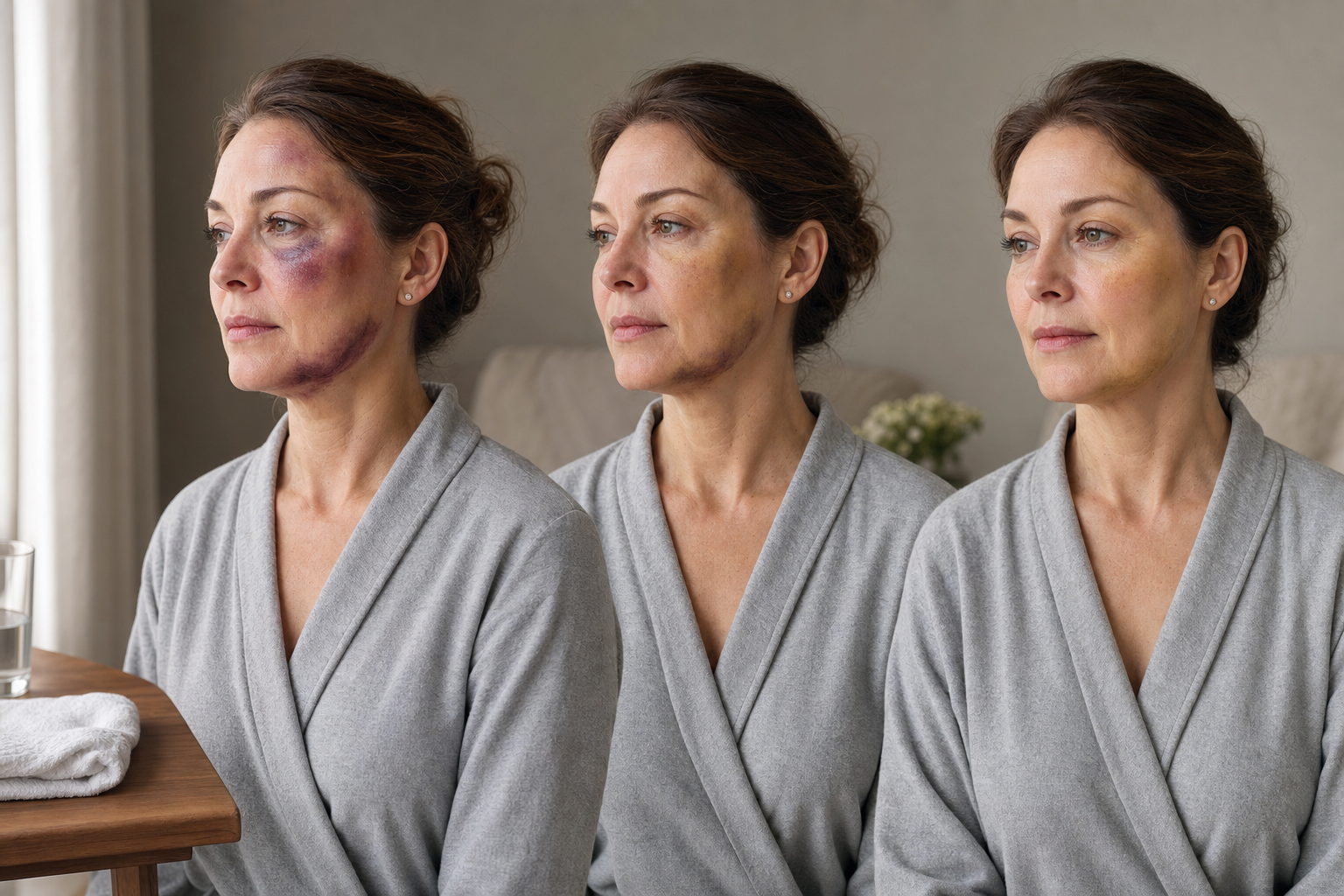
Mini facelift bruising commonly peaks during the first 48 to 72 hours. Discoloration may appear red, purple, blue, green, or yellow as blood products break down. By Day 5, bruising can remain pronounced while healing progresses normally. Most visible color fades substantially within 10 to 14 days, though mild swelling, tightness, and uneven color may last longer.
Key Takeaways
- Bruising after a mini facelift follows a predictable color sequence, shifting from deep red and purple tones to green and yellow shades as the body gradually reabsorbs trapped blood beneath the skin.
- Keeping your head elevated while sleeping and applying cold compresses during the first few days can limit fluid buildup and reduce the spread of discoloration.
- A bruise that appears more prominent around Day 5 usually reflects normal healing rather than a complication, since blood products often migrate downward before they begin to fade.
- Avoiding blood-thinning supplements, alcohol, and strenuous activity during early recovery gives damaged vessels the best chance to seal and heal without additional bleeding.
- Contact your surgeon if bruising intensifies after the first week, becomes increasingly painful, or appears significantly worse on one side, as these signs warrant professional evaluation.
Online photographs may reflect selected lighting, makeup, filters, or an unusually easy recovery and should not determine your schedule. The Mini Facelift is planned around anatomy, skin quality, tissue movement, and surgical approach. Ask your operating surgeon or qualified clinician about your appearance.
The Day-by-Day Bruising Timeline: What Your Skin Shows from Day 1 to Day 14
Bruising is blood beneath the skin, also called ecchymosis. Its color changes as hemoglobin is metabolized and cleared. Skin tone, blood pressure, tissue handling, medications, and dissection affect the pattern, so recovery is not identical for every patient.
Days 1-3: Peak Discoloration and Deep Purple-Black Ecchymosis
On Day 1, skin near the incision may look pink, red, or dusky. Swelling can make the lower face feel firm or tight, while a dressing may limit visibility. By Days 2 and 3, darker purple, maroon, or blue-black areas may appear near the ears, jawline, cheeks, and upper neck. This is often the visual peak as fluid and blood products settle into nearby tissue.
Dark color alone does not establish a complication. Bruising may differ from side to side and look more pronounced after sleep or prolonged sitting. Promptly notify the surgical team about sudden changes, marked one-sided swelling, or increasing discomfort.
Days 4-7: Transition to Blue-Green and the Day 5 Milestone
Day 5 is often misunderstood because the face may not yet look socially presentable. Purple or blue areas can remain while nearby skin becomes green, olive, or blue-green. Borders may move downward as residual blood products follow tissue planes. Swelling often softens but can still affect the cheeks, jawline, and neck.
Searches for mini facelift pictures after 5 days or 1 week mini facelift recovery pictures day by day cannot produce one normal image. One patient may look relatively clear at Day 5, while another may show substantial color with an uncomplicated recovery. Serial examination and the surgeon’s instructions are more useful than social media comparisons.
| Recovery period | Common visible changes | What the patient may feel |
|---|---|---|
| Days 1-3 | Redness, purple or blue-black ecchymosis, early swelling | Tightness, tenderness, pressure, reduced facial movement |
| Days 4-7 | Dark areas remain; edges may become blue-green and descend toward the neck | Firmness, pulling near the incision, gradual reduction in pressure |
| Days 8-10 | Green tones begin fading; yellow or tan areas become more apparent | Less tenderness, with residual fullness or sensitivity |
| Days 11-14 | Yellow-brown staining and faint residual discoloration gradually clear | Improved comfort, though the contour may not yet be final |
Days 8-14: Yellow Fading and Clearance Begins
From Days 8 through 14, purple and blue shades commonly become green, yellow, tan, or light brown. This shift reflects clearance rather than permanent staining. Resolution may occur in patches around the incision, jawline, and neck. Mild swelling can make the face appear less defined even as color improves.
Many patients improve meaningfully by the end of Week 2, but visible bruising often resolves before deeper swelling. A gradual change from dark to light color is more useful than comparison with another person’s facelift pictures after 10 days. Dr. Mark Albert can assess whether your findings fit the expected course during follow-up care.
The Gravity Descent Phenomenon: Why Your Neck Is Bruised After Ear-Level Incisions
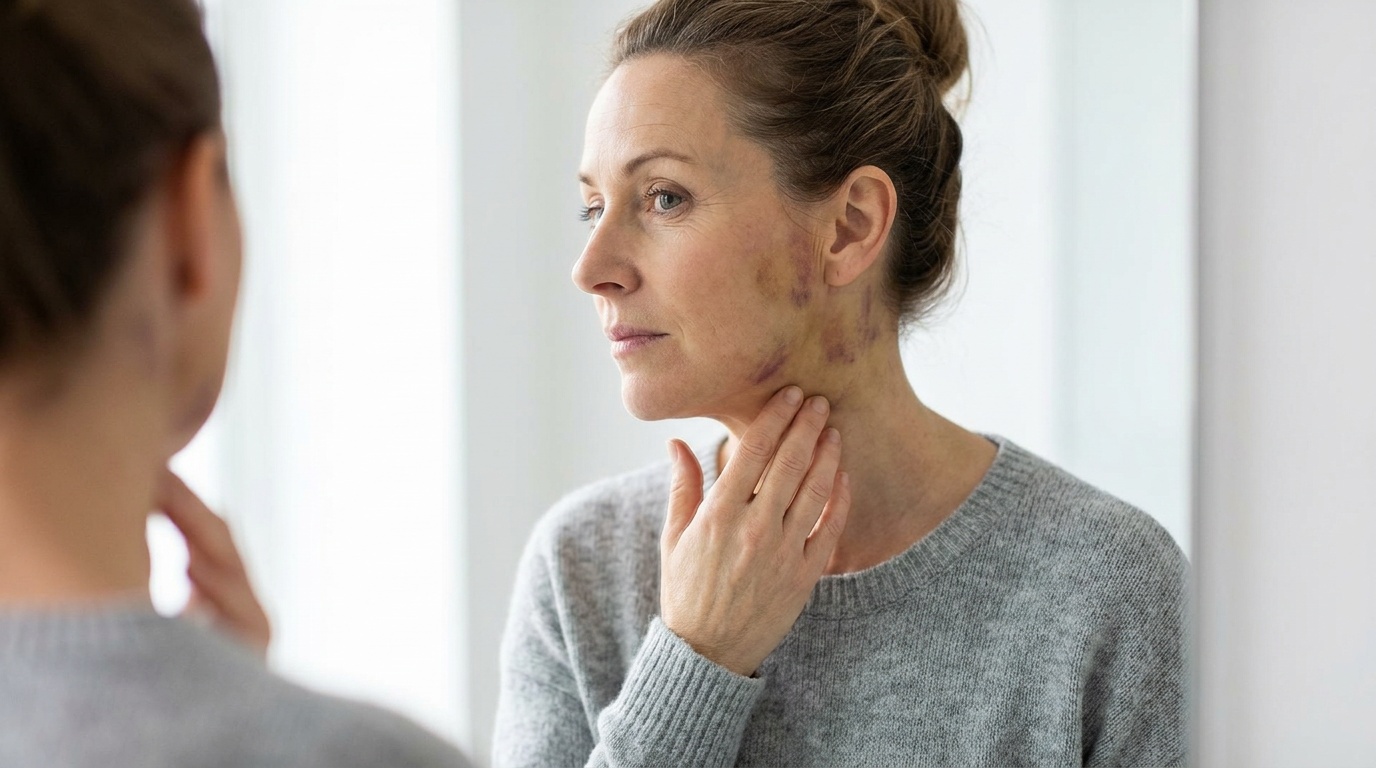
Neck discoloration can occur even when incisions are around the ears. Lower-face surgery involves tissue layers connecting the cheek, jawline, and upper neck. Small vessels in subcutaneous tissue and the SMAS, or superficial musculoaponeurotic system, may release limited blood during elevation and repositioning. Over several days, that blood can move through soft tissue in the direction of gravity.
How Lower Face Dissection Creates Bruising That Drops Into the Neck and Collarbone
When upright, fluid may move from the cheek or jawline toward the chin, neck, and occasionally the collarbone. Blue, green, or yellow color may appear there later than near the ear. The location alone does not mean the neck was directly operated upon. Tissue movement, spaces between tissue layers, and vascular anatomy affect the pattern.
Key insight: Bruising that gradually descends, changes color, and lightens is often part of healing. Rapid enlargement, marked one-sided swelling, severe or increasing pain, or sudden skin tension requires immediate contact with the surgical team.
Why Mini Facelift Bruising Migrates Differently Than Full Facelift Bruising
A Mini Facelift generally treats a smaller area than a full facelift, but bruising depends on the tissues addressed, not incision length alone. Some patients have little neck discoloration; others develop noticeable color beneath the jaw. Skin elevation, SMAS work, tissue laxity, vessel fragility, and postoperative position affect migration. Neck lift lower facelift recovery pictures day by day cannot predict your course. Individual assessment, follow-up, and communication with Dr. Albert are more reliable.
Normal Bruising vs. Expanding Hematoma: A Survival Guide for Post-Op Day 1 to Day 14
Normal mini facelift bruising usually changes gradually, peaks around 48 to 72 hours, and fades through several colors. A hematoma is blood that continues accumulating, often during the first 24 to 48 hours. Color alone cannot distinguish them; swelling, pain, firmness, temperature, and change over time provide more information. Only the surgical team can determine the cause through examination.
Key Visual and Sensation Differences: Color, Size, Temperature, and Pain
Ordinary ecchymosis may be purple, blue, green, yellow, or brown and may extend slowly toward the jawline or neck. Tenderness, tightness, and mild firmness are possible, with discomfort that remains stable or improves. Swelling is usually diffuse rather than a rapidly enlarging pocket.
| Finding | More consistent with expected bruising | More concerning for an expanding hematoma |
|---|---|---|
| Change in size | Color spreads slowly or lightens over several days | One side becomes noticeably larger over minutes or hours |
| Texture | Soft, mildly firm, or diffusely swollen tissue | Increasing pressure or a tense, localized collection |
| Pain | Tenderness that is stable or gradually decreasing | New, escalating, or disproportionate pain, especially on one side |
| Skin appearance | Expected red, purple, blue, green, or yellow color changes | Marked skin tension, worsening asymmetry, or rapidly changing discoloration |
| Temperature and general symptoms | Skin temperature is generally similar to nearby tissue | Increasing warmth, drainage, dizziness, weakness, or breathing difficulty requires urgent assessment |
Facelift pictures after 10 days cannot assess pressure beneath the skin. A normal-looking image may still require review if symptoms worsen, while dark discoloration may be uncomplicated when tissue is soft and steadily improving. Dr. Mark Albert and the surgical team interpret findings alongside technique, blood pressure, medications, and examination.
When to Contact Your Surgeon Immediately: Red Flags for Hematoma
Contact the operating surgeon immediately if swelling expands quickly, one side becomes substantially tighter, pain intensifies, or new marked asymmetry develops. Do not wait for a scheduled appointment. The team may examine the incision, evaluate circulation, and decide whether treatment is needed. The reported hematoma rate after facial rejuvenation is approximately 1% to 3%, with most events developing within the first 24 to 48 hours.
Bruising that lightens from purple to yellow with improving comfort differs from a collection that enlarges and creates pressure. Do not diagnose a hematoma independently. Instructions from the operating surgeon take priority because surgical plane, SMAS treatment, incision design, and medical history affect monitoring.
Week 4 and Beyond: Why Puffiness and Firmness May Still Linger
At four weeks, bruising may be reduced while puffiness, tightness, or firm areas remain along the jawline and near the ears. Deeper edema can persist after visible color clears. Healing also includes collagen remodeling around elevated or repositioned tissue, which can make the contour feel uneven or less soft. “4 weeks after facelift still swollen” does not by itself mean healing has failed.
Residual Edema and Fibrotic Nodules: Normal Healing or Worrisome?
Residual micro-swelling may persist for three to six months before softness and refined contours mature. Small firm areas may be localized edema, healing tissue, or fibrotic nodules. They should soften or become less noticeable rather than enlarge quickly. New redness, warmth, drainage, fever, worsening pain, or a growing one-sided lump warrants prompt review. Examination can distinguish remodeling from infection, fluid accumulation, hematoma, or another issue.
Realistic Resolution Windows: When to Expect Final Contour and Color
Most visible discoloration resolves substantially within 10 to 14 days, while swelling follows a slower, less uniform schedule. Some patients look socially comfortable earlier than others. Final contour should not be judged from one photograph under different lighting or camera angles. A Mini Facelift’s recovery depends on skin quality, tissue movement, surgical depth, vascular response, and healing. Follow-up assessment is the appropriate way to evaluate progress.
Key insight: At Week 4, gradual improvement matters more than complete symmetry or softness. Stable or declining swelling may fit normal recovery, while rapid enlargement, increasing pain, warmth, drainage, or systemic illness should prompt medical advice.
Surgeon-Approved Aftercare: How to Minimize Bruising and Speed Recovery

After a Mini Facelift, aftercare supports hemostasis, limits unnecessary fluid accumulation, and protects healing skin. Bruising and swelling often peak during the first 48 to 72 hours. Follow the surgical plan, avoid activities that raise blood pressure, and report changes promptly. Dr. Mark Albert’s instructions reflect medical history, medications, blood pressure, incision design, tissue movement, and facial dissection.
Pre-Op Prep: Supplements and Medications to Stop, and When
Give the surgeon a complete list of medications and supplements, including nonprescription pain relievers, vitamins, herbal products, nicotine products, and medications from other clinicians. Some affect platelet function, clotting, blood pressure, or anesthesia. Never stop a prescribed medication independently; the operating surgeon and prescribing clinician should decide whether adjustment is needed. Discuss bleeding disorders, uncontrolled blood pressure, allergies, and prior anesthesia problems.
- Give the surgical team an updated list of every medication, supplement, and herbal product.
- Follow written instructions about which products to pause and when to restart them.
- Do not begin aspirin, anti-inflammatory medication, vitamins, or herbal remedies for bruising without approval.
- Tell the team about easy bruising, abnormal bleeding, allergies, and prior surgical complications.
Post-Op Essentials: Head Elevation, Cold Compresses, and Heart Rate Management
Rest with the head elevated as directed, including during sleep if instructed. Elevation may limit dependent fluid in the cheeks, jawline, and neck. Use a cold compress only as instructed, with a barrier between the cold source and skin; avoid pressure on incisions or numb areas. Limit walking to the approved level and postpone strenuous exercise, heavy lifting, bending, and flushing activities until cleared.
Exertion, anxiety, heat, and straining can raise heart rate and blood pressure. Take prescribed medication as directed, avoid smoking and alcohol unless instructed otherwise, and maintain suitable hydration. These measures cannot eliminate bruising but may reduce avoidable stress during healing.
Returning to Public Life: Makeup Coverage, Social Timing, and Sun Protection
Return to work, social events, and makeup use according to incision healing and surgical clearance. Concealer or foundation may cover residual color once skin is closed, dry, and approved for cosmetics. Never apply makeup over open areas, drainage, crusting, or irritation. Plan important events with extra time because yellow discoloration, swelling, tightness, or asymmetry may remain after darker bruising fades.
Protect healing skin from direct sun with physical coverage and the method recommended by your clinician. Ultraviolet exposure can prolong discoloration. If recovery differs from expectations, contact the surgical office instead of relying on edited photographs. New swelling, increasing pain, drainage, fever, or rapidly changing asymmetry requires prompt medical guidance.
Frequently Asked Questions
How long do facelift bruises last?
Mini facelift bruising usually fades substantially within 10 to 14 days, although mild discoloration, swelling, or tightness can last longer. Bruising often peaks during the first 48 to 72 hours, then changes from purple or blue to green, yellow, or tan. Recovery varies with skin tone, medications, blood pressure, and surgical technique.
How long does it take to look normal after a mini facelift?
Mini facelift recovery often shows meaningful visible improvement by the end of the second week, but a final appearance may take longer as swelling and uneven color settle. Some patients look socially presentable earlier, while others have noticeable bruising through Day 10 or beyond. Your operating surgeon can assess your individual healing.
What are the signs of a botched mini facelift?
A mini facelift complication may involve rapidly increasing one-sided swelling, worsening pain, expanding firmness, marked skin tension, drainage, fever, or concerning changes in skin color. Bruising that gradually changes color and lightens is often part of healing, but appearance alone cannot determine the cause. Contact the surgical team promptly about sudden or worsening changes.
What are the downsides of a mini facelift?
Mini facelift downsides can include bruising, swelling, tightness, temporary sensitivity, scarring, asymmetry, infection, bleeding, nerve-related changes, and the possibility of revision surgery. The procedure may address a smaller area than a full facelift and may not produce the same result for every patient. Candidacy, technique, risks, and expected recovery require an individualized consultation.
What is the most regretted cosmetic surgery?
No single cosmetic surgery is universally the most regretted, because satisfaction depends on goals, expectations, anatomy, complications, and recovery. Facelift concerns may involve asymmetry, scarring, persistent swelling, or a result that does not match expectations. A consultation with Dr. Mark Albert can help explain options, limitations, and relevant risks before choosing surgery.
Why is my neck bruised after a mini facelift?
Neck bruising after a mini facelift can occur when blood products move downward from the cheek or jawline through soft tissue with gravity. Color may appear later near the neck or collarbone and then change from blue or purple to green or yellow. Rapid enlargement, severe pain, or marked one-sided swelling requires prompt contact with the surgical team.

