
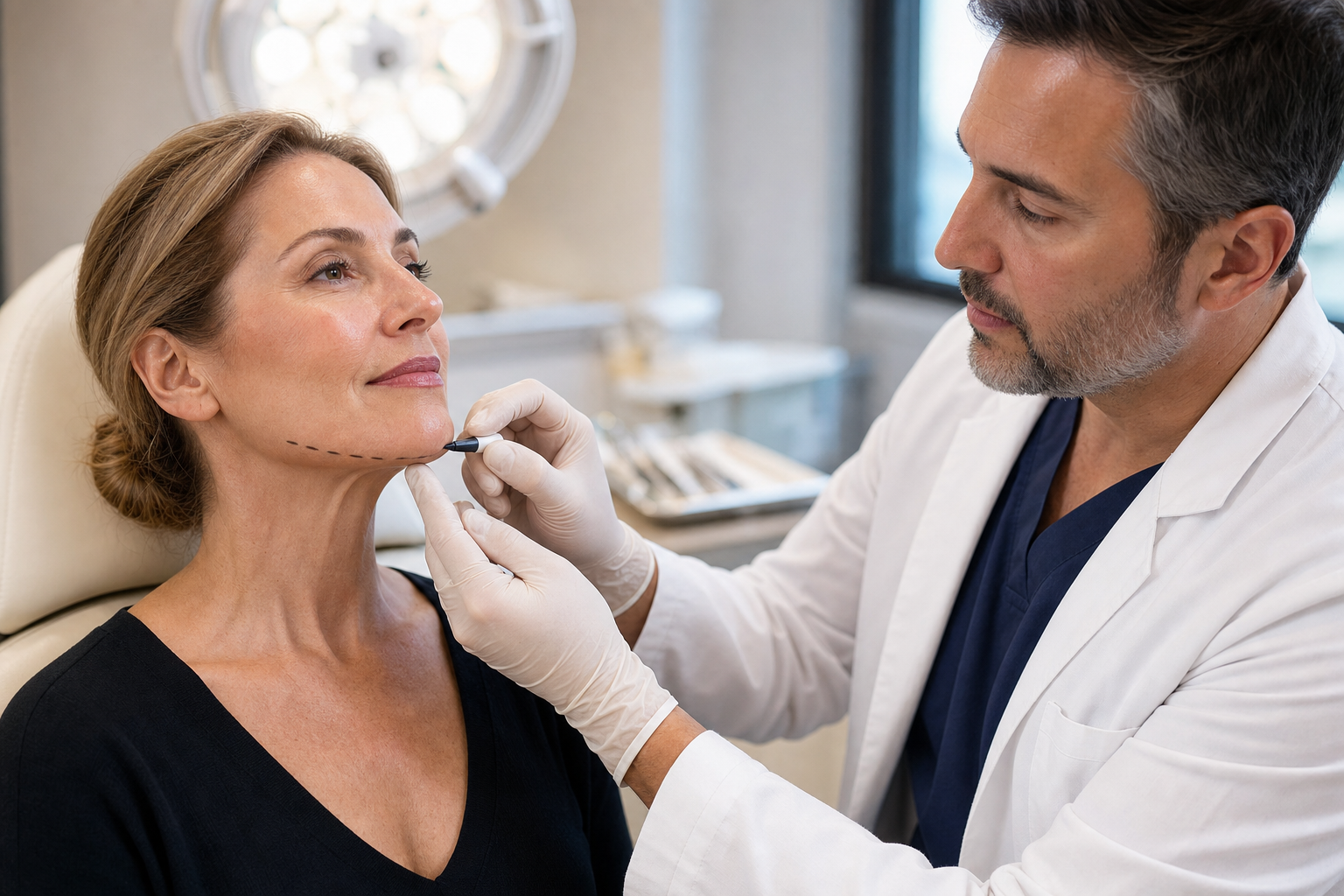
mini facelift procedure types
“Mini facelift” describes a family of limited-incision operations rather than one standardized procedure. The relevant mini facelift procedure types differ in incision design, tissue layer addressed, degree of lifting, and ability to improve the jawline or neck. A careful evaluation with a qualified plastic surgeon is needed to determine whether the Mini Facelift is appropriate for your anatomy and goals.
Dr. Mark Albert evaluates facial skin, the superficial musculoaponeurotic system (SMAS), retaining ligaments, fat compartments, platysma muscle, cheek descent, and neck laxity. These distinctions help patients ask better questions and avoid assuming that a smaller incision means a smaller operation in every meaningful way.
Understanding the Nuances of Mini Facelift Procedures
What Constitutes a “Mini Facelift” in Modern Plastic Surgery?
A mini facelift generally uses shorter incisions and focuses on early laxity in the lower face, jowls, and upper jawline. The operation may reposition skin alone, tighten the SMAS with sutures, suspend deeper tissues, or release selected retaining ligaments. The term does not identify one incision, tissue plane, or expected result.
Limited facial lifting may suit adults with mild to moderate descent who do not have the skin excess or neck separation commonly addressed with a more extensive facelift. Age alone does not determine suitability; skin quality, facial proportions, prior surgery, skeletal support, hairline, and the location of laxity also matter.
The Spectrum of Limited-Incision Techniques: Beyond a Single Definition
The phrase “mini facelift” may refer to a skin-only lift, SMAS plication, MACS lift, S-lift, or limited-incision deep plane approach. These operations can share a short external incision while differing substantially beneath the skin. Patients should ask which layer will be repositioned, whether retaining ligaments will be released, how much of the jawline is included, and whether the surgeon expects the neck to change.
Why “Mini” Does Not Always Mean “Simple”: Anatomical Considerations
Facial rejuvenation is not determined by incision length. The surgeon must account for the facial nerve, superficial temporal vessels, SMAS, parotid fascia, platysma, retaining ligaments, and the natural direction of tissue descent. A technically limited operation can still require careful dissection, precise vector selection, and disciplined tissue handling.
Skin pulled too tightly can create an over-pulled or windblown appearance, while inadequate deep support can leave residual jowling or produce early recurrence. Natural results depend on distributing tension through appropriate structural layers. Candidacy, anesthesia, recovery, risks, and expected improvement vary by patient and require an in-person consultation.
Categorizing Mini Facelift Techniques: A Structural Deep Dive

The main mini facelift procedure types can be distinguished by the layer carrying the lift. Skin-only operations place most corrective force in the skin. SMAS-based techniques add deeper support. MACS and S-lift designs use defined suspension patterns, while a limited-incision deep plane approach works beneath the SMAS in selected areas. These labels describe surgical concepts, not fixed packages, and may be modified for tissue quality, asymmetry, facial anatomy, and examination findings.
Cutaneous Lifting (Skin-Only): The Simplest Approach and Its Limitations
A cutaneous lift removes or redrapes excess skin without directly tightening the SMAS. It may improve surface laxity when deeper descent is limited. Its principal limitation is less durable structural support; excessive skin tension can widen scars or create an unnatural pull at the hairline or ear.
SMAS Plication Techniques: Addressing Deeper Facial Layers
SMAS plication folds and secures the SMAS with sutures rather than excising or extensively dissecting it. This can transfer support away from the skin and improve jowling or lower-face laxity. The result depends on tissue thickness, suture placement, vector, and the amount of descent. It does not automatically provide the same mobility or reach as deeper-plane surgery.
MACS Lift: Suspension and Support
MACS means Minimal Access Cranial Suspension. This technique uses limited access and vertically oriented suspension sutures anchored toward the temporal region. It can suit selected lower-face descent and jowling, with less broad dissection than some traditional approaches. Its effect on the mid-face and neck is limited by tissue mobilization and anatomy.
S-Lift: A Specific Incision Pattern for Mid-Face and Jawline
An S-lift refers primarily to an S-shaped incision and focused lifting design. It may address the cheek, lower face, and jawline through skin redraping with or without deeper-layer treatment. The incision shape does not define operative depth. Patients should ask whether the SMAS or platysma will be treated and which portion of the neck is included.
Limited-Incision Deep Plane Facelift: A More Comprehensive Mini Approach
A limited-incision deep plane facelift releases selected retaining ligaments and repositions a composite layer of facial soft tissue beneath the SMAS. This may move descended cheek and lower-face tissues with less dependence on skin tension. It remains anatomically selective, not universally equivalent to a full deep plane facelift. Risks include bleeding, infection, nerve injury, contour irregularity, and asymmetry.
Technical Comparison Table: Mini Facelift Procedure Types
The table below provides a conceptual comparison. Actual technique selection depends on an examination by a board-certified plastic surgeon, the patient’s goals, and the surgeon’s operative judgment.
| Technique | Primary layer or design | Typical focus | Important limitation |
|---|---|---|---|
| Cutaneous lift | Skin redraping | Surface laxity and limited excess skin | Less structural support and greater dependence on skin tension |
| SMAS plication | Folded and sutured SMAS | Jowls and lower-face laxity | Reach and mobility may be less than with deeper dissection |
| MACS lift | Vertical cranial suspension sutures | Selected lower-face descent and jawline laxity | Mid-face and neck correction may remain limited |
| S-lift | S-shaped incision with variable tissue treatment | Focused cheek, jawline, or lower-face lifting | The incision name does not define the operative depth |
| Limited-incision deep plane | Deeper plane with selected ligament release | More substantial cheek and lower-face descent | Still has defined anatomical boundaries and surgical risks |
For patients reviewing mini facelift procedure types, the most useful comparison is not the marketing label. Ask which tissues will be moved, where the incision will be placed, whether the neck is included, what improvement is realistic, and what risks apply. Dr. Mark G. Albert, MD, FACS is certified by the American Board of Plastic Surgery and is a Fellow of the American College of Surgeons.
Navigating the 40s “Grey Area”: Candidacy and Realistic Expectations
Patients in their 40s may notice early jowling, a softer jawline, or lower-cheek descent before substantial skin excess develops. The mini facelift procedure types may suit some adults at this stage, but age does not establish candidacy. The relevant questions concern laxity location, skin quality, facial structure, health history, expectations, and whether the operation addresses the tissue that has descended.
Identifying Early Signs of Aging: Jowls, Jawline, and Mid-Face Volume Loss
Early aging may appear as a fold beside the mouth, a less distinct mandibular border, or a jowl that becomes visible when the head turns. Mid-face descent can reduce cheek projection and deepen the transition between cheek and lower eyelid. These changes may involve the SMAS, retaining ligaments, fat compartments, and platysma, not only excess skin.
The “Is There Enough to Work With?” Dilemma: A Surgeon’s Perspective
“Not enough to work with” can mean that visible laxity is limited, not that surgery is impossible. A surgeon must determine whether a structural lift would produce proportionate improvement or whether the change would be too subtle to justify operative risk. A focused operation may suit localized laxity; broader descent across the cheek, jawline, and neck may require a broader procedure.
Dr. Mark Albert, a board-certified plastic surgeon and Fellow of the American College of Surgeons, evaluates the relationship between the skin envelope and deeper support rather than using age as a threshold. Consultation should cover asymmetry, scar position, anesthesia, recovery, nerve-related risks, bleeding, infection, contour irregularity, and concerns that remain outside the plan.
When Non-Surgical Options Fall Short: The Case for Early Intervention
Skin care, injectables, energy-based tightening, and threads may address selected surface or contour concerns, but they do not all reposition descended facial tissue. Repeated treatments may provide temporary or incomplete improvement in jowling. Early surgery is not automatically preferable; it becomes a discussion when laxity persists, the patient understands operative tradeoffs, and a tissue lift is desired.
Dr. Mark Albert’s Approach to Individualized Candidacy Assessment
Dr. Albert’s assessment should connect the stated concern with facial anatomy: direction of descent, skin condition, SMAS support, platysma position, and neck laxity. Photographs and examination help distinguish a lifting problem from concerns a limited operation may not address. The vector should preserve facial expression and proportion rather than create excessive lateral tension or a windblown appearance.
Candidacy Decision Checklist for the 40s Patient
Before deciding, consider whether the consultation answers these questions:
- Which areas are changing: jowls, cheek descent, jawline, neck skin, or several areas?
- Which tissue layer will be repositioned, and how will tension be distributed?
- What improvement is realistic, and which concerns will remain untreated?
- Will the incision and scar location suit the hairline, ear anatomy, and hairstyle?
- What anesthesia, recovery period, restrictions, and follow-up care are expected?
- Have material risks, medical factors, and alternatives been discussed?
Anatomical Boundaries and Recovery Realities: What to Expect
Incision Placement and Scar Concealment: Minimizing Visibility
Limited-incision surgery generally places incisions around the ear and, depending on design, within the hair-bearing temple or sideburn area. Scar quality depends on wound healing, skin tension, incision geometry, infection risk, and individual biology. A shorter incision does not eliminate scarring. Patients should ask to see the planned pathway and understand whether it permits adequate access.
Addressing Neck Laxity: The Limits of Mini Facelifts and Neck Lifts
A focused lower-face lift may improve the jawline while leaving loose neck skin or platysmal bands unchanged. Neck correction depends on laxity, platysma, submental tissues, skin recoil, and the operation selected. Patients with vertical neck banding or significant skin redundancy should not assume that a limited facial lift will provide full neck correction.
Debunking the “Weekend Facelift” Myth: An Honest Recovery Timeline
“Weekend facelift” is a marketing phrase, not a reliable recovery promise. Research summarized by the American Society of Plastic Surgeons describes mini facelifts as having shorter recovery than extended full facelifts, yet bruising, swelling, tightness, and incision care still require planning. Social recovery commonly takes about 7 to 14 days, varying with technique, anesthesia, tissue handling, health, and healing.
Swelling, Bruising, and Social Recovery: A Day-by-Day Expectation
Typical Recovery Pattern
- First several days: Swelling, bruising, facial tightness, and fatigue may be most noticeable. Dressings, medications, and activity instructions require attention.
- Days 5 to 7: Some patients begin limited social activity, but discoloration and swelling can remain. Strenuous activity generally requires clearance.
- Days 7 to 14: Many patients appear more presentable, although asymmetry, firmness, numbness, and residual swelling may persist.
- Following weeks: Incisions mature gradually, sensation changes settle at different rates, and the contour continues to soften.
Internal healing continues after a patient feels comfortable in public. Follow-up appointments assess incisions, swelling, contour, and concerning symptoms. Worsening pain, expanding swelling, fever, drainage, shortness of breath, or other unexpected changes require prompt medical contact.
Longevity: Factors Influencing How Long Results Last
Longevity reflects tissue quality, genetics, sun exposure, smoking status, weight fluctuation, facial anatomy, technique, and structural support. Research cited by the American Society of Plastic Surgeons places typical mini facelift recovery below that of more extensive operations, but recovery speed does not establish permanence. Research findings indicate that a structurally anchored SMAS mini facelift may last approximately 5 to 8 years, while comprehensive deep-plane procedures are often described in the range of 10 to 15 years. These are general estimates, not individual guarantees.
The mini facelift procedure types differ in how much tissue they mobilize and support, so durability cannot be predicted from “mini” alone. A qualified surgeon should explain scope, likely aging pattern, limitations, and risks during an in-person consultation.
Comparing Mini Facelift Options with Other Rejuvenation Techniques

The best choice among mini facelift procedure types depends on facial descent, tissue layers requiring repositioning, and the desired degree of change. A focused operation may suit early jowling and limited jawline laxity, while broader aging across the cheek, lower face, and neck may require a more extensive plan. The Mini Facelift is not defined by incision length alone.
Mini Facelift vs. Traditional Full Facelift: Scope and Impact
A mini facelift usually concentrates on the lower third of the face, jowls, and upper jawline through more limited access. A traditional facelift generally allows broader mobilization of facial skin and deeper support for laxity extending through the cheek, jawline, and neck. A larger operation is not automatically better, and a smaller operation is not automatically sufficient. The decision should reflect tissue descent, skin excess, facial proportions, and desired correction.
Mini Facelift vs. Nanolift™: Understanding Dr. Albert’s Proprietary Technique
Nanolift™ is Dr. Mark Albert’s proprietary facelift technique and should be discussed according to its surgical scope, tissue support, incision design, and expected recovery. The name alone does not establish suitability. Consultation with Dr. Albert should address how Nanolift™ differs from a conventional limited lift, which anatomical layers it treats, and whether it is intended for early laxity or established descent.
Mini Facelift vs. Neck Lift: Targeting Specific Areas of Concern
A mini facelift can improve selected jawline laxity but may not correct loose neck skin, prominent platysmal bands, or central neck fullness. A neck lift is planned around cervical anatomy and may suit a neck-centered concern. Some patients have both lower-face and neck changes, while others have a localized problem. The surgeon should state which areas are included and whether the operation can meet the patient’s goals.
When to Choose a Mini Facelift: Benefits and Limitations
A focused lift may suit mild to moderate laxity concentrated in the lower face when temporary treatments no longer address the concern. Potential advantages include a more limited operative field and less extensive recovery than a comprehensive facelift. Limitations include incomplete neck correction, less mid-face reach, residual asymmetry, and an inadequate result if aging is widespread. Candidacy, anesthesia, risks, and recovery vary by patient.
| Option | Primary scope | Structural considerations | Key limitation |
|---|---|---|---|
| Mini Facelift | Lower face, jowls, and upper jawline | May use skin, SMAS, suspension, or deeper-plane support | May not address marked neck laxity or broad cheek descent |
| Full Facelift | More extensive facial and often jawline correction | Allows broader tissue mobilization and structural repositioning | More extensive surgery and recovery may not be justified for limited laxity |
| Nanolift™ | Determined by Dr. Albert’s individualized operative plan | Requires discussion of its specific tissue layers and vectors | The proprietary name does not replace anatomical assessment |
| Neck Lift | Neck skin, platysma, and neck contour | Focused on cervical anatomy rather than the entire face | May not correct cheek descent or prominent jowls by itself |
Dr. Mark G. Albert, MD, FACS, is certified by the American Board of Plastic Surgery and is a Fellow of the American College of Surgeons. Consultation can help determine whether the featured Mini Facelift, a broader facelift plan, Nanolift™, or a neck-focused operation aligns with the patient’s anatomy and priorities. No technique should be selected without reviewing material risks, scar placement, recovery, and residual concerns.
Frequently Asked Questions
What is the new facelift everyone is getting?
The “new facelift” usually refers to modern limited-incision techniques, such as a MACS lift or limited-incision deep plane facelift, rather than one standardized operation. Mini facelift procedure types differ in the tissue layer treated, incision design, and ability to address jowls, the jawline, cheeks, or neck. A consultation with Dr. Mark Albert is needed to match the approach to your anatomy and goals.
What is the downside of a mini facelift?
The main downside of a mini facelift is that its limited scope may not correct substantial neck laxity, extensive skin excess, or advanced facial descent. Other possible risks include bleeding, infection, nerve injury, scarring, asymmetry, contour irregularity, and recurrent laxity. Recovery and results vary according to the technique, tissue layers treated, and individual healing.
What is the best age for a mini facelift?
The best age for a mini facelift depends more on facial anatomy and the location of laxity than on a specific number. Adults with mild to moderate lower-face descent, jowls, or upper jawline laxity may be considered, while skin quality, prior surgery, facial proportions, and neck changes also matter. An in-person assessment is required to determine suitability.
Can I see mini facelift pictures for jowls before and after?
Mini facelift before-and-after pictures can show how selected patients’ jowls and jawlines changed, but they cannot predict an individual result. Photos should be reviewed with attention to lighting, facial position, incision design, tissue layers treated, and follow-up timing. Dr. Mark Albert can discuss whether a mini facelift procedure type addresses your pattern of lower-face laxity.
How long does it take to look normal after a mini facelift?
Recovery after a mini facelift varies, and the time needed to look socially presentable depends on swelling, bruising, incision placement, surgical extent, and personal healing. Early swelling and temporary asymmetry can affect appearance, while scars and tissue settling continue to change over time. Your surgeon should provide individualized recovery guidance and warning signs before surgery.
Which mini facelift procedure type is best for jowls?
The best mini facelift procedure type for jowls depends on whether the problem involves skin laxity, SMAS descent, retaining ligaments, or deeper cheek and lower-face tissues. Skin-only lifting, SMAS plication, MACS lift, S-lift, and limited-incision deep plane approaches provide different degrees of support and reach. A qualified plastic surgeon must examine the tissues before recommending one.
Can a mini facelift also improve the neck?
A mini facelift may provide some neck improvement, but its effect depends on the incision design, tissue mobilization, platysma laxity, and amount of neck skin excess. Limited procedures may not address separated platysma bands or substantial neck laxity. A consultation should identify which neck areas are included and which concerns may require a different surgical plan.

