
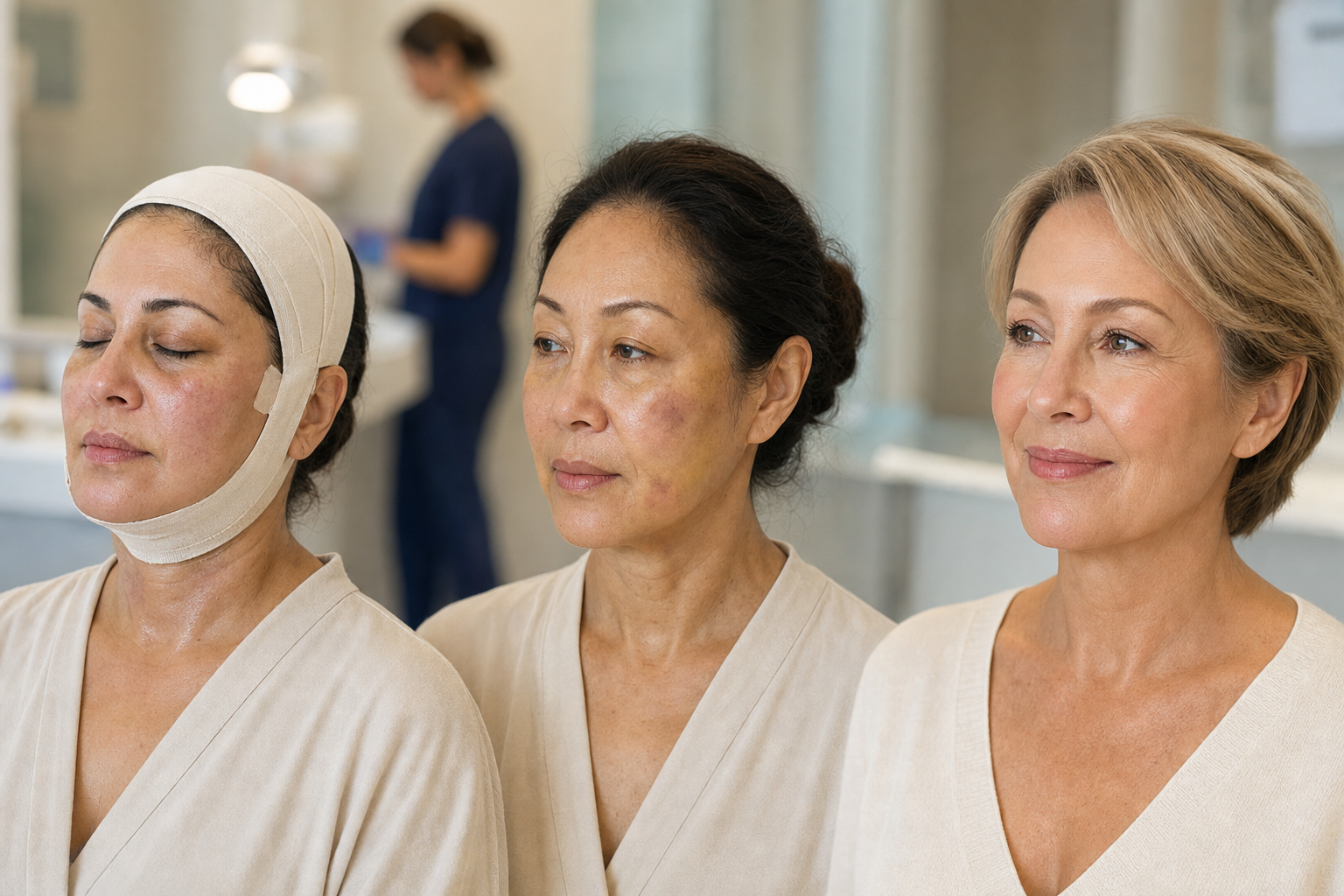
mini facelift recovery pictures
Quick answer: mini facelift recovery pictures are most useful when they show consistent lighting, facial position, dates, and the full incision area. A Day 5 image may show swelling, bruising, tightness, and unevenness within a normal healing pattern. By six weeks, visible recovery is often quieter, though subtle swelling and tissue maturation can continue. The Mini Facelift is individualized, so photographs cannot determine whether healing or candidacy is appropriate.
Key Takeaways
- Consistent lighting, facial positioning, and dated images make recovery photos far more reliable for tracking progress over time.
- Swelling, bruising, and tightness visible around day five often fall within a normal healing pattern rather than signaling a complication.
- Visible changes tend to settle by the six-week mark, yet deeper tissue maturation and mild residual swelling can continue for months.
- Because every mini facelift is tailored to the individual patient, photographs alone cannot confirm healing quality or determine surgical candidacy.
Dr. Mark Albert evaluates recovery alongside surgical technique, tissue handling, skin quality, incision placement, and baseline anatomy. Dr. Mark G. Albert, MD, FACS, is certified by the American Board of Plastic Surgery and is a Fellow of the American College of Surgeons. This guide helps readers assess photographs, but an in-person assessment is necessary for concerns about healing, infection, bleeding, increasing pain, or another possible complication.
Why Mini Facelift Recovery Pictures Matter for Realistic Expectations
How to critically evaluate mini facelift recovery pictures online
Authentic recovery photographs should identify the postoperative day or week and use similar camera distance, facial expression, head position, and lighting. Look for front, profile, and three-quarter views showing the ears, hairline, jawline, neck, and incision zones. A useful gallery includes several healing stages, not only an early and polished final photograph. Images show appearance, not symptoms, wound quality, sensation, or the surgeon’s clinical reasoning.
Bruising color stages and what they reveal about healing progress
Bruising commonly changes from red or purple to blue, green, yellow, or brown as blood products clear from tissues. Color variation may be uneven. Swelling often peaks between 48 and 72 hours after incision closure, then declines. A photograph cannot confirm normal healing. Expanding discoloration, marked asymmetry, worsening pain, drainage, fever, or skin color changes should prompt contact with the surgical team.
The problem with filtered, cropped, and lighting-manipulated social media photos
Filters can soften texture, reduce redness, alter skin tone, and obscure scars. Cropping may remove swelling near the ears or hairline, while overhead lighting deepens shadows beneath the jaw. Extending the chin or turning the neck also changes apparent contour. Treat mini facelift recovery pictures as visual documentation, not proof of a predictable result. Healing speed, swelling, bruising, scar maturation, and final contour differ among patients.
Mini Facelift Recovery Timeline: From Early Healing to Final Outcome

Recovery progresses from swelling control and wound observation toward a gradual return to daily activity. Many patients resume desk work and low-key social activities within 7 to 14 days, depending on the operation, occupation, bruising, and instructions. A mini facelift may involve less extensive dissection than a comprehensive deep plane facelift, but it still affects skin, connective tissue, and lower facial tissue planes. A shorter procedure still requires monitoring.
| Recovery stage | Possible visible findings | Activity considerations |
|---|---|---|
| First 48 hours | Swelling, bruising, tightness, dressings, and possible drainage devices | Rest, head elevation, prescribed wound instructions, and limited movement |
| Day 5 | Persistent edema, yellowing or purple bruising, and early incision crusting | Short walks may be appropriate if approved; strenuous activity remains restricted |
| Week 1 | Bruising begins to fade; incision and suture areas receive clinical review | Some patients begin desk work, based on medical guidance and comfort |
| Week 2 | Less discoloration, residual fullness, and improving facial movement | Low-key social activity may be reasonable; exercise clearance varies |
| Weeks 3 to 6 | Contour becomes more settled while scars remain immature | Activity increases gradually after surgeon approval |
| Six weeks | More stable early contour, with possible subtle swelling | Many restrictions have eased, but tissue maturation continues |
The first 48 hours: rest, drain care, and initial swelling control
Early recovery centers on rest, head elevation, medication instructions, dressing or drain care when applicable, and incision observation. Swelling may increase during this period. Follow the operating surgeon’s guidance for showering, sleeping position, walking, and wound checks. Early tightness or asymmetry should not be interpreted from a photograph without clinical context.
Day 5 post op mini facelift recovery pictures: a detailed visual benchmark
At Day 5, photographs may show pronounced swelling near the cheeks, jawline, and ears, with bruising in changing shades. The face can appear firm, uneven, or temporarily overcorrected; these findings do not predict final contour. A useful image documents the whole face under neutral conditions, while the surgeon assesses skin viability, incision integrity, fluid collection, and other clinical findings.
Week 1 post op: suture removal and incision assessment
During the first week, the surgical team may evaluate sutures, incision edges, swelling, bruising, and sensation. Some patients can manage limited work, while others need more privacy. Healing around the tragus and hairline may remain pink or raised. The treating clinician should provide instructions about cleansing, makeup, hair care, and activity.
Week 2 mini facelift recovery pictures: bruising transitions and social readiness
By the second week, bruising often fades substantially, though yellow discoloration, puffiness, numbness, or tightness may remain. Approximately 80 percent of noticeable facial swelling resolves within two to three weeks, according to the research findings provided for this guide. Social readiness depends on lighting, hairstyle, work expectations, and personal comfort.
Weeks 3 through 6: scar maturation and returning to exercise
The contour generally looks more settled while scars change in color, firmness, and texture. Walking and light activity may progress before running, heavy lifting, or vigorous gym workouts. Exercise clearance depends on incision healing, blood pressure considerations, swelling, and the operation performed. The surgeon’s individualized timeline takes priority over an online calendar.
Six weeks post op mini facelift recovery pictures: final contour evaluation
At six weeks, photographs may show early facial contour, jawline definition, and symmetry more clearly than early images, but not necessarily the final result. Complete tissue maturation can require 6 to 12 months, with ongoing swelling or scar changes. Compare mini facelift recovery pictures with the same patient’s baseline and earlier stages rather than judging one image alone.
Candidacy in Your 40s: When a Mini Facelift Makes Sense and When It Does Not
For adults in their 40s, mini facelift recovery pictures can set expectations but cannot establish candidacy. Age alone does not determine whether the Mini Facelift is appropriate. Dr. Mark Albert considers skin laxity, lower facial contour, tissue quality, facial proportions, medical history, and goals. Consultation determines whether limited surgery can produce meaningful improvement without an over-tightened appearance.
The grey area: determining sufficient tissue laxity for a mini facelift
A mini facelift addresses selected lower-face and jawline changes through planned incisions and tissue adjustment. It may suit localized laxity and patients seeking measured refinement rather than broad structural change. Mild looseness alone does not automatically justify surgery. The surgeon assesses how skin, superficial muscular aponeurotic system, retaining ligaments, and lower facial tissue planes relate.
Physical signs that suggest a mini facelift will provide meaningful improvement
Examination may identify early jowling, reduced jawline definition, mild to moderate skin laxity, and soft-tissue descent around the lower cheeks. Skin quality and ability to redrape also matter. Patients need a clear discussion of which concerns a Mini Facelift can address and which may remain. Photographs, facial movement, side views, and gentle tissue assessment are more useful than age or one comparison image.
Why some patients in their 40s are better served by waiting
Waiting may be appropriate when laxity is minimal, expectations rely on filtered images, or the desired change exceeds what limited surgery can provide. Patients may need time to consider scars, swelling, numbness, bruising, activity restrictions, and possible revision surgery. Candidacy should not be driven by pressure to undergo an operation beyond the anatomy or goals.
What a board-certified plastic surgeon evaluates during consultation
Dr. Mark G. Albert, MD, FACS, is certified by the American Board of Plastic Surgery and is a Fellow of the American College of Surgeons. Consultation includes facial anatomy, skin movement, tissue descent, incision considerations, general health, and recovery priorities. Candidacy, technique, anesthesia, risks, and outcomes require clinical assessment. A qualified surgeon should explain limitations as directly as potential benefits, supporting informed consent rather than a decision based on a photograph or sales message.
Essential Aftercare and Incision Healing for Optimal Recovery
After a Mini Facelift, wound care helps the surgical team monitor healing and identify concerns early. Written instructions take priority because dressings, cleansing, suture removal, medications, and activity limits vary with technique and medical history. Keep follow-up appointments even when incisions feel comfortable. Photographs cannot show tenderness, drainage, skin temperature, or wound separation.
Step-by-step incision and healing care guide for mini facelift recovery
Incision line placement around the tragus and hairline maturation
Incisions may follow natural creases near the tragus, around the earlobe, and along portions of the hairline, depending on anatomy and the operative plan. Early lines can be pink, firm, raised, or uneven. Hair-bearing skin may require specific washing, brushing, and styling instructions. Scar color, thickness, sensitivity, and texture can change for months. Cosmetics or hair should not conceal an incision until the skin has closed and the surgeon approves.
Managing comfort, swelling, and bruising at home
Rest, head elevation, short gentle walks, and limiting bending may support comfort when approved. Use only the pain medicine and cold-compress method in your instructions. Do not pressure an incision, sleep on operative areas, or resume strenuous movement because a photograph looks improved. Sudden one-sided swelling, expanding bruising, severe pain, shortness of breath, or bleeding requires prompt medical advice.
Diet and lifestyle choices that support healing after mini facelift surgery
Follow your surgeon’s eating, drinking, medication, and supplement instructions. Adequate fluids and regular nourishing meals support recovery, while alcohol, nicotine, and unapproved supplements may affect bleeding, circulation, or wound healing. Avoid swimming, intense heat, heavy lifting, and gym workouts until cleared. Return to activity gradually according to incision status, swelling, blood pressure, and the operation performed.
Frequently Asked Questions About Mini Facelift Recovery and Results

What should I look for when examining mini facelift recovery pictures online?
Look for dated images with consistent lighting, camera distance, facial position, and expression. They should show the ears, hairline, jawline, and incision areas rather than a cropped front view. A credible record includes several stages and does not filter redness, swelling, bruising, or texture. Images cannot confirm wound integrity, sensation, infection, fluid collection, or whether the plan suited the patient.
How long do bruising and peak swelling typically last after a mini facelift?
Facial edema commonly peaks between 48 and 72 hours after incision closure, then decreases. Bruising may change from purple or red to green, yellow, or brown. Fullness, tightness, or mild discoloration may continue during the second week. Research findings provided for this guide indicate that approximately 80 percent of noticeable swelling resolves within two to three weeks, although deeper healing continues longer. Worsening symptoms should be discussed with the surgical team.
When can I return to work, social events, and gym workouts after surgery?
Many patients return to desk work and low-key social settings within 7 to 14 days, though occupation, bruising, comfort, and healing alter the timeframe. Light walking may be permitted early, while lifting, running, bending, and vigorous exercise require clearance. The surgeon should assess incisions, swelling, blood pressure considerations, and overall recovery before approving demanding activity.
How much do mini facelift results improve between Week 2 and six months?
At Week 2, edema, bruising, numbness, tightness, and temporary asymmetry can obscure contour. The face often looks more settled by six weeks, but this is not necessarily the final result. Skin redraping, scar maturation, sensation, and deeper tissue adaptation continue. Complete tissue maturation may require 6 to 12 months. Dr. Mark Albert can assess progress and explain whether changes fit the expected course or need evaluation.
Frequently Asked Questions
How much younger will I look after a mini facelift?
Mini facelift results may create a more rested or refreshed appearance, but the amount of visible age reduction varies by anatomy, skin quality, tissue changes, technique, and healing. Mini facelift recovery pictures cannot predict an individual result or establish a specific number of years. Dr. Mark Albert evaluates expected changes during an individualized consultation.
How painful is mini facelift recovery?
Mini facelift recovery commonly involves tightness, tenderness, swelling, and bruising, while pain levels vary among patients and procedures. Prescribed medications and postoperative instructions may help manage discomfort, but photographs cannot show pain or other symptoms. Increasing pain, fever, drainage, marked asymmetry, or concerning skin changes should prompt contact with the surgical team.
Can I see pictures of mini facelift before and after results?
Mini facelift before and after pictures can provide visual examples, but they cannot predict a specific patient’s result or confirm appropriate healing. Look for dated front, profile, and three-quarter views with consistent lighting, camera distance, facial position, and coverage of the ears, hairline, jawline, neck, and incisions. A consultation with Dr. Mark Albert provides clinical context.
How long does it take to look normal after a mini facelift?
Mini facelift patients often begin looking more presentable within several weeks, though timing varies with bruising, swelling, the procedure performed, work demands, and individual healing. Some patients return to desk work within 7 to 14 days when medically cleared, while subtle swelling and scar changes may continue beyond six weeks. Recovery guidance must come from the treating surgeon.
What are the downsides of a mini facelift?
Mini facelift downsides may include temporary swelling, bruising, tightness, altered sensation, visible or immature scars, unevenness during healing, and the possibility of an outcome that does not match expectations. Risks and limitations vary with technique, anatomy, skin quality, and medical factors. Dr. Mark Albert reviews candidacy, alternatives, and potential complications during consultation.
How can I tell whether mini facelift recovery pictures show normal healing?
Mini facelift recovery pictures alone cannot determine whether healing is normal because photographs do not show wound quality, sensation, temperature, drainage, or pain. Dated images may document changing bruising and swelling, but expanding discoloration, worsening pain, fever, drainage, skin color changes, or marked asymmetry require prompt contact with the surgical team. An examination is needed for clinical assessment.