

revision deep plane facelift
A revision deep plane facelift addresses structural problems left by a prior facelift, including recurrent jowls, a windswept appearance, widened scars, lost sideburns, pixie ears, or features that appear pulled rather than naturally supported. Assessment must account for scar tissue, altered tissue planes, skin quality, retaining ligaments, and facial nerve anatomy.
Key Takeaways
- A revision deep plane facelift corrects specific deformities from a prior surgery, such as recurrent jowls, pulled features, or widened scars.
- The surgeon must navigate altered tissue planes and scar tissue to safely reposition facial structures without damaging underlying nerves.
- Understanding the anatomy of retaining ligaments and the facial nerve is essential for achieving a natural result in this more complex procedure.
- Patients often choose revision when their first facelift left visible signs like pixie ears, lost sideburns, or a windswept appearance.
- Each revision case requires a customized plan that accounts for skin quality, scar location, and the degree of structural imbalance.
Dr. Mark Albert, a board-certified plastic surgeon and Fellow of the American College of Surgeons, evaluates each face as a new anatomical problem. This guide explains how deeper tissue release may restore proportion while respecting the limits of secondary surgery. A Mini Facelift may suit selected patients with localized laxity, but candidacy, technique, recovery, risks, and outcomes require individualized clinical assessment.
Understanding Revision Deep Plane Facelifts: Restoring Natural Facial Harmony
Revision surgery may be considered after an unnatural vector, recurrent laxity, scar-related distortion, or imbalance between the face and neck. A revision deep plane facelift may work beneath the most heavily scarred subcutaneous layer, release selected retaining ligaments, and reposition deeper tissues without relying on skin tension alone. The operation cannot erase every scar, reverse all aging, or guarantee a particular appearance.
The Need for Revision: When Initial Facelifts Fall Short
Premature relapse may occur when the first operation tightened skin without restoring deeper support. Other problems include an overly lateral pull, excessive skin removal, tension around the ear, thickened scars, a pulled tragus, displaced hairline, and reduced natural movement. Consultation should identify the cause before a corrective technique is selected.
Dr. Mark Albert's Perspective: The Deep Plane Advantage in Revision Surgery
Dr. Albert’s approach centers on anatomy and tissue behavior. Prior surgery can obscure landmarks and tether skin to underlying structures. A deeper plane may release tissue that superficial dissection cannot mobilize effectively. The objective is not to pull harder, but to reduce skin tension, preserve natural transitions, and reposition cheek, jowl, and neck tissues according to anatomy.
Key Goals of Revision Deep Plane Facelift
Goals may include better facial balance, softer jowls, correction of an oblique or windswept vector, less ear tension, and a more natural relationship among the cheek and lower face. The operation may address pixie ear or tragal distortion caused by prior traction. It must respect skin perfusion, scar maturity, nerve pathways, and available healthy tissue. A Mini Facelift serves a more limited laxity pattern and is not interchangeable with complex revision surgery.
Is a Revision Deep Plane Facelift Right for You?
Suitability depends on healing, medical status, skin condition, anatomy, and the source of dissatisfaction. Many surgeons allow approximately 6 to 12 months for scar tissue and swelling to mature, although timing varies. An in-person examination determines whether deeper release, limited revision, or no further surgery is medically reasonable.
Navigating Scar Tissue and Anatomical Challenges in Revision Facelifts
The Biomechanical Impact of Prior Surgery: Scar Tissue and Altered Planes
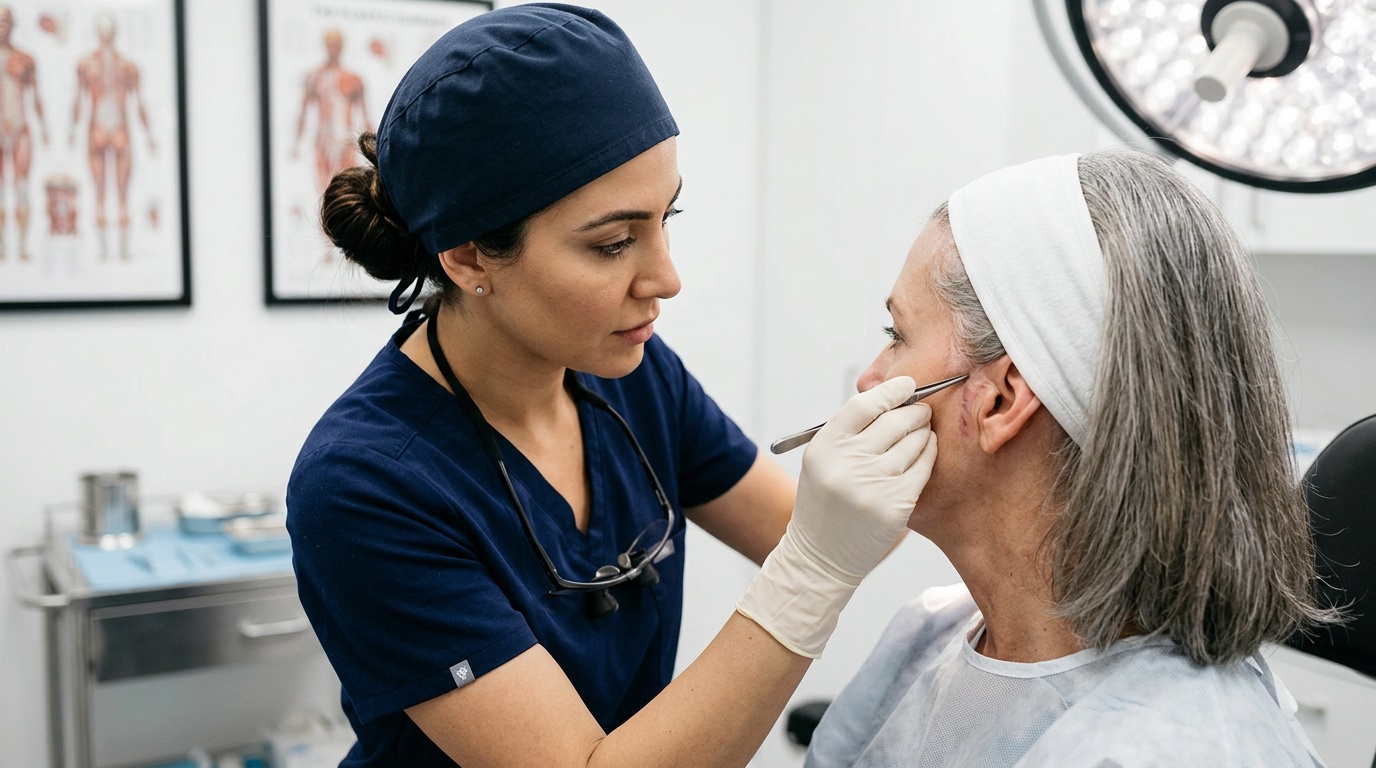
Healing creates fibrosis that can bind the skin, superficial musculoaponeurotic system, and deeper layers. Adhesions change tissue movement and conceal landmarks. Planning must account for incision placement, undermining, skin removal, sutures, altered vascularity, and facial nerve branches. Revision begins with this map of altered anatomy, not assumptions based on an untouched face.
Why Subcutaneous Scarring Hinders Traditional Facelift Techniques
Superficial dissection through dense scar tissue can create uneven mobility and encourage another skin-dominant pull. That may worsen scarring, ear distortion, or a stretched appearance while leaving deeper descent insufficiently corrected. A skin-only lift may also recur sooner when structural support is not addressed. These limitations do not make every superficial technique inappropriate, but they require individualized planning.
The Deep Plane Approach: Operating Beneath the Scar Layer
Deep plane surgery follows anatomical spaces beneath portions of the superficial scar layer. Releasing selected retaining ligaments may permit movement of cheek and lower facial tissues with less traction at the skin edge. The surgeon must balance mobilization with facial nerve protection and blood-supply preservation. “Beneath the scar layer” is a strategy, not a guarantee that all scar tissue will be bypassed or complications avoided.
| Revision finding | Why it matters | Planning consideration |
|---|---|---|
| Dense subcutaneous fibrosis | Limits superficial tissue glide | Assess deeper planes and scar distribution |
| Unnatural lateral vector | Creates a windswept or flattened appearance | Reevaluate direction of tissue repositioning |
| Pixie ear or tragal distortion | Suggests excessive tension near the ear | Reduce skin traction and restore attachment thoughtfully |
Correcting Unnatural Vectors and “Windswept” Appearances
A prior facelift may pull tissue too far laterally, creating a narrow, flattened cheek or tight lower face. Deeper repositioning can change support direction rather than repeat the original pull. The intended result is a gradual cheek, jawline, and neck transition, with proportion preserved during expression and rest. Skin elasticity and previous tissue removal may limit correction.
Addressing Pixie Ear Deformities and Tragal Distortion
Pixie ears can develop when tension pulls the earlobe downward and forward. Tragal distortion changes the contour at the ear canal. Correction may release abnormal tension, reposition deeper support, and rebuild the relationship between ear and facial skin. Scar tissue, limited mobility, and nearby nerve branches make secondary repair technically demanding.
The Deep Plane Facelift Advantage: A Comparative Look at Techniques
Primary vs. Revision Deep Plane Facelift: Key Differences
A primary deep plane facelift uses tissue not altered by undermining, skin removal, or scarring. Revision surgery begins with different anatomy: fibrosis may tether skin to deeper layers, landmarks may be less distinct, and previous incisions may affect blood supply and mobility. The surgeon must determine which structures failed to provide support and whether concerns arise from skin tension, an unfavorable vector, or scar distortion.
Deep Plane Facelift vs. SMAS Plication and Skin Tightening for Revisions
SMAS plication uses sutures in the superficial musculoaponeurotic system, while skin tightening relies on excision and redraping of the outer envelope. Either may suit selected patients, but neither automatically addresses scar-bound tissue beneath a previous facelift. When recurrent jowls or midface descent reflect inadequate deeper release, repeating a lateral pull may leave the mechanical problem unresolved. A Mini Facelift may suit localized, modest laxity, but not extensive scarring, pixie ears, or structural failure.
| Approach | Primary focus | Revision consideration |
|---|---|---|
| Deep plane release | Mobilization of selected deeper facial tissues | May reduce dependence on traction through scarred skin |
| SMAS plication | Suture-based support of the SMAS layer | Effect depends on tissue quality and the location of prior work |
| Skin tightening | Removal and redraping of excess skin | May not correct an unfavorable deeper vector or recurrent midface descent |
| Mini Facelift | More limited correction for selected laxity patterns | May not address extensive scarring, pixie ears, or structural failure |
Restoring Structural Support: The Role of Deep Retaining Ligaments
Deep retaining ligaments connect facial soft tissue with bone and fascia, helping determine how cheek, jowl, and lower-face tissues descend. Selective release may allow movement of a larger tissue unit instead of skin alone. Available movement depends on scar density, elasticity, prior removal, and facial proportions. The goal is controlled mobilization; unnecessary dissection can add risk without meaningful benefit.
Dr. Mark Albert's Technical Considerations for Revision Cases
Dr. Mark Albert evaluates incision placement, hairline changes, ear position, scar thickness, skin perfusion, symmetry, and the direction of previous movement before selecting a plane. He considers whether the problem is localized or involves cheek, jawline, neck, and ear as a connected unit. The plan must respect the remaining skin envelope and avoid new tension that could widen scars or reproduce a pulled appearance. He discusses the limits of secondary surgery as directly as its possible benefits.
Managing Altered Facial Nerve Branches in Secondary Dissection
Facial nerve branches run through or near facelift planes. Prior dissection and scarring can make their course less predictable near the cheek, jawline, and temple. Secondary surgery requires landmark identification, measured release, and avoidance of unnecessary traction or cautery. Temporary weakness, persistent nerve injury, bleeding, infection, skin-healing problems, asymmetry, recurrent laxity, and unsatisfactory scars remain possible. Consultation should address nerve preservation and when further dissection should not be attempted.
Patient Readiness and Surgical Planning for Revision Deep Plane Facelifts
When to Consider Revision: Optimal Timing After Primary Surgery
Most board-certified plastic surgeons allow at least 6 to 12 months after the initial operation for swelling and scar tissue to mature. Earlier evaluation may be needed for wound concerns, infection, severe asymmetry, or another issue requiring prompt care. Timing depends on healing, deformity, skin condition, and proposed correction. A date should not be chosen based only on dissatisfaction during early recovery.
Assessing Candidacy: Physical and Emotional Readiness for Revision
Readiness includes general health, medications, nicotine exposure, operative records, healing history, and skin and scar condition. Emotional readiness also matters. Patients should understand that revision may improve balance without restoring the preoperative face or removing every visible mark.
- Healing from the primary operation is sufficiently advanced for meaningful assessment.
- Expectations focus on proportion, movement, and correction of defined concerns.
- Medical conditions and medications have been reviewed with a qualified clinician.
- The patient accepts that nerve, scar, skin-healing, asymmetry, and recurrence risks remain.
- There is adequate time available for follow-up and an individualized recovery plan.
The Consultation Process with Dr. Mark Albert: A Detailed Evaluation
Dr. Albert examines the face at rest and during expression, including cheek, jowls, jawline, neck, ears, hairline, scars, skin movement, and symmetry. Photographs and prior surgical information may help reconstruct the original approach, but examination remains central. Patients should bring operative reports when available and describe recurrence timing, sensation changes, movement concerns, and features that feel unnatural.
Developing a Personalized Surgical Roadmap for Natural Balance
Planning defines tissues requiring release, scars that may be revised, and concerns that cannot be safely corrected. It should address vector, support, incision strategy, anesthesia, monitoring, and limits imposed by previous skin removal. Candidacy, technique, recovery, risks, and outcomes require individualized assessment. A narrower correction may be recommended when a broader operation creates disproportionate risk.
Realistic Expectations and the “Uncanny Valley” Fear
Patients may fear looking windswept, over-tightened, or unlike themselves. Natural balance depends on movement, contour transitions, ear position, and consistency between the upper and lower face, not on removing every line. Revision may address an abnormal vector or recurrent descent, but cannot guarantee a specific appearance. Consultation should define concerns, acknowledge uncertainty, and establish reasonable improvement without pursuing artificial smoothness.
Recovery, Results, and Long-Term Facial Harmony

Understanding the Recovery Journey After Revision Deep Plane Facelift
Recovery varies with scar release, skin quality, anesthesia, medical history, and treatment areas. Swelling, bruising, tightness, altered sensation, and temporary asymmetry are common early considerations. Incisions require observation, and activity restrictions should follow the surgeon’s instructions. Previously operated tissue may heal less predictably, making follow-up part of treatment.
| Recovery phase | Typical focus | Clinical consideration |
|---|---|---|
| Early healing | Wound care, swelling control, and rest | Report concerning bleeding, infection, worsening pain, or skin-color changes promptly |
| Initial follow-up | Incision assessment and activity guidance | Temporary firmness, numbness, or uneven swelling may affect appearance |
| Later maturation | Scar softening and contour evaluation | Final assessment requires patience because tissue remodeling continues |
What to Expect: Short-Term and Long-Term Outcomes
Early photographs can mislead because edema and scar firmness obscure balance. Later evaluation considers proportion, movement, ear position, scar quality, and the relationship among cheek, jawline, and neck. Revision cannot restore every structure removed previously or prevent future aging. Outcomes vary with elasticity and the correction that could be performed safely.
The Importance of Continuity of Care
Communication helps distinguish expected healing from complications requiring examination. Dr. Albert’s follow-up may review incisions, movement, sensation, contour, symmetry, and scarring. Operative records and photographs can guide future decisions. Patients considering a more limited Mini Facelift still need complete evaluation rather than assuming the same indications or recovery.
Maintaining Your Results: Lifestyle and Future Considerations
Long-term facial harmony depends on aging, sun exposure, weight changes, skin characteristics, and health. Protecting healing incisions from excess sun and following individualized instructions may support scar maturation. Future concerns should be assessed before another procedure. A second revision may be inappropriate when skin reserves, vascularity, or nerve safety limit additional surgery.
When to Seek Expert Advice: Dr. Mark Albert and Albert Plastic Surgery
Contact a qualified clinician promptly for increasing redness, drainage, fever, sudden swelling, significant bleeding, new facial weakness, or skin-color changes. Patients seeking review of prior facelift results can arrange individualized consultation with Dr. Mark Albert through Albert Plastic Surgery. Bring operative information when available, describe remaining concerns, and ask which improvements are realistic, which risks apply, and whether further surgery is medically reasonable.
Frequently Asked Questions
How long does it take to look normal after a revision deep plane facelift?
Revision deep plane facelift recovery commonly involves visible swelling and bruising for several weeks, while final refinement may take several months. Prior scar tissue, skin quality, surgical extent, and healing can affect the timeline. Dr. Mark Albert provides individualized recovery guidance after examining the altered tissue planes and overall health.
What is the average cost of a revision deep plane facelift?
Revision deep plane facelift cost varies based on surgical complexity, anesthesia, facility fees, geographic location, and whether ear, neck, or scar corrections are included. Secondary surgery may require more planning because prior procedures alter tissue planes and available skin. A consultation with Dr. Mark Albert is needed for a personalized estimate.
What is the new facelift everyone is getting?
The deep plane facelift is often described as a newer facelift approach because it repositions deeper facial tissues rather than relying mainly on skin tension. A revision deep plane facelift may be considered when prior surgery caused recurrent laxity, a windswept appearance, or ear distortion. The appropriate technique depends on individual anatomy and surgical history.
Does a deep plane facelift really last 10 years?
A deep plane facelift may provide long-term improvement, but no facelift can guarantee a specific duration or stop natural aging. Results vary with age, skin quality, genetics, lifestyle, and prior procedures. Revision surgery also has limits when skin has been removed, scars are dense, or tissue mobility is reduced.
What is the downside of a revision deep plane facelift?
Revision deep plane facelift risks include bleeding, infection, scarring, asymmetry, numbness, delayed healing, hairline or ear changes, and facial nerve injury. Prior surgery can increase technical difficulty because scar tissue and altered anatomy may obscure normal tissue planes. An in-person evaluation is needed to weigh potential benefits against these limitations.
Can a revision deep plane facelift fix a windswept appearance or pixie ear?
A revision deep plane facelift may improve a windswept appearance or pixie ear by reducing abnormal skin tension and repositioning deeper tissues. The extent of correction depends on scar maturity, tissue quality, prior skin removal, and nearby nerve anatomy. Dr. Mark Albert assesses each concern separately before recommending revision, limited correction, or no further surgery.