
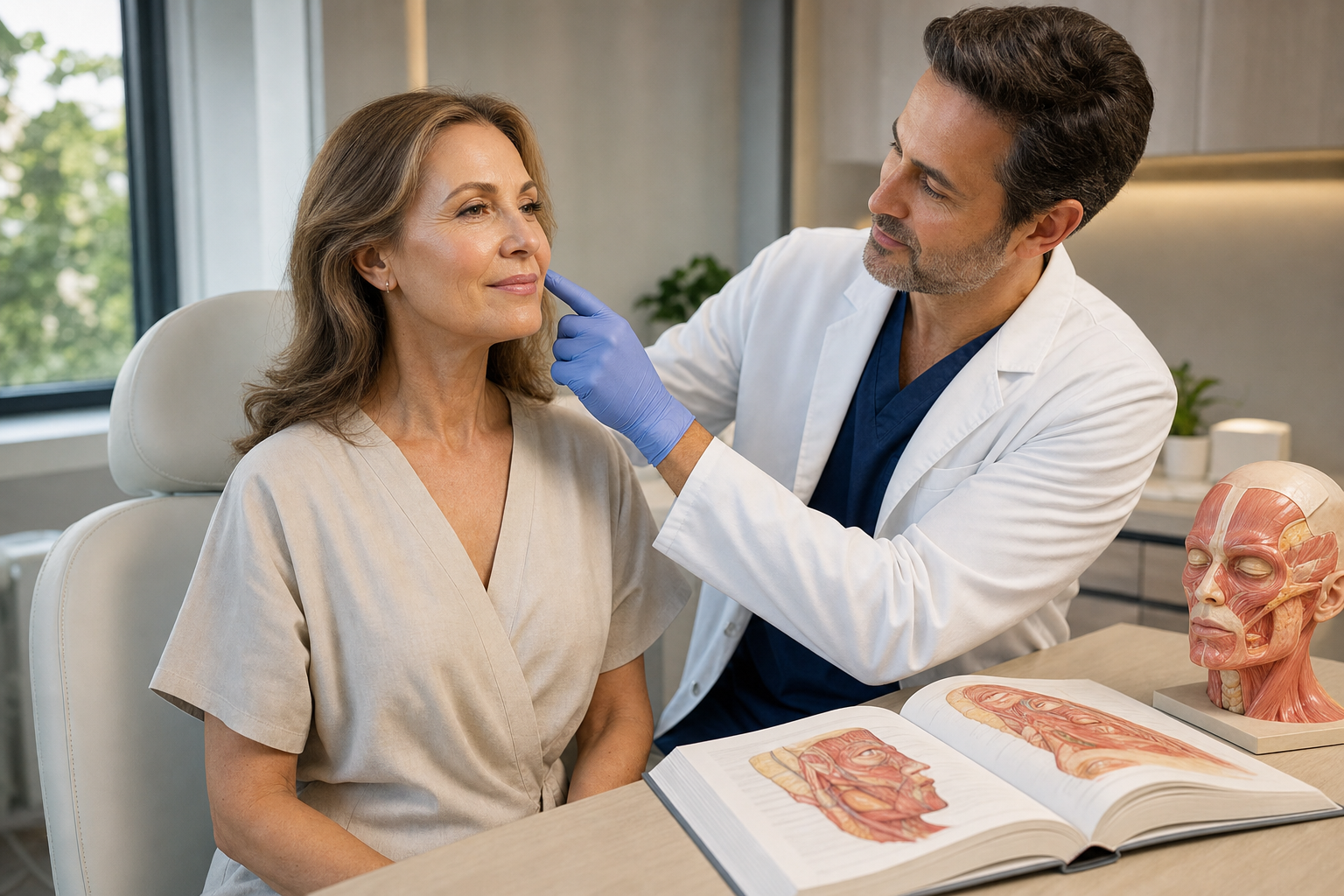
super high smas deep plane facelift
For readers trying to understand a super high smas deep plane facelift, the central idea is anatomical: the surgeon works with deeper facial support structures so lifted tissue can be repositioned with less reliance on skin tension. This approach may be considered when aging involves midface descent, deepening folds, jowling, and reduced definition along the jawline. The appropriate technique, incision pattern, anesthesia plan, and recovery expectations must be determined during an in-person consultation.
Key Takeaways
- A super high SMAS deep plane facelift targets deeper facial layers, allowing lifted tissue to be repositioned without placing excessive tension on the skin.
- Candidates often show midface descent, deepened folds around the nose and mouth, jowling, and softening of the jawline contour.
- By releasing and mobilizing deeper support structures, this technique can create natural-looking, longer-lasting results compared with more superficial methods.
- Incision placement, anesthesia choice, and recovery timelines vary from patient to patient and should be discussed during a personal consultation.
- Choosing a surgeon experienced in deep plane anatomy is an important factor in achieving both safety and aesthetic quality.
Terminology can be confusing because surgeons may use terms such as high SMAS, extended deep plane, and high-entry dissection differently. The following guide explains the relevant layers, retaining ligaments, and surgical planes before discussing how technique selection depends on each patient’s anatomy.
Understanding the Super High SMAS Deep Plane Facelift: A Surgeon's Perspective
A super high SMAS deep plane facelift is an advanced facelift approach that enters the deeper facial plane at a high point above the zygomatic arch, then releases selected retaining ligaments so the midface and lower face can be repositioned in a more vertical or oblique direction. Rather than treating the skin as the primary lifting structure, the operation addresses the SMAS and connected soft-tissue layers beneath it. The term describes an anatomical strategy, not a standardized operation that is identical for every patient.
Dr. Mark Albert's Approach to Advanced Facial Rejuvenation
Dr. Mark Albert is a board-certified plastic surgeon and Fellow of the American College of Surgeons. His training includes plastic surgery residency and chief residency at the University of Massachusetts Medical School, followed by an aesthetic plastic surgery fellowship at Manhattan Eye, Ear, and Throat Hospital. He is also Program Director of the MEETH Aesthetic Plastic Surgery Fellowship and an Assistant Clinical Professor of Surgery at the Zucker School of Medicine at Hofstra/Northwell.
In an individualized facelift plan, visible signs of aging are considered alongside facial proportions, skin quality, soft-tissue mobility, skeletal support, and the position of the malar fat pad. A high-entry deep plane technique may be appropriate for selected anatomy, while another facelift design may better address a different pattern. A Mini Facelift is also a distinct facelift option, generally planned according to the degree and location of tissue descent. Patients should not assume that a more extensive-sounding technique is automatically preferable.
The Core Concept: Elevating Deeper Facial Structures
The face contains connected layers that move together through facial expression and aging. The SMAS links facial muscles with the overlying skin and subcutaneous tissue. With age, retaining ligaments may tighten, stretch, or contribute to downward displacement of soft tissue. In a deep plane operation, selected attachments are released under the SMAS, allowing a composite soft-tissue unit to move rather than pulling only on the skin. This can reduce closure tension at the skin edges, though it does not eliminate scars, risks, or variation in healing.
Anatomy Revealed: The Foundation of High-Entry Deep Plane Techniques
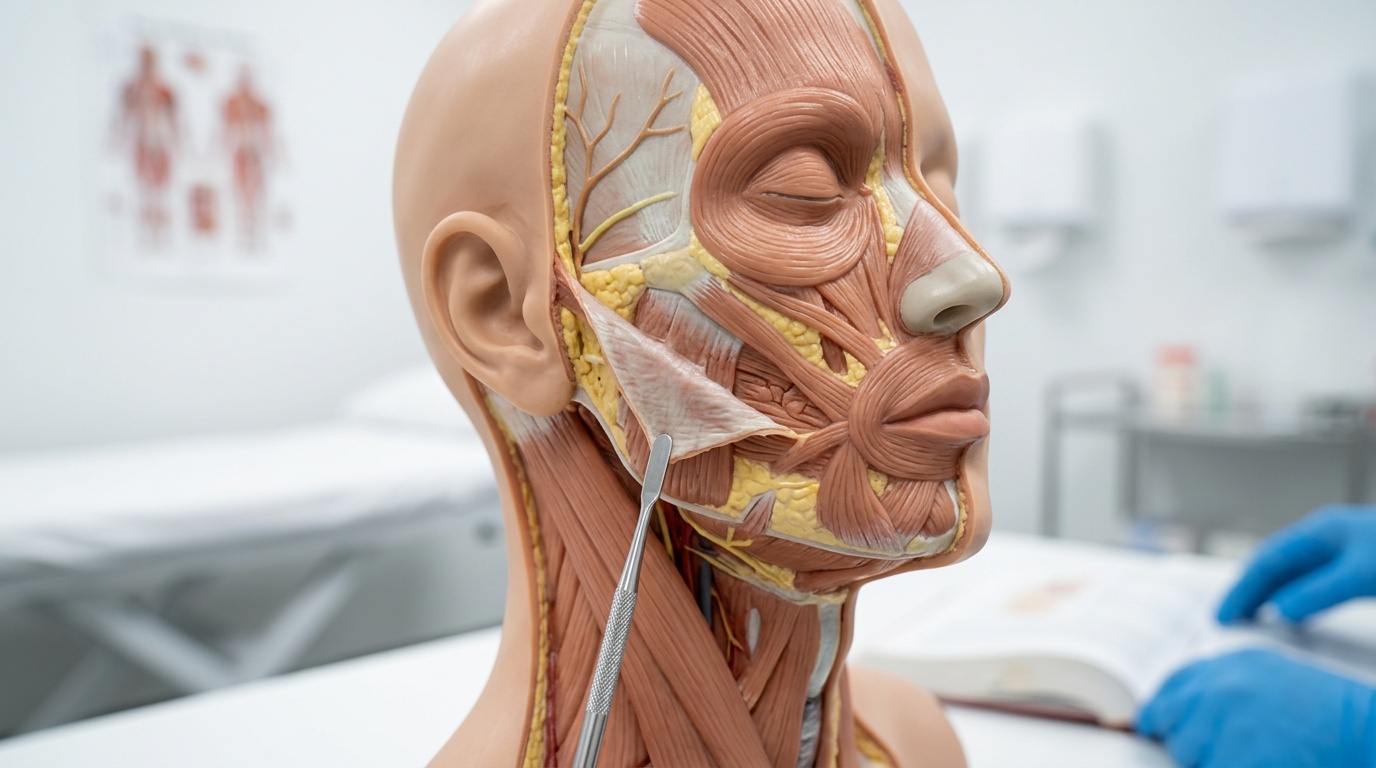
The Superficial Musculoaponeurotic System (SMAS): More Than Just a Layer
The SMAS is a fibromuscular sheet connecting facial expression muscles with the soft tissue beneath the skin. It is not a single, uniform membrane across the entire face. Its thickness and relationship to nearby muscles vary around the cheek, temple, parotid region, and jawline. Because it participates in facial movement, elevation must account for the zygomaticus muscles, facial nerve branches, and the intended direction of tissue movement.
Facial Retaining Ligaments: The Critical Anchors
Retaining ligaments tether facial soft tissue to deeper structures. Zygomatic ligaments support tissue near the cheek and lower eyelid region. Masseteric attachments relate to the cheek over the masseter muscle, while mandibular ligaments help define the transition between the lower face and neck. Releasing selected attachments can permit movement of the malar fat pad and adjacent soft tissue. The extent of release depends on anatomy, prior surgery, tissue quality, and the surgeon’s assessment of facial nerve safety.
The Deep Plane: Navigating Beneath the SMAS for Structural Support
The deep plane lies beneath the SMAS and above deeper muscle and neurovascular structures. Dissection in this plane follows recognized anatomical relationships rather than simply creating a wider pocket. The surgeon must identify safe boundaries, preserve facial nerve branches, and maintain adequate blood supply to the skin flaps. Modern deep plane concepts developed from anatomical and surgical work associated with Skoog in 1974 and Hamra in 1990, with later techniques emphasizing ligamentous release and deeper tissue repositioning.
Understanding the “High Entry” and “Super High” Distinction Above the Zygomatic Arch
A conventional lower entry may reach the deep plane from a more lateral or lower point. A high-entry approach begins above the zygomatic arch, giving access to the midface through a superior route. “Super high” generally indicates an even higher entry and broader integration with the tissues of the upper cheek and temple. This location can influence how the malar soft tissue is elevated rather than merely tightening the skin toward the ear.
Clinical data published by Ovid in Facial Plastic Surgery reported a 70% to 77% mechanical increase in vertical and oblique vector repositioning for midface soft tissue with a high-SMAS entry compared with conventional lower entry techniques. That finding describes mechanical repositioning, not a not assured aesthetic outcome. It does not mean every patient requires a high-entry operation or remove the need for careful nerve protection, vascular awareness, and individualized planning.
This anatomy helps explain why a deeper lift may affect the cheek, nasolabial region, jowls, and jawline together. It also explains why the operation requires knowledge of the zygomatic arch, facial nerve pathways, masseteric fascia, subplatysmal layers, and skin blood supply. A super high smas deep plane facelift remains surgery with meaningful risks, including bleeding, infection, nerve injury, asymmetry, scar concerns, skin-healing problems, and an outcome that may not match expectations. A second mention of a Mini Facelift reinforces that procedure selection should follow examination findings.
Comparing Advanced Facelift Techniques: Beyond Buzzwords
Traditional SMAS Plication vs. Deep Plane Release
Traditional SMAS plication typically gathers or folds the SMAS layer to support the lower face, while the skin is redraped over that repair. Deep plane surgery releases selected retaining ligaments beneath the SMAS, allowing connected soft tissue to move as a unit. The distinction concerns the level of dissection, structures mobilized, direction of tissue movement, and the surgeon’s assessment of facial nerve anatomy.
When deeper tissues are repositioned, less lifting force needs to be placed on the skin edges. Research published in Facial Plastic Surgery describes deep anatomical repositioning as a way to remove nearly all closure tension from the skin edges in primary facelift surgery. This may reduce the tendency toward visible incision widening or earlobe distortion, though scars, healing variation, asymmetry, and other surgical risks remain possible.
The Evolution to High SMAS Entry and Extended Deep Plane Dissection
A high SMAS entry begins above the zygomatic arch rather than approaching the deeper plane from a lower lateral point. This superior route can provide access to the midface, including the malar fat pad and tissues near the zygomaticus muscles. An extended deep plane dissection may continue the release across additional facial regions when the patient’s descent pattern requires broader movement. The terms can overlap, so patients should ask a surgeon to identify the exact entry point, tissue layer, release pattern, and intended vector.
For a selected patient, a super high smas deep plane facelift uses a particularly high entry and integrates deeper cheek support with lower-face repositioning. Ovid clinical data in Facial Plastic Surgery reported a 70% to 77% mechanical increase in vertical and oblique vector repositioning for midface soft tissue with high-SMAS entry compared with conventional lower-entry techniques. This statistic describes mechanical movement, not a promised appearance or a universal indication.
How “Super High” SMAS Integration Addresses Midface Volume and Descent
Midface aging may involve descent of cheek soft tissues, flattening near the malar prominence, deeper nasolabial folds, and a less defined transition into the lower face. A high-entry deep plane approach can address tissue position by releasing selected attachments and elevating the soft-tissue unit vertically or obliquely. It does not recreate lost bone, replace every form of volume loss, or guarantee correction of hollowness. Improvement depends on skin elasticity, skeletal structure, tissue quality, and the extent of descent.
The goal is balance between the cheek, jowl, jawline, and temple rather than isolated movement of one facial region. Dr. Albert may select a different facelift design when the anatomy does not call for extensive deep-plane mobilization. A Mini Facelift is a separate option for appropriately selected patterns of tissue descent.
Avoiding the “Windblown” Look: The Biomechanics of Vertical Lift
An excessively pulled appearance can occur when skin bears too much lifting force or tissue moves primarily backward toward the ears. A deeper release can allow movement upward and slightly inward, preserving more natural relationships around the cheeks and mouth. Overcorrection, uneven tension, limited skin elasticity, scarring, and individual healing can still affect the result.
Comparative Analysis: Traditional SMAS, High SMAS, and Super High Deep Plane
The following table describes broad technical distinctions. Actual operations may combine concepts, and terminology varies among surgeons. A consultation with Dr. Mark Albert should focus on anatomy and surgical planning rather than a procedure name alone.
| Approach | Primary tissue level | Typical emphasis | Planning considerations |
|---|---|---|---|
| Traditional SMAS | SMAS plication, folding, or excision | Lower-face support and skin redraping | Skin tension, tissue quality, and the extent of jowling |
| High SMAS | SMAS mobilization with entry above the zygomatic arch | Midface and lower-face repositioning | Cheek anatomy, retaining ligaments, and facial nerve pathways |
| Super high deep plane | High-entry dissection beneath the SMAS with broader ligament release | Vertical or oblique elevation of connected midface and lower-face tissues | Extent of descent, malar position, skin laxity, and safe dissection boundaries |
For patients considering a super high smas deep plane facelift, the useful comparison is whether the planned plane, release, and vector address the patient’s aging pattern. A second Mini Facelift reference is relevant because a less extensive facelift may be more appropriate for selected anatomy. Every option carries limitations and risks, including bleeding, infection, nerve injury, asymmetry, skin-healing problems, scarring, and dissatisfaction with the outcome.
Patient Candidacy and Individualized Surgical Planning with Dr. Albert
Assessing Facial Aging Patterns: Soft Tissue Descent, Volume Loss, and Bone Structure
Facelift planning begins with an examination of how the face has changed, not with selecting a technique from a menu. Dr. Albert evaluates skin laxity, jowling, cheek descent, nasolabial folds, jawline definition, and the position of the malar fat pad. He also considers skin quality, facial symmetry, skeletal support, prior surgery, and the relationship between the cheek, mouth, and lower face. Midface hollowness may reflect tissue descent, volume changes, bone structure, or a combination. A facelift repositions soft tissue but cannot recreate skeletal support or correct every cause of facial hollowing.
Who Is an Ideal Candidate for a Super High SMAS Deep Plane Facelift?
A suitable candidate may have moderate to advanced descent of the cheek and lower-face tissues, pronounced jowls, reduced jawline definition, or aging that extends beyond what a limited skin lift can address. Good candidates generally understand that surgery involves incisions, anesthesia, recovery, scarring, and meaningful risks. General health, medication use, smoking status, healing history, and personal expectations also affect planning. Some patients may be better suited to a different facelift design, including a Mini Facelift when tissue descent is more limited and localized.
The Consultation Process: Tailoring the Technique to Your Anatomy
During consultation, Dr. Mark Albert reviews the patient’s goals and examines the face at rest and with expression. Discussion may include incision placement, the intended lifting vector, the degree of retaining-ligament release, facial nerve considerations, anesthesia, recovery support, and realistic limits. Patients should ask which tissues will be elevated, why a high-entry approach is being considered, and how the plan addresses cheek and jawline anatomy. Photographs may assist planning, but they do not replace direct examination.
Understanding Realistic Outcomes and Limitations
The intended result is a refreshed, proportionate appearance with improved soft-tissue position and jawline balance. Results vary with tissue elasticity, facial structure, healing, age, and preexisting descent. Surgery may soften folds and improve contour, but it does not stop future aging, remove every line, or guarantee symmetry. Bleeding, infection, nerve injury, hematoma, skin-healing problems, scar visibility, asymmetry, altered sensation, recurrent laxity, and dissatisfaction should be reviewed before consent. A consultation can determine whether a Mini Facelift or a more extensive operation better matches the patient’s anatomy and objectives.
Recovery, Safety, and What to Expect Post-Surgery

The Surgical Procedure: An Overview of Dr. Albert’s Method
The operation is planned around the patient’s facial anatomy, with incisions and dissection selected to permit controlled repositioning of descended tissue. When a deeper plane is used, the surgeon releases selected attachments while protecting facial nerve branches, blood supply, and surrounding structures. The skin is then redraped without making it the sole source of lifting force. The exact operative sequence, anesthesia plan, duration, and need for observation vary by patient.
Managing Swelling and Bruising: Timelines and Modern Protocols
Swelling and bruising are expected after facelift surgery and may be uneven from one side to the other. Early recovery commonly centers on rest, head elevation, prescribed wound care, activity restrictions, and scheduled examinations. Visible bruising often improves before all swelling resolves, while firmness, tightness, numbness, and subtle asymmetry can persist longer. The return to work, exercise, travel, and social activities depends on healing and the surgeon’s instructions.
- Early days: Dressings, swelling, bruising, and close follow-up may be part of care.
- Early weeks: Incisions continue healing, while swelling and altered sensation gradually change.
- Later healing: Contour and scar appearance continue to mature over time.
Nerve Safety and Preservation in Deep Plane Techniques
Deep-plane surgery requires detailed knowledge of facial nerve pathways and careful work around moving muscles and neurovascular structures. Temporary weakness, numbness, or altered facial movement can occur, and permanent nerve injury is a recognized material risk. No technique can make nerve injury impossible. Surgical judgment, anatomical planning, gentle tissue handling, and postoperative monitoring support safety, yet individual outcomes cannot be not assured.
Long-Term Tissue Stability and Natural Appearance
Moving deeper soft-tissue layers may reduce dependence on skin tension and support a natural direction of lift. It does not stop aging or ensure permanent contour. Weight changes, skin quality, genetics, sun exposure, and time influence long-term appearance. The most reliable expectation is improvement within anatomical limits, followed by ongoing maturation.
When to Seek Follow-Up Care
Patients should follow the prescribed appointment schedule and contact the surgical team promptly for increasing pain, rapidly expanding swelling, persistent bleeding, fever, drainage, wound separation, shortness of breath, or new facial weakness. Urgent symptoms require immediate medical attention. Postoperative concerns should be assessed directly rather than managed through general online guidance.
Postoperative Safety Checklist
- Keep every scheduled follow-up appointment.
- Use wound care and medications exactly as directed.
- Protect healing incisions from unnecessary pressure and sun exposure.
- Report unexpected swelling, drainage, fever, bleeding, or weakness promptly.
- Resume exercise, travel, and other activities only after receiving individualized clearance.
Frequently Asked Questions
Is a deep plane facelift better than a SMAS facelift?
A deep plane facelift is not universally better than a SMAS facelift because the appropriate technique depends on facial anatomy, tissue descent, skin quality, and surgical goals. A super high SMAS deep plane facelift works beneath the SMAS and may reposition midface and lower-face tissues with less reliance on skin tension. Each approach has risks, limitations, and variable outcomes.
What is the average cost of an SMAS facelift?
An SMAS facelift has no single average cost because pricing varies with the surgeon, geographic location, facility, anesthesia, procedure complexity, and any additional treatments. A super high SMAS deep plane facelift may involve a different operative plan than a traditional SMAS facelift. A consultation and written estimate are needed to discuss fees for an individual case.
What is the new facelift everyone is getting?
A super high SMAS deep plane facelift is one advanced facelift approach receiving attention, but no single facelift is appropriate for everyone. The technique enters a deeper plane at a high point above the zygomatic arch and may reposition selected midface and lower-face tissues. Surgical planning should follow an in-person assessment rather than a trend.
What is the ideal age for a SMAS facelift?
A SMAS facelift has no fixed ideal age because candidacy depends more on tissue descent, skin quality, facial structure, health, and personal goals than on age alone. A super high SMAS deep plane facelift may be considered when midface descent, folds, jowling, or reduced jawline definition are present. A qualified surgeon must assess risks and alternatives.
How painful is a SMAS facelift?
A SMAS facelift commonly involves postoperative discomfort, tightness, swelling, bruising, and temporary changes in sensation, though the experience varies among patients. A super high SMAS deep plane facelift has its own recovery considerations because deeper tissue work may affect swelling and sensation. The surgeon should explain pain-control options, warning signs, activity limits, and expected follow-up during consultation.
How long do results from a super high SMAS deep plane facelift last?
A super high SMAS deep plane facelift repositions descended facial tissues, but it does not stop future aging or replace lost bone support. The duration of visible improvement varies with anatomy, skin quality, age, lifestyle, and healing. Long-term outcomes cannot be not assured, and a consultation is needed to discuss realistic expectations and possible future treatment.